“ The long rows of succulent plants, as high as the girl's knees, seemed breathing, conscious things to which she was giving relief as she smoothly cut away the tenaciously encroaching weeds and deep-rooted grass, the heaviest bunches of which she took up and threshed against the hoe-handle and left in the sun to die lest they be revived by some shower which would beat their roots into the mellow soil again. ”
Succulent
Definition and stakes
The theme of “succulent” has been addressed by authors such as Herbert Spencer, Charles Darwin, Will N. Harben, Shirley Hibberd and L. H. Bailey. It is often associated with terms like flower, seed, leaf, plant and root.
Quotes about “succulent”
 Shirley Hibberd,
The Amateur's Greenhouse and Conservatory
(1873)
Shirley Hibberd,
The Amateur's Greenhouse and Conservatory
(1873)
“ A considerable number of succulent plants deserve to be reckoned amongst the most interesting and useful subjects to which an amateur gardener can give attention, for their variety of form is endless; many of them produce magnificent flowers; not a few are grotesque and comical in outline, and they will all bear occasional neglect with less harm than any other plants in our gardens. ”
 Herbert Spencer,
The Principles of Biology, Volume 2…
(1899)
Herbert Spencer,
The Principles of Biology, Volume 2…
(1899)
“ The succulent axes so strangely combined in these plants, maintain for a long time the translucency of their outer layers and their greenness; and they so efficiently perform the offices of leaves that leaves are not produced. ”
“ The roughness and ruggedness of its leaves, the sharp-angled stem strongly set, make a foil that a sculptor cannot improve. Then wonder how this marvellous thing was born out of your garden soil through the medium of one small strand of a succulent stem. ”
Alfred Barton Rendle, 1911 Encyclopædia Britannica (1911)
“ The outer succulent part is the swollen receptacle, the horny core being the true fruit developed from the usually five carpels and enclosing the seeds. In the medlar the core (or true pericarp) is of a stony hardness, while the outer succulent covering is open at the summit. The pome somewhat resembles the fruit of the rose (fig. 3) , where the succulent receptacle surrounds a number of separate achenes. The name capsule is applied generally to all dry syncarpous fruits, which dehisce by valves. ”
Charles Grant Blairfindie Allen, Popular Science Monthly (1880)
“ Indeed, the more we consider the origin and nature of succulent fruits, the more does it become clear that they have been developed to suit the tastes of animals having essentially identical sensations with our own. ”
 Thomas Clarkson,
An Essay on the Slavery and Commerce of the Human Species…
Thomas Clarkson,
An Essay on the Slavery and Commerce of the Human Species…
“ Large spreading succulent plants, if among the productions of the soil, have the same effect: they afford agreeable cooling shades, and a moist atmosphere from their continual exhalations, by which the ardour of the sun is considerably abated. ”
Anthony Florian Madinger Willich, Domestic Encyclopædia (1802)
“ Those, the leaves of which grow after the seed-stalks are formed, and retain their succulence and verdure during the whole season. Such are the Fescue and Meadow Grasses, that continue green and succulent, even after the seeds have attained to maturity, and while the flower-stalks are fading. ”
 Charles Darwin,
The Variation of Animals and Plants under Domestication
Charles Darwin,
The Variation of Animals and Plants under Domestication
“ In the production of large, fleshy, turnip-like stems, we have a case of analogous variation in three forms which are generally considered as distinct species. But scarcely any modification seems so easily acquired as a succulent enlargement of the stem or root—that is, a store of nutriment laid up for the plant’s own future use. ”
William Withering, An Account of the Foxglove and some of its Medical Uses
“ These cautions are unnecessary to the accurate botanist, who well knows, that a plant in the spring, though more succulent and full of juices, is destitute of those qualities which may be expected when that plant has attained its full vigour, and the seed-vessels begin to be manifest. ”
R. Lloyd Praeger, Aspects of plant life; with special reference to the British flora
“ Conversely, roots are readily produced even from the upper portions of many stems—else how could we{109} grow cuttings? Where roots are succulent—that is, when they have a reserve of food stored in them—cuttings of them will conversely produce stems. ”
Herbert Spencer,
The Principles of Biology, Volume 2…
(1899)
“ The succulent leaf cannot be swayed about by the wind as much as an ordinary leaf; and such small bends as can be given to it and its foot-stalk are prevented from affecting in any considerable degree the tubes running through its interior. Hence the retentiveness of the vessels in these fleshy leaves, as shown by the small exudation of dye; and hence the small thickening of their surrounding prosenchyma by woody deposit. ”
 Grant Allen,
The Evolutionist at Large
Grant Allen,
The Evolutionist at Large
“ Such a general tendency to display colour and collect sugary juices in so many diverse parts may be compared to the general bulbous tendency of the tiger-lily or the onion, and to the general succulent tendency of the cactus or the house-leek. In each case, the plant benefits by it in one form or another; and whichever form happens to get the start in any particular instance is increased and developed by natural selection, just as favourable varieties of fruits or flowers are increased and developed in cultivated species by our own gardeners. ”
 Edward Payson Roe,
Success with Small Fruits
Edward Payson Roe,
Success with Small Fruits
“ If the infested shoots are examined in summer, thousands of minute insects, of a pale yellow color, and covered with a powdery exudation, will be found sucking the juices of the succulent stem and leaves, causing the crimping, curling, and twisting of these parts as described. ”
 Margaret Armstrong,
Field Book of Western Wild Flowers
Margaret Armstrong,
Field Book of Western Wild Flowers
“ A rather large family, widely distributed; odd-looking, mostly very succulent herbs, with smooth, fleshy leaves and stems, without stipules; flowers in clusters; sepals, petals, pistils, and stamens, all of the same number, usually four or five, sometimes the stamens twice as many; ovary superior; receptacle with honey-bearing scales, one behind each pistil; pistils separate, developing into small dry pods, containing few or many, minute seeds. ”
U. P. Hedrick, The Peaches of New York
“ In nature the seeds are self-sown as they ripen, the succulent coat keeping the hard envelope containing the kernel from becoming stony so that the young plant bursts forth at the proper season. But in cleaning and drying seeds for sale and transportation, they become hard and dry and must be subjected to somewhat special treatment before planting. ”
active 1823-1849 Mary Eaton, The Cook and Housekeeper's Complete and Universal Dictionary…
“ Also numerous herbaceous and succulent plants are productive of bottom offset suckers from the roots, by which they may be increased. In slipping and planting these sorts of offset suckers, the smaller ones should be planted in nursery beds, pots, &c. according to the nature of growth and temperature of the different sorts, to have the advantage of one summer's advanced growth ”
1911 Encyclopædia Britannica, Volume 7… (1911)
“ Correlated with their life in dry situations, the bulk of the tissue is succulent, forming a water-store, which is protected from loss by evaporation by a thickly cuticularized epidermis covered with a waxy secretion which gives a glaucous appearance to the plant. ”
Various, Transactions of the Linnean Society of London (1811)
“ Several slender stems," he adds, "spring from one root, thickly encompassed with little round succulent sharp-pointed leaves. It throws out, moreover, a stem towards the middle, about a span high, with an umbel of slender (greenish or) pale yellowish flowers. ”
active 1799-1828 Henry Cranke Andrews, The botanist's repository for new and rare plants… (1797)
“ A flower divested of the petals, and cut open to the base of the tube. 2. The seed-bud cut transversely. 3. One of the side shoots. 4. Miniature figure of the plant. No genus of plants more remarkable has yet been discovered than that to which our present subject belongs, whether we consider their simple succulent structure, strange diversity of form and habit, or the geometrical manner of their growth and disposition of their spines. Some of them, like the Opuntia and Ficus Indica, grow like figs or cucumbers stuck one upon another ”
Bernice Brilmayer, All about miniature plants and gardens indoors and out (1963)
“ Peperomia PiperaceaeSince almost all of these succulents, with their “catkin-like” flower spikes, fit within our miniature measurements, I’ve enjoyed picking a few to serve as a sample of their modest but much varied appeal. ”
 Mrs. Loudon,
Instructions in gardening for ladies
(1840)
Mrs. Loudon,
Instructions in gardening for ladies
(1840)
“ For this reason, we must adopt the mode of treating succulents, which the best gardeners find most successful, without troubling ourselves to discover why it is so different from the natural habit of the plants. ”
 Sylvanus Stall,
What a Young Husband Ought to Know
Sylvanus Stall,
What a Young Husband Ought to Know
“ What we have written in allegory takes place in fact. Every intelligent observer has noted the depth of color, passionate beauty, and sweet fragrance of the flower as the hour approaches when the stigma awaits the pollen which is to fertilize the ovules that lie hidden away in the ovary or pod. When that union has been effected the flower fades, its petals fall off; the calyx, which as a vase held the corolla erect in its splendor, but which remains to shield and protect the ovules or little seeds which are being formed and perfected, now droops, turning toward the earth. ”
Charles Grant Blairfindie Allen, Popular Science Monthly (1878)
“ The sole object of flowering is the production of seeds—that is to say, of embryo plants, destined to replace their parents, and continue the life of their species to future generations. Flowers and seeds go together; every flower producing seed, and every seed springing from a flower. Ferns and other like plants, which have no blossoms, bring forth spores which grow into shapeless little fronds, instead of true seeds containing a young plantlet. But all flowering species produce some kind of genuine fruit, supplied with more or less nutriment for the tender embryo in its earlier days. ”
 Julius von Sachs,
History of botany
(1890)
Julius von Sachs,
History of botany
(1890)
“ He continues, 'The fructification consists of the sexual organs of the flowers; that the anthers are the male organs, the pollen the fertilising matter, is proved by their nature, further by the fact that the flower precedes the fruit, as also by their position, the time, the loculaments (anthers) , by castration, and by the structure of the pollen.' Here too the main point with Linnaeus is the nature of the male organs, and that we may know what this nature is he refers to a former paragraph, where we learn that the essence of the flower is in the anthers and stigma. ”
 Nicholas Culpeper,
The Complete Herbal
Nicholas Culpeper,
The Complete Herbal
“ At the tops of the branches stand many small green heads, out of which grow several small, yellow threads or thumbs, which are the flowers, and continue many days blown in that manner, before it pass away into down, and with the seed is carried away in the wind. The root is small and thready, and soon perishes, and as soon rises again of its own sowing, so that it may be seen many months in the year both green and in flower, and seed; for it will spring and seed twice in a year at least, if it be suffered in a garden. ”
 Frances Theodora Parsons,
Plants and their children
(1896)
Frances Theodora Parsons,
Plants and their children
(1896)
“ Now, if you do not pull apart the pea blossom, you find nothing else. But you know that the seed-holding fruit is the object of the flower’s life, and that so this flower is pretty sure to have somewhere either a pistil with its seedbox, or stamens with their dust boxes, or both; for without the seeds of the seedbox, and the pollen of the dust boxes, no fruit can result. ”
condesa de Emilia Pardo Bazán, Morriña (Homesickness)
“ Twenty summers run to seed, a pale, dull complexion, eyes black and sparkling, but with the eyelids drooping, and surrounded by purple rings, a sarcastic mouth, the lips delicately curved and somewhat pale, shaded by a light mustache, hair smooth and silky, a head narrow at the temples, a slender throat, the back of the neck slightly hollowed in, flat wrists and a graceful shape made up a figure still immature, interrupted in its development by the chlorosis which is the result of a hothouse existence in which the plant that requires the pure, free air, dwindles and wilts. ”
Thomas W. Shannon, Self Knowledge and Guide to Sex Instruction…
“ In some plants each flower has more than one pistil.How the papa and mamma natures unite.—When the pollen is ripe, the anther cells burst open and the{95} little, light, powdery pollen falls out and it is carried by gravity, the wind or by insects to the stigma. The little pores of the stigma open and admit the grains of pollen and the style carries the pollen to the ovary where it unites with the little seed. The seed are then said to be fertilized. This means that the father and mother natures have united in the seed. The seed grow and develop in the ovary. ”
 Georg Brandes,
Eminent Authors of the Nineteenth Century…
Georg Brandes,
Eminent Authors of the Nineteenth Century…
“ Near together are the buds, the full-blown flowers, and those which already bear seed, the virgin and the fecundated plants, the flowers without fragrance and those with pleasant perfume, the poisonous, and the useful, the healing weed. Frequently the plant which takes the humblest place in the system, as the flowerless fern, is the most beautiful to the eye. ”
Elisha Noyce, Outlines of Creation
“ By scattering the pollen, flowers are often fecundated, for there are many plants, the female flowers of which are separate from the males, and it is only by insects and the wind, that the females are fecundated, for the Bee, with the pollen adhering to every part, first visits one flower and then another in search of nectar. ”
Norman Taylor, Botany: The Science of Plant Life
“ The actual process of fertilization, pregnancy, the forming of the fruit and later the seed, and the latter’s birth of a new plant, comprise one of the most fascinating of those provisions of nature which secure the perpetuation of the plant world. In the life history of even the commonest weed along the roadside there is this constant renewal of life by sexual reproduction, just as in animals and in man. In the chapter on “How Plants Produce Their Young” will be found some account of this supreme function of flowers, after which, as if their usefulness were over, they wither and perish. ”
Edward Payson Roe,
Success with Small Fruits
“ The ovule in the ovarium to which the stigma leads represents, at maturity, a seed—the actual fruit of the strawberry—and within each seed Nature, by a subtile process of her own, wraps up some of the qualities of the plant that produced the seed, and some of the qualities also of the plant from which came the pollen that impregnated the ovule. ”
 Margaret Sanger,
What Every Mother Should Know; or…
Margaret Sanger,
What Every Mother Should Know; or…
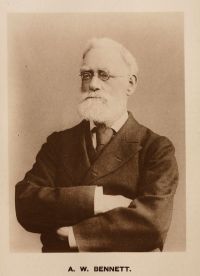
“ They had seen that after the pollen reaches the seeds, that they are given new life, that they remain right in their little nest and are nourished by the pistil or mother flower, until they are full grown or matured. ”
 Alfred William Bennett,
Popular Science Monthly
(1873)
Alfred William Bennett,
Popular Science Monthly
(1873)
“ The pollen is thus thrown on to the head or body of the insect, which carries it away to the next flower it visits, and leaves some of it on the stigma, and thus cross-fertilization instead of self-fertilization is secured. ”
 Hereward Carrington,
Hindu Magic: An Expose of the Tricks of the Yogis and Fakirs of India
Hereward Carrington,
Hindu Magic: An Expose of the Tricks of the Yogis and Fakirs of India
“ After a while the cloth is removed, and the seed is found to have sprouted, and an inch or so of the stem and the first green leaves are seen to be sprouting from the earth. The illusion is perfect, and the onlookers are more taken up with gazing in wonder at the miraculous growth and discussing it one with another than with critically examining the seed and the sprouting plant. ”
Charles Grant Blairfindie Allen, Popular Science Monthly (1878)
“ The purely accidental or functional origin of this covering is testified by the immense variety of ways in which it has been developed. Sometimes a single seed has shown a slight tendency to succulence in its outer coat, and forthwith it has gone on laying up juices from generation to generation, until it has developed into a one-seeded berry. Sometimes a whole head of seeds has been surrounded by a fleshy stem, and the attention of animals has thenceforward encouraged its new habit by insuring the dispersion of its embryos. ”
 Frank Hamilton Cushing,
Outlines of Zuñi Creation Myths
Frank Hamilton Cushing,
Outlines of Zuñi Creation Myths
“ THE GENERATION OF THE SEED OF SEEDS, OR THE ORIGIN OF CORN."We are the People of Seed," said these strangers, replying to our fathers of old, "born elder brothers of ye, and led of the gods!""Nay," contended our fathers, "verily, we are led of the gods and of us are the Seed people and the substance of seed whereof our wise elders carry the potencies." Whereupon they grew yet more angry, so dark were they of understanding! ”
1911 Encyclopædia Britannica, Volume 17… (1911)
“ The so-called seeds are clusters of spurious fruits. After fertilization the fleshy receptacle and the base of the perianth of each flower enlarge and the flowers in a cluster become united; the fleshy parts with the ovaries, each of which contains one seed, become hard and woody. ”
 Sarah Margaret Fuller,
Papers on Literature and Art
(1846)
Sarah Margaret Fuller,
Papers on Literature and Art
(1846)
“ It crushes to earth without mercy all the humble buds of Phantasy, all the plants that, though green and fruitful, are also a prey to insects, or have suffered by drouth. It weeds well the garden, and cannot believe, that the weed in its native soil, may be a pretty, graceful plant. ”
Related terms
Authors who wrote about “succulent”
Herbert SpencerCharles DarwinWill N. HarbenShirley Hibberd L. H. BaileyCharles Grant Blairfindie AllenAlfred Barton RendleThomas ClarksonAnthony Florian Madinger WillichWilliam WitheringR. Lloyd PraegerGrant AllenEdward Payson RoeMargaret ArmstrongU. P. Hedrickactive 1823-1849 Mary EatonVariousactive 1799-1828 Henry Cranke Andrews