“ Here the cabbage palm shot its smooth and lofty trunk high into the air, there the bamboo waved its leafy ostrich plumes, and all about and around the soil was spread like an Indian shawl, with many a gorgeous flower and many a splendid fruit. ”
Cabbage palm
Definition and stakes
The theme of “cabbage palm” has been addressed by authors such as James John Howard Gregory, Maturin M. Ballou, F. F. Rockwell, E. G. Squier and Ellen Eddy Shaw. It is often associated with terms like plant, leaf, seed, tree and soil.
Quotes about “cabbage palm”
J. G. Wood, The uncivilized races of men in all countries of the world… (1875)
“ The skill of the natives in tree climbing is also exercised for another purpose besides hunting for bees and animals. The well-known cabbage-palm grows to a very great height, and, like other palms, never grows quite straight, but has always a bend in the trunk. After the manner of the palm-tribe, it grows by a succession of buds from the top, and this bud, popularly called the “cabbage,” is a favorite article of food. It has been called the prince of vegetables, and one enthusiastic traveller declares that it must have been the ambrosia of the Olympic gods. ”
John Cargill Brough, The fairy tales of science (1857)
“ Thus we see that food and raiment grow on this wonderful plant. The cabbage-palm of Surinam is another of our wonderful plants. This gigantic tree has a stem about seven feet in circumference at the base, which ascends straight and tapering to a vast height, and bears a plume of graceful foliage. The cabbage lies concealed within the leaves that surround the top of the trunk. It is about two or three feet long and as thick as a man’s arm. When eaten raw, it greatly resembles the almond in flavour, but is much more tender and delicious. ”
“ In the moist depressions, or valleys, near our encampment, we also found another variety of [166] palm, which often stands the traveler, under the tropics, in good stead, as a substitute for other and better vegetable food. I mean the Palmetto Royal, or Mountain Cabbage (Areca oleracea) , which has justly been called the “Queen of the Forest.” It grows to a great height, frequently no thicker than a man’s thigh, yet rising upward of a hundred and fifty feet in the air. No other tree in the world equals it in height or beauty. ”
Various, Lippincott's Magazine of Popular Literature and Science…
“ It grows to the height of forty or fifty feet, is long-lived, and bears fruit nearly the whole year round. The cabbage palm is much less common in a wild state, and few planters will take the trouble to cultivate it, since a whole tree must be destroyed to obtain a single dish. The edible part consists of snow-white flakes found just inside the bark near the top of the tree. When stewed in the expressed juice of the cocoa-nut it constitutes one of the most luscious dishes I have ever eaten. ”
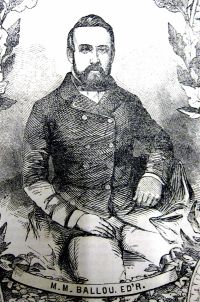 Maturin M. Ballou,
Under the Southern Cross
“ The palm-like cabbage-tree is indigenous, and imparts an aspect of Equatorial Africa to the whole. To us there is a pleasing revelation in these trees and plants, however simple they may be in themselves. There is a refinement, a delicacy of taste, a love of the beautiful in Nature evinced in all such gathering of the products of widespread countries and different hemispheres, and placing them in juxtaposition. Wonderful are the lovely contrasts and striking natural peculiarities presented to the eye in so comparatively a small compass. ”
A. M. Brooks, Petals Plucked from Sunny Climes
“ The cabbage-palm grows in the vicinity, and is much used in building wharves—it not being effected by the sea-water, and resisting the attacks of the Teredo Navalis, which destroys the hulls of vessels when made of any other timber but this, which it never molests. ”
Maturin M. Ballou,
Equatorial America
“ One presents all the grossness and belittling aspect of money-getting, the other the graces, liberality, and ennobling appearance of culture and refinement. Of all the trees in these attractive environs, the palm, in its great variety, challenges one's admiration most. We mention it frequently, for it was our constant delight. At every turn one comes upon it, in its several species,—the cocoa-palm, the palmetto, the cabbage, the assai-palm, the fanshaped-palm, and scores of other varieties. The hand and taste of woman are seen in these gardens of the environs. ”
James Cook, A Voyage Towards the South Pole and Round the World Volume 2
“ The cutting off the cabbage effectually destroys the tree; so that no more than one can be had from the same stem. The cocoa-nut tree, and some others of the palm kind, produce cabbage as well as these. ”
Edward Ellis Morris, Austral English
“ Better at any rate `the cabbage garden' than the mere sheep run or cattle paddock."Cabbage-Palm , n. same as Cabbage-tree (1) (q.v.) .Cabbage-tree , n (1) Name given to various palm trees of which the heart of the young leaves is eaten like the head of a cabbage. In Australia the name is applied to the fan palm, Livistona inermis, R. Br., and more commonly to Livistona australis, Martius. In New Zealand the name is given to various species of Cordyline, especially to Cordyline indivisa. See also Flame-tree (2) . ”
1911 Encyclopædia Britannica, Volume 20… (1911)
“ The leaves of palms are either arranged at more or less distant intervals along the stem, as in the canes {Calamus, Daemonorops, fig. 2, &c.) , or are approximated in tufts at the end of the stem, thus forming those noble crowns of foliage (figs. 5, 6, 7) which are so closely associated with the general idea of a palm. In the young condition, while still unfolded, these leaves, with the succulent end of the stem from which they arise, form " the cabbage, " which in some species is highly esteemed as an article of food. ”
Robert Kerr, A General History and Collection of Voyages and Travels…
“ We found here the palm of three different sorts. The first, which grows in great plenty to the southward, has leaves that are plaited like a fan: The cabbage of these is small, but exquisitely sweet; and the nuts, which it bears in great abundance, are very good food for hogs. The second sort bore a much greater resemblance to the true cabbage-tree of the West Indies: Its leaves were large and pinnated, like those of the cocoa-nut ”
 Mrs. Loudon,
Instructions in gardening for ladies
(1840)
“ All cabbages require a rich soil, and frequent hoeing up; and in dry weather they should be watered to make them succulent. The stalks of the spring cabbages are generally pulled up and carried to the refuse heap as soon as the cabbages are cut; but the stalks of the summer and autumn kinds are left standing, that they may throw out what are called sprouts. The culture of the red cabbage is exactly the same; except that there is no spring crop, and the stalks are never left standing for sprouts. ”
 William Henry Giles Kingston,
The Wanderers; Or, Adventures in the Wilds of Trinidad and Orinoco
“ Most of the palms also had fruit; some like the cocoanut, others like small berries. Then there was the palmetto, with its tender succulent bud on the summit of the stem, used as a vegetable with meat. Others had bunches of bright chestnut-brown fruit hanging from between the leaves which form the crown, each bunch about a foot in length, massive and compact, like a large cluster of Hamburg grapes. Then there was another palm, bearing a greenish fruit not unlike the olive in appearance, which hung in large pendent bunches just below the leaves. ”
 James John Howard Gregory,
Cabbages and Cauliflowers: How to Grow Them
“ The outer leaves which surround the head appear to have the same office as the leaves which surround the growing fruit bud, and that office closes with the first year, as does that of the leaves surrounding fruit buds, when each die and drop off. In my locality the public must have perceived more or less clearly the analogy between the heads of cabbage and the buds of trees, for when they speak of small heads they frequently call them "buds." ”
 Matthew Flinders,
A Voyage to Terra Australis
(1814)
“ A small species of cabbage tree, called here palmiste, is not rare and is much esteemed; the undeveloped leaves at the head of the tree, when eaten raw, resemble in taste a walnut, and a cauliflower when boiled; dressed as a sallad they are superior to perhaps any other, and make an excellent pickle. ”
James John Howard Gregory,
Cabbages and Cauliflowers: How to Grow Them
“ On my own grounds from a strain of seed that had been grown isolated for years, there recently came a plant that in its structure closely resembled Brussels Sprouts, growing about two feet in height, with a small head under each leaf. The cultivated cabbage was first introduced into England by the Romans, and from there nearly all the kinds cultivated in this country were originally brought. Those which we consider as peculiarly American varieties, have only been made so by years of careful improvement on the original imported sorts. ”
Mrs. Loudon,
The Lady's Country Companion; Or…
“ Thus, onions may be [Pg 232] succeeded by lettuces, carrots by peas, potatoes by cabbages, and turnips by spinach. These plants may of course be varied according to circumstances; but the principle is never to have two fleshy-rooted plants like the carrot and the potato succeed each other; but always to let a plant cultivated for its leaves or seeds follow one cultivated for its root, and so on.The cabbage tribe is very much improved by cultivation, but the plants contained in it require a great deal of manure and frequent watering to make them succulent and good. ”
Ida D. Bennett, The Busy Woman's Garden Book
“ These little miniature cabbages, growing closely together on a stalk, are delicious boiled like cabbage or used as a salad. The culture is the same as that accorded cabbage. The seed should be sown in the hotbed in spring and set out in the open ground in May in rows three feet apart and about twenty inches apart in the rows. Cultivate to keep down weeds and maintain a dust-mulch. By fall the little heads will be fully developed. The delicate flavor is improved by a touch of frost. ”
Little book of knowledge, or, The country man's choice companion (1799)
“ Prune your wall trees, lay gillyflowers and carnations, sow lettuce, and spinnage, for latter sallading, transplant or remove tulips, or other bulbous roots, plant cuttings of myrtles, but let them not have too much sun at first. Remove your large sided cabbage planted in may, to head in autumn. Keep weed from growing to seed, and begin your howing. Gather the snails from your wall-fruit, but pull n (illegible text) off the bitter fruit, for then they will begin with others. ”
 G. K. Chesterton,
Tales of the Long Bow
(1925)
“ Archer moved heavily in the direction of the plot of cabbages, which swelled with monstrous contours and many colours; objects, perhaps, more worthy of the philosophic eye than is taken into account by the more flippant tongue. Vegetables are curious-looking things and less commonplace than they sound. If we called a cabbage a cactus, or some such queer name, we might see it as an equally queer thing. ”
James John Howard Gregory,
Cabbages and Cauliflowers: How to Grow Them
“ Considering the circumstances under which this insect appears, usually in a very dry season, I hold that it is rather the product than the cause of disease, as with the bark louse on our apple-trees; as a remedy I advocate sprinkling the plants with air-slaked lime, watering, if possible, and a frequent and thorough stirring of the soil with the cultivator and hoe. The better the opportunities the cabbage have to develop themselves through high manuring, sufficient moisture, good drainage, and thorough cultivation, the less liable they are to be "lousy." ”
Sutton & Sons Ltd., The Culture of Vegetables and Flowers From Seeds and Roots
“ It may be said in a general way that a Cabbage may be grown almost anywhere and anyhow; that it will thrive on any soil, and that the seed may be sown any day in the year. All this is nearly possible, and proves that we have a wonderful plant to deal with; but it is too good a friend of man to be treated, even in a book, in an off-hand manner. The Cabbage may be called a lime plant, and a clay plant; but, like almost every other plant that is worth growing, a deep well-tilled loam will suit it better than any other soil under the sun. ”
William Saunders, Catalogue of Economic Plants in the Collection of the U. S. Department of Agriculture
“ The fruits are large and have a thick coating of fibrous pulp, which is cooked and eaten or made into jelly. The young palm plants are cultivated for the market, as cabbages are with us, and eaten, either when fresh or after being dried in the sun. ”
F. F. Rockwell, Home Vegetable Gardening
“ Having, then, good seeds on hand and the soil properly prepared to receive them, the only problem remaining is what way they shall be put in. The different habits of growth characteristic of different plants make it patent at the outset that there must be different methods of planting, for very evidently a cabbage, which occupies but three or four square feet of space and stays in one place to make a head, will not require the same treatment as a winter squash, roaming all over the garden and then escaping under the fence to hide some of its best fruit in the tall grass outside. ”
Chautauqua Institution, The Chautauquan, Vol. 05, March 1885
“ A more wonderful plant and a more useful one is seldom found in the whole range of the vegetable kingdom. The Romans did much to extend the culture of the cabbage. In Scotland it was not generally known until the time of Cromwell. Much improvement has been made in American sorts of cabbages within the past fifty years. In the wild state the cabbage has a hard, woody stalk, but the fine specimens in market have only a small stem, bearing a large, compact head, of closely folded leaves.The first essential in the successful growing of cabbage is the right kind of soil. ”
Robert Kerr, A General History and Collection of Voyages and Travels…
“ We got, however, from the rocks, at low water, a few rock-oysters, and cockles of a very large size; and from the shore some cocoa-nuts, and the upper part of the tree that bears them, which is called the cabbage: This cabbage is a white, crisp, juicy substance, which, eaten raw, tastes somewhat like a chesnut, but when boiled is superior to the best parsnip; we cut it small into the broth that we made of our portable soup, which was afterwards thickened with oatmeal, and made a most comfortable mess: For each of these cabbages, however, we were forced to cut down a tree ”
James John Howard Gregory,
Cabbages and Cauliflowers: How to Grow Them
“ If a piece of land is planted with seed grown from two heads of cabbage the product will bear a striking resemblance to the two parent cabbages, with a third variety which will combine the characteristics of these two, yet the resemblance will be somewhat modified at times by a little more manure, a little higher culture, a little better location, and the addition of an individuality that particular vegetables occasionally take upon themselves which we designate by the word "sport." ”
Various, Vick's Illustrated Monthly Magazine…
“ I have seen the cabbage bed so full of plants that it seemed as if two plants or more had sprung from every seed. Early and late cabbage, the rows labeled, can be planted in the same bed; lettuce, pepper grass, parsley and radishes in another, taking care to sow the radish seed thinly as the plants will not transplant well, and the radishes must be used for the table taken from the place where the seeds are sown. Cabbages grow better when the small plants are transplanted to the large bed where they are to stand for their season’s growth. ”
Johann Beckmann, A History of Inventions, Discoveries…
“ Our plant-connoisseurs have unfortunately not yet condescended to examine the class of kitchen vegetables; though it would certainly be rendering a far greater service to botany, and promote its utility much more, to describe and delineate all the species, varieties, and deviations, than to give new names to a dozen of new genera from Polynesia. According to the Linnæan system, we have at present the following species of the cabbage, which have been adopted by all botanists, without further observation. ”
F. M. Hexamer, Asparagus, its culture for home use and for market
“ Seeds of cabbage taken from the same bag and sown at the same time, but planted out in soils of light sandy loam, heavy clayey loam, and peat or leaf-mold, will show such marked differences when at maturity as easily to be pronounced different sorts. This, no doubt, is the reason why the multitude of varieties of all vegetables, when planted side by side to test them, are so wonderfully reduced in number. ”
Sutton & Sons Ltd., The Culture of Vegetables and Flowers From Seeds and Roots
“ Cabbage may be sown in pans or boxes placed in a frame, to be planted out in due time for summer use, and from a quick-growing variety tender hearts may be cut almost as early as from autumn-sown plants. Where plantations stand rather thick, draw as fast as possible from amongst them every alternate plant, to allow the remainder ample space for hearting. It is well to remember that the small loose hearts of immature Cabbages make a more delicate dish than the most complete white hearts; but when grown for market, or to meet a large demand, there must be bulk and substance. ”
Related terms
Authors who wrote about “cabbage palm”
James John Howard GregoryMaturin M. BallouF. F. RockwellE. G. SquierEllen Eddy ShawWilliam SaundersFearing BurrSutton & Sons Ltd.Mrs. LoudonIda D. BennettAnthony Florian Madinger WillichRobert KerrVariousMatthew FlindersJames CookAnonymousEdward Ellis Morris H. Rider HaggardJ. G. WoodA. M. Brooks
