“ Nowhere else can be found a finer sight than is witnessed in the range country. In every direction broad meadows stretch away to the horizon where numberless cattle roam and are the embodiment of bovine happiness and contentment. Scattered about in irregular groups they are seen at ease lying down or feeding, and frisking about in an overflow of exuberant life. Cow paths or trails converge from every point of the compass, that lead to springs and water holes, on which the cattle travel. ”
Cattle range
Definition and stakes
Quotes about “cattle range”
Edward C. Taylor, Ted Strong's Motor Car
“ On the open range the cattle get mixed more or less, and in the spring there is a general round-up of the cattle, after the calves have been born and are following their mothers.The cow-punchers go into the vast herds and drive out the calves. Of course, the mother follows the calf, lowing piteously for it.When the cow is out with the calf, it can be plainly seen to whom she belongs by the brand on her. Her owner, or his men or representatives, promptly throw her and the calf into their own herd, and later put their brand on the calf. ”
B. M. Bower,
The Lure of the Dim Trails
“ Range-bred cattle are blessed with rugged constitutions and can bear much of cold and hunger. The cow that can turn tail to a biting wind the while she ploughs to the eyes in snow and roots out a very satisfactory living for herself breeds calves that will in time do likewise and grow fat and strong in the doing. He is a sturdy, self-reliant little rascal, is the range-bred calf. When fifteen hundred head of mixed stock, bearing Northern brands, were in the hands of the day-herders, Park and his crew were detailed to take them on and turn them loose upon their own range north of Milk River. ”
James Fowler Rusling, Across America; Or, The Great West and the Pacific Coast
“ His cattle range is down Crow Creek to the Platte, twenty to thirty miles. On this grazing ground he has 6,700 cattle, classed as follows: 3,500 beeves, 2,000 cows, and 1,200 calves. The stock cattle are half-breeds, except yearlings and calves, which he has raised, and which show the Durham cross. The beeves are heavy, fat cattle, ranging in live weight from 1,200 to 1,400 pounds. This whole range down Crow Creek, from Cheyenne to the Platte, affords the best of grasses, and the creek bluffs shelter the stock completely from storms. ”
Andy Adams,
Wells Brothers: The Young Cattle Kings
“ My boys, here on the Beaver, report a measly loss of twelve head, out of over five hundred cattle. And you must recollect that these were rag-tag and bob-tail, the flotsam of a hundred herds, forty per cent cripples, walking on crutches. Think of it! Two per cent loss, under herd, a sleet over the range for six weeks, against your ten per cent kill on an open range. You must have a slatterly, sore-thumbed lot of men on your beef ranch. ”
Con Price, Memories of Old Montana
“ Now from the first day we worked the range, we cut out some steers fat enough for beef, and those cattle were under constant herd night and day, and the men were supposed to handle those cattle so they would gain in flesh while we were holding them—and any cowboy caught running or roping those steers was fired at once—and great care was taken to keep the cattle from stampeding. When we got all through we would have 2,000 or 2,500 head of cattle in the herd. ”
Andy Adams,
Reed Anthony, Cowman: An Autobiography
“ A cañon on the west was decided on as a range, as it was well watered from living springs, having a valley several miles wide, forming a park with ample range for two thousand cattle. The bluffs on either side were abrupt, almost an in closure, making it an easy matter for two men to loose-herd a small amount of stock, holding them adjoining my deeded range, yet separate. The survival of the fittest was adopted as the rule in beginning the herd, five hundred choice cows were to form the nucleus, to be the pick of the new ranch, thrift and formation to decide their selection. ”
George Bird Grinnell,
Musk-Ox, Bison, Sheep and Goat
“ The days of free ranging, [Pg 150] where the cattle are turned out on the prairie to look after themselves, winter and summer, are almost over, and year by year the area of the free range is becoming more and more contracted. The advantages of great size and a valuable robe would still be an attraction to the farmer; but the hardiness which enables the half-breed animal to endure almost any winter weather will soon cease to be required, because the cattle of almost all the western country will be kept under fence, and fed on hay during the winter. ”
Eugene Manlove Rhodes,
Stepsons of Light
“ That is why so many think—not unnaturally—that range cattle were always held under herd. But it is a mistaken impression. Cattle do not thrive under herd.Cattle on the free range—everybody’s cattle—were turned loose and mixed together. ”
Thomas Wallace Knox,
Camp-Fire and Cotton-Field: Southern Adventure in Time of War
“ Indeed, the fewer cattle are kept on any place the better, unless the range is remarkably good. When young stock of any kind are stinted of their proper food, and their growth receives a check, they never can wholly recover it. ”
“ The native cattle, like the horses, are small and wild, but are hardy and make good rustlers. The native stock has been greatly improved in recent years by cross breeding with thoroughbred Durham and Hereford bulls. Grade cattle are better suited for the open range than are pure bred animals, which are more tender and fare better in fenced pastures. By cross breeding the quality of range cattle has steadily improved until the scrub element has been almost bred out. ”
Andy Adams,
Wells Brothers: The Young Cattle Kings
“ And then, since we've claimed it, we want to make a showing of occupying the range, by scattering the cattle over it. Within a month, our cows must rest in the shade of Hackberry Grove and be watering out of those upper springs. When you take a country, the next thing is to hold it. ”
Nat Love,
The Life and Adventures of Nat Love
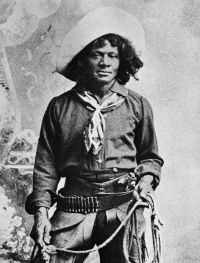
“ This round up is to run in all the near cattle belonging to each man, and head them toward our respective ranges. If we find any other brand mixed up with ours we head them toward their own range, and keep our own together. Every cow boy does the same and in this way every cattleman is enable to get his own brand together on his own range, so that when the next general round up occurs he will have most of his near cattle together on the home range. ”
George W. Romspert, The Western Echo
“ In a week or ten days they generally come in with the cattle; and they often round up a mighty herd. Each brand now has one or more representatives, and they watch closely after the interests of their employers. They then prepare to take out of the round-up all the brands that belong to that particular range, brand the calves, and let them go. The herd is surrounded and held by cow-boys; and fires are built around, and all the different brands of that range are heated for action. ”
Abner E. Woodruff, Evolution of American Agriculture (c/1919)
“ The general farmer is now taking the place of the range men as the breeder and feeder of cattle. Better methods are producing more and better cattle and, despite the trustification of the slaughtering business by the packing interests, the raising and finishing of "block" cattle is a most attractive side of modern farming. ”
Andy Adams,
Reed Anthony, Cowman — The Fruits Of Conspiracy
“ Cattle, especially steers, locate slowly, and a good summer's rest usually fortifies them with an inward coat of tallow and an outward one of furry robe, against the wintry storms. I was anxious to get the through cattle to the new range as soon as practicable, and allowed the sellers to set their dates as early as possible, many of them agreeing to deliver on the reservation as soon as the middle of May. ”
H. K. Shackleford, Fred Fearnot's New Ranch
“ We expect to cut several hundred tons of hay while it is yet young and fresh and full of milk, and feed that to the milch cows during the winter. The beef cattle on the range can keep fat on the dry grass like those on all ranches do. ”
George Pattullo,
The Untamed: Range Life in the Southwest
“ The cattle grazed in scattered bunches over some hundred thousand acres of the east range--they are not so companionable as horses and do not herd so closely in their feeding. Nor will the bulls take such responsibilities upon their shoulders as do stallions with the mares and colts. ”
Alfred Henry Lewis,
Wolfville Nights
“ Cattle find a natural theatre of existence on the plains. There, likewise, flourishes the pastoral man. But cattle herding, confined to the plains, gives way before the westward creep of agriculture. Each year beholds more western acres broken by the plough; each year witnesses a diminution of the cattle ranges and cattle herding. This need ring no bell of alarm concerning a future barren of a beef supply. ”
“ He killed th' wobblers but says th' tracks show that about a dozen was in th' herd. That means eight of 'em are on our range among the cattle. Tell th' boys we start th' round-up at daylight. If we can, we 'll make this do for the spring round-up, too; if not, then th' calves 'll have to wait till we can go for 'em. Th' north range won't have no itch cows on it yet, so take th' south first. As fast as we can cut out th' cattle that are free from it, we 'll throw 'em over on th' north range. Begin in th' Hog Back country an' clean up. Drive everything out of it. ”
Francis Francis, Saddle and Mocassin
“ When you bring cattle from a distance, too, some of 'em is sure to die on the road; and more'll die before they get wonted to the range; and no matter how fine a range you [Pg 163] turn 'em on to, it'll take a long time for 'em to find their condition again after a change of country. Then very likely half the cows you bring from a distance ain't been served, and many of them as has calves loses 'em on the trail. In the long run you'll always find it pay to buy cattle that you know something about, and buy 'em pretty near home, too."Spring's the best time to buy stock. ”
William L. Grant, Arthur P. Coleman, Ernest H. Godfrey, George M. Wrong,George R. Parkin, Lawrence J. Burpee and William C. H. Wood, 1911 Encyclopædia Britannica, Volume 5… (1911)
“ Throughout other parts bullocks are fed on pasture land, and also in stables on nourishing and succulent feed such as hay, Indian corn fodder, Indian corn silage, turnips, carrots, mangels, ground oats, barley, peas, Indian corn, rye, bran and linseed oil cake. The breeding of cattle, adapted for the production of prime beef and of dairy cows for the production of milk, butter and cheese, has received much attention. There is government control of the spaces on the steamships in which the cattle are carried, and veterinary inspection prevents the exportation of diseased animals. ”
Anthony Florian Madinger Willich, Domestic Encyclopædia (1802)
“ By this means, very few or no division-fences are required: instead of 1 1/3 of an acre, one-fourth part will suffice for the subsistence of a beast during the six warmer months; the whole of their manure is well preserved, and given to the soil, where it is most wanted, and in the best condition; the land is not trodden in, and the cattle always ready for immediate rise. They are also kept more cool, are less tormented by flies than if pastured, acquire good coats, and full flesh; though they consume a much smaller quantity of food. ”
Robert Jennings, Cattle and Their Diseases
“ We want cattle for distinct purposes, as for milk, beef, or labor. In a large majority of cases—especially in the dairy districts, at least, comprising the Eastern and Middle States—the farmer cares more for the milking qualities of his cows, especially for the quantity they give, than for their fitness for grazing, or aptness to fatten. These latter points become more important in the Western and some of the Southern States, where much greater attention is paid to breeding and to feeding, and where comparatively slight attention is given to the productions of the dairy. ”
“ This is injurious in all domestic animals and fowls. Always have the cow and the bull from different regions: attention to this would constantly improve any breed we have, and by improving the size of cattle, and milking qualities of cows, would add vast amounts to the wealth of farmers, without the necessity of purchasing, at a great price, any of the high-bred cattle. We have observed, in our article on calves, that abundant feeding during the first year has much to do with the excellence of stock. ”
Alfred Charles True,
The New International Encyclopædia…
“ The Red Polls are a comparatively new breed, resembling the Devons, hornless, and inclined to the beef form. They are only fair dairy cattle, being in the class of breeds which aim to serve the dual purpose of milk and beef production. The Shorthorns, described above as beef cattle, although a typical beef breed, are to some extent dual-purpose animals, and some families have been notable for milk-production. ”
Sir Charles Alexander Cameron, The Stock-Feeder's Manual
“ Milch Cows.—When dairy-farming is conducted on pure pastures, the cows are altogether dependent upon the grasses; and in winter, the animals suffer much from scarcity of food. This is the very worst system of cow-keeping, but it is prevalent amongst many small farmers in Ireland, and is to be met with even in England and Scotland. I am strongly of opinion that it would be far more economical to keep cows (and other cattle) altogether in the house, and feed them with cut grass, than to allow them to remain out altogether in the field. ”
James Wilson, The evolution of British cattle and the fashioning of breeds…
“ It must be remembered that other factors interfere with milking capacity as such alone. The cow's size, age, and health might be mentioned, for instance. If these other factors can be eliminated, then, if the hybrids are intermediates, there will be three grades of cows, viz. high grade, medium, and low grade. The cows' grade being manifest by their yield of milk, the difficult part of the problem is to determine the grade of the bull; and for this there is only one test, the test of breeding. He is either high grade, middle, or low grade. ”
P. M. Hough, Dutch Life in Town and Country
“ It is well known that his cattle are the best in all the country, for the pastures, by reason of the damp polder ground, are very rich, and yield year out year in an abundant crop of grass and hay, the cows he keeps for milking purposes giving from 20 to 30 litres, or from 45 to 70 pints, of milk a day, which is a very high yield. ”
Robert Jennings, Cattle and Their Diseases
“ It is better to have the whole herd, so far as may be, uniform in size; for, if they vary greatly, some may get more than they need, and others will not have enough. This, however, cannot always be brought about.Crossing and Breeding [77] The raising of cattle has now become a source of profit in many sections,—to a greater extent, at least, than formerly—and it becomes a matter of great practical importance to our farmers to take the proper steps to improve them. ”
James Russel Roberts, Stock and stalks (1921)
“ I would want one acre of alfalfa and one acre of pasture for every cow that I expected to keep. If we have a large number of young stock, the pasture would need to be increased. I would fill these silos with corn, grain and all, and use the silage to feed only the cows giving milk. I would use a Smalley feed cutter with snapping attachments and use cut-up dry fodder containing no grain as the principal feed for the dry cows and all young stock on the place. The farmer usually milks only one-half as many cows as he has cattle all together. ”
Alfred Charles True,
The New International Encyclopædia…
“ The most important results of man's agency in improving cattle by breeding, care, and management have been a tendency of the animals to mature at an earlier age, and readily to lay on flesh and fat, and an increase of the milk-production far beyond the needs of the calf, and prolongation of the natural period of milk-flow. At the present time the various recognized breeds of domestic cattle may be classified in a general way as beef cattle and dairy cattle. ”
James P. Boyd, Triumphs and Wonders of the 19th Century…
“ It would be interesting to take up each separate breed of cattle and trace its source, giving credit to the men who improved and developed it, and the date of each importation; but the limitations of this article forbid anything more than brief mention of the more prominent breeds, and many which possess great merit cannot be even mentioned. The improved cattle of the United States may be grouped under three heads—beef, dairy, and general purpose. ”