“ The only difference claimed in favour of the shorthorn is, that it maintains more flesh than the Ayrshire, keeps its money value together better, and can be finished for the butcher with greater ease and more satisfactory results. ”
Shorthorn
Definition and stakes
The theme of “Shorthorn” has been addressed by authors such as Walter Johnson and James Wilson. It is often associated with terms like horn, cattle, river, Shorty and house.
Quotes about “Shorthorn”
Walter Johnson, Byways in British Archaeology
“ We pass to the last of our ancient types, the “Celtic shorthorn” (Bos longifrons = B. brachyceros) , already mentioned as known to the Romans. This smaller ox had an abnormally developed forehead, hence its name longifrons. The short horns and the depressed curve of the upper portion of the skull frontal should be compared with the corresponding features in the urus (Fig. 97 C) . The Celtic shorthorn was domesticated in Britain in the Neolithic period, and during the Bronze Age it was our characteristic, if not our only ox, and occupied this{480} ”
James Wilson, The evolution of British cattle and the fashioning of breeds…
“ They could not stand starvation so well as the small polls, but with better treatment they gave a heavier yield of milk. A few were of a dull-red colour, but they were not so high in favour as the brindled cattle. The polled cattle were the dairy stock. The butter they produced was very fine in summer and autumn, but hard and white in winter. The establishing of a beef trade with England, and the introduction of Shorthorn bulls and turnip husbandry, opened up a new era for Buchan. The native cattle fattened well, and money was made by doing so. ”
 Elihu Burritt,
A Walk from London to John O'Groat's
Elihu Burritt,
A Walk from London to John O'Groat's
“ He now owns the largest herd of Shorthorns in the world, breeding and feeding them to the highest perfection in the cold and naturally unfertile county of Aberdeen, which no man of less patience and perseverance would select as the ground on which to enter the lists against such an array of competitors in Great Britain and other countries. ”
W. H. R. Curtler, A Short History of English Agriculture
“ They are not so well qualified for crossing as Shorthorns, but have blended well with that breed, and produced good crosses with Ayrshires and Jerseys, but not with Devons. It has been said that they are not a favourite sort with London butchers, as they require time to ripen, which does not suit a hurrying age. ”
 D. H. Lawrence,
Women in Love
(1920)
D. H. Lawrence,
Women in Love
(1920)
“ The Brangwens went home to Beldover, the wedding-party gathered at Shortlands, the Criches' home. It was a long, low old house, a sort of manor farm, that spread along the top of a slope just beyond the narrow little lake of Willey Water. Shortlands looked across a sloping meadow that might be a park, because of the large, solitary trees that stood here and there, across the water of the narrow lake, at the wooded hill that successfully hid the colliery valley beyond, but did not quite hide the rising smoke. ”
 Charles Dudley Warner,
The Complete Writings of Charles Dudley Warner…
Charles Dudley Warner,
The Complete Writings of Charles Dudley Warner…
“ The scenery is constantly grander as we ascend. The day is not wholly clear; but high on our right are the vast snow-fields of the Weishorn, and out of the very clouds near it seems to pour the Bies Glacier. In front are the splendid Briethorn, with its white, round summit; the black Riffelhorn; the sharp peak of the little Matterhorn; and at last the giant Matterhorn itself rising before us, the most finished and impressive single mountain in Switzerland. Not so high as Mont Blanc by a thousand feet, it appears immense in its isolated position and its slender aspiration. ”
“ The mountains themselves stood back, as it were, darkling and unobtrusive; all that was left of the Matterhorn was a towering gap in the stars; and in the faint cold light stood my friends, somewhat close together, and I thought I saw the red tips of two cigarettes. There was at least no mistaking the long loose limbs in the light overcoat. And because a woman always looks relatively taller than a man, this woman looked nearly as tall as this lad. "Bob Evers? You may not remember me, but my name's Clephane—Duncan, you know!" ”
Sir Charles G. D. Roberts, Kings in Exile
“ The lower slope was difficult to climb, a tangle of tumbled boulders and fallen trunks, mantled in the soundless gloom of the fir-forest. Skilled woodsman though he was, Horner’s progress was so slow, and the windless heat became so oppressive to his 142 impatience, that he was beginning to think of giving up the idle venture, when suddenly he came face to face with a perpendicular and impassable wall of cliff. ”
Sir Charles G. D. Roberts, Kings in Exile
“ It was still early morning when Horner started to descend the mountain. It was dusk when he reached the lake and flung himself down, prostrated with fatigue and pain and strain of nerve, beside his canoe. From moment to moment, through spells of reeling faintness and spasmodic exhaustion, the silent gulfs of space had clutched at him, as if the powers of the solitude and the peak had but spared him so long to crush him inexorably in the end. At 164 last, more through the sheer indomitableness of the human spirit than anything else, he had won. ”
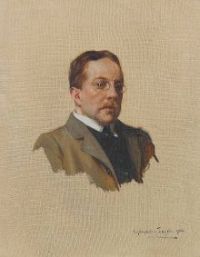 E. W. Hornung,
The Rogue's March
(1896)
E. W. Hornung,
The Rogue's March
(1896)
“ The fields were dazzling green in the sweet, hot sunshine; the hedgerows sparkled with a million emeralds; and up the hill to the right, beneath a row of horse-chestnuts clouded over with young leaves, the white trousers and shiny hats of a body of police caught without riveting Mr. Harding’s roving eye. The sun shone brilliantly upon the cool green spot where they stood; but yet another constable, with a tall companion in plain clothes, was descending the right-of-way, and reached the road-side stile as the coach passed. ”
“ Disappointed faces met me on my next visit to the veranda. The little crowd there had dwindled to a group. I could have had the telescope now for as long as I liked: the upper part of the Matterhorn was finally and utterly effaced and swallowed up by dense white mist and cloud. My friend the mountaineer looked grave, but his disfigured face did not wear the baulked expression of others to which he drew my attention. "It is like the curtain coming down with the man's head still in the lion's mouth," said he. ”
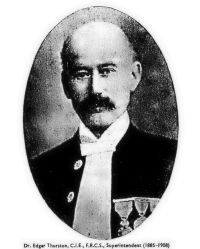 Edgar Thurston,
Castes and Tribes of Southern India
(1909)
Edgar Thurston,
Castes and Tribes of Southern India
(1909)
“ In most cases only the horn, with a small piece of skull and skin, is sold. Sometimes, instead of the skin from the part where the horn is made, a piece of skin is taken from the snout, where the long black hairs are. The horn then appears surrounded by long black bushy hairs. The Kuruvikkārans explain that, when they see a jackal with such long hairs on the top of its head, they know that it possesses a horn. A horn-vendor, whom I interviewed, assured me that the possessor of a horn is a small jackal, which comes out of its hiding place on full-moon nights to drink the dew. ”
E. W. Hornung,
Stingaree
(1908)
“ A round moon topped the sand-hills as the trio rode away; it was near its almost dazzling zenith when they reined up at the scene of the murder. This was at a point where the sandy track ran through a belt of scrub, and the sergeant got off to examine the ground with Hardcastle, while Tyler mounted guard in the saddle. But nothing of importance was discovered by the pair on foot, and nothing seen or heard by their mounted comrade. They found the station still astir and faintly aglow in the veiled daylight of the moon. A cluster of the men stood in a glare at the door of their hut ”
Margaret A. McIntyre, The Cave Boy of the Age of Stone
“ CHAPTER XI THORN MEETS THE CHILDREN OF THE SHELL MOUNDS Every day Thorn worked for a little while at the chipping of stone axes, but he had plenty of time for play. One morning he ran to the river and jumped on his raft. "Ha!" he said, "my other self jumped the stream with me. And now it leans over a shadow raft and reaches for a shadow pole." He looked about him. On the grass lay the long shadows of the trees. In the clear water were the pictured banks. "Everything has another self," he thought. ”
E. W. Hornung,
Some Persons Unknown
“ VI When C. J. returned, the sun shone into the room no more; it was afternoon.Kenyon was very white."Well?""Kenyon, they don't know!""But they're still in the house. Why haven't they gone? What are they waiting for? Tell me, C. J. You said you'd tell me!""Poor old Kenyon—dear old fellow!" faltered Forrester. "I promised to tell you, I know I did, and downstairs they've asked me to. Now you'll never feel it, Kenyon. They're going to do something which may make you better. You—you'll be put to sleep—you'll never feel a thing!" ”
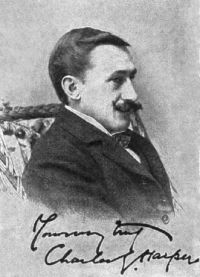 Charles G. Harper,
The Somerset Coast
Charles G. Harper,
The Somerset Coast
“ The road down from Selworthy to Porlock passes the little river Horner and commands views on the left hand up to the purple hills of Exmoor, up to Cloutsham, where the wild red deer couch, and the great heights of Dunkery, Easter Hill, and Robinow. To the left lies the hamlet of Horner, so-called from the river, “Hwrnr,” = “the Snorer,” snoring, as the Anglo-Saxons are supposed to have fancifully likened the sound of its hoarse purring, over the boulders and amid the gravel-stones that strew its shallow woodland course. ”
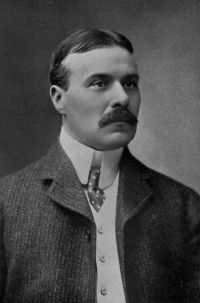 Robert William Chambers,
The Mystery of Choice
(1897)
Robert William Chambers,
The Mystery of Choice
(1897)
“ On our side of the river the cliffs were covered with blackthorn and hawthorn, with here and there a stunted oak, probably so placed by Providence as general rendezvous for all the small twittering birds of Finistère. Birds were everywhere. From the clouds came the ceaseless carol of skylarks; from the grain fields and the flowering gorse rose an unbroken chorus, taken up and repeated by flocks of microscopical songsters among the blackthorns on the cliffs. ”
E. W. Hornung,
The Rogue's March
(1896)
“ But as for Claire, one moment she held her breath in horrid certainty that he had heard; in another she was satisfied that he had not; and had forgotten his existence the next. Indeed, by the time she looked upon the meadow, asleep beneath its soft grey coverlet of dew, the wide world contained but one live man, and he was at the gate upon the farther side. Yet was he? Round the meadow ran a gravel path, upon which she thought her feet pattered loud enough for all the world to hear. ”

“ So when Horn halted for camp one afternoon in a beautiful valley in the Wyoming hills there were only nine men with him. On a long journey through wild country strangers grow close together or far apart. Bill Horn did not think much of the men who had accepted the chance he offered them, and daily he grew more aloof. They were not a responsible crowd, and the best he could get out of them was the driving of oxen and camp chores indifferently done. ”
 Madison Grant,
The Rocky Mountain Goat
Madison Grant,
The Rocky Mountain Goat
“ The horns of the female are slightly longer and much more slender than those of the male. A little over eleven inches appears to be the extreme limit of horns for the male. The longest horns known are from British Columbia, attaining a length of something over ten inches up to an extreme measurement of eleven and one-half, which appears to be the record. The horns from the Bitter Root Mountains average at least an inch shorter, as do those from the coast ranges in the United States. ”
John McElroy, Si Klegg, Book 4
“ Shorty was taller and more spare, but he was quicker and had the longer reach. It looked as if the Englishman had the advantage, from his solid strength and staying power, as well as "science." But those who looked on Shorty as inferior did not know of the training he had received among the turbulent crews of the Mississippi River boats. A man who had summered and wintered with that fractious race had little to learn in any trick or device of fighting. ”
Various, The Idler, Volume III., Issue XIII.…
“ Sometimes I met him shambling along the brink of the Cliffs—a grotesque little figure, with his old shapeless hat, his huge coat flapping behind him, and the mighty blackthorn he carried—he knew the ground so well that he walked as if he could see (indeed, he saw more than I could, for while to me the breakers were only streaks of light, he spoke as if he was close to them on the wet weedy rocks) , or I came on him lying by the edge, listening to the grumbling of the breakers and the cries of the gulls. ”
“ But opposite the gates they turned to the left, into a narrow road with hedges, from which you can see the rectory, and as Herbert put it afterward:"That's what knocked our Tiny!"For the girl's first glimpse of the old house was over the hedge and far away above a brilliant sash of meadow green. The cream-colored walls were aglow in the low late sunshine, what was to be seen of them, for they were half hidden by a creeper almost as old as themselves. The red-tiled, weather-beaten roof was dark with age. Even at a distance one smelt rats in the wainscot within the stuccoed walls. ”
“ The stars blinked high overhead, and the stars deep down in the tranquil water answered them. The voice of the weir seemed nearer and louder. A gentle breeze stirred the line of poplars by the river's brink in the meadow, and fanned the temples of the motionless man at their feet. A bat passed close over him, lightly touching his hair with its wing. Miles did not stir. ”
E. W. Hornung,
Raffles — The Knees of the Gods
(1906)
“ It was on the knees of the gods, he said, when I begged him to bend lower, but for the moment I thought his tone as changed as his face had been earlier in the morning. To oblige me, however, he took more care; and, when he had done all that one comrade could for another, he did avail himself of the cover he had found for me. So there we lay together on the veldt, under blinding sun and withering fire, and I suppose it is the veldt that I should describe, as it swims and flickers before wounded eyes. ”
 Owen Wister,
The Virginian: A Horseman of the Plains
Owen Wister,
The Virginian: A Horseman of the Plains
“ We followed the backward trail in among the pines, and came after a time upon their camp. And then I understood the mistake that Shorty had made. He had returned after his failure, and had told that other man of the presence of new horses. He should have kept this a secret; for haste had to be made at once, and two cannot get away quickly upon one horse. But it was poor Shorty's last blunder. ”
“ Lascelles only looked at me with her mouth tight shut and her eyes wide open; and I concluded—somewhat uneasily, I will confess—that she saw for herself what I meant. "As for the Matterhorn," I went on, "that, I believe, is not such a very dangerous exploit in these days. There are permanent chains and things where there used to be polished precipices. It makes the real mountaineers rather scornful; anyone with legs and a head, they will tell you, can climb the Matterhorn nowadays. ”
E. W. Hornung,
Stingaree
(1908)
“ No one accompanied the armed men and the bound. But every man on the place, from homestead, men's hut, rabbiter's tent, and boundary-rider's camp—every single man who could be mustered for the nonce had a horse run up for him—escorted Dr. Methuen in close cavalcade to the Mulfera boundary, where the final cheering took place, led by Carmichael, who, of course, was font and origin of the display. And Carmichael rode by himself on the way back; he had been much with the Bishop during his lordship's stay ”
“ Often they thought they had reached the lead, but always they overtook more stampeders who had started before them. Occasionally, groups of men attempted to swing in behind to their pace, but invariably they were discouraged after a mile or two, and disappeared in the darkness to the rear."We've been out on trail all winter," was Shorty's comment. "An' them geezers, soft from laying around their cabins, has the nerve to think they can keep our stride. Now, if they was real sour-doughs it'd be different. If there's one thing a sour-dough can do it's sure walk." ”
James M'Govan, Traced and Tracked; Or, Memoirs of a City Detective
“ It was agreed that Shorty should go over to the hide and get the plunder, while The Fin went to a safe reset to arrange about its disposal. This programme worked perfectly in all but one trifling item—the finding of the plunder. Shorty did himself up with soot to resemble a chimney-sweep, and with a ladder and the proper key of the hatch got up to his hide behind the cistern, only to groan and curse over the fact that the cotton handkerchief and its contents were gone. The truth flashed on him at once—some one had found the plunder. Shorty was as much enraged as if he had been robbed. ”
