“ Efficient domestic management implies industry, application, method, moral discipline, forethought, prudence, practical ability, insight into character, and power of organization—all of which are required in the efficient management of business of whatever sort. Business qualities have, indeed, a very large field of action. They mean aptitude for affairs, competency to deal successfully with the practical work of life—whether the spur of action lie in domestic management, in the conduct of a profession, in trade or commerce, in social organization, or in political government. ”
Domestic management
Definition and stakes
The theme of “domestic management” has been addressed by authors such as Frederick Winslow Taylor, Lucy Maynard Salmon, Catharine Esther Beecher, D. Cussons and East Germany/SED. It is often associated with terms like economy, industry, household, service and trade.
Quotes about “domestic management”
Anne Cobbett, The English Housekeeper: Or, Manual of Domestic Management
“ The reader, therefore, must be content with the information that this part of the work appears to be very amply stored with the good things of this world, and, what is more to the purpose, a very cursory glance has convinced us that the colonist family might avail themselves of the greater part of this division of the book with advantage and profit. The truly valuable portions of the work are those which relate to domestic management. ”
Various, Encyclopaedia Britannica, 11th Edition…
“ It is derived from the Gr. οἰκονομία, the management (νέμειν, to control) of an οἶκος or house, extended in meaning to the administration of a state. Of its original sense, the art or science of managing a household, the expression “domestic economy” survives, but the principal use in this sense is confined to the thrifty management of the financial resources of a household or of an individual. It is thus used as equivalent to “saving,” not only of money, but of time, labour or effort, and, generally, of the least expenditure of means to attain a required end. ”
Sivachandra Vasu, The Hindoos as They Are
“ The study of domestic economy engages her attention from the moment she undertakes the varied duties in the inner department of a household, the proper management of which, is, to her, a congenial occupation, becoming her sex, her position, her habitude, her taste. ”
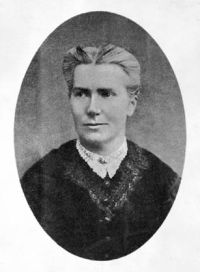 Emily Blackwell,
Popular Science Monthly
(1883)
Emily Blackwell,
Popular Science Monthly
(1883)
“ So far, therefore, from deploring the encroachments of business organization on domestic work as a danger to the happiness of domestic life, we should see in them an agency which will lead to its higher development. ”
 Lucy Maynard Salmon,
Domestic service
(1897)
Lucy Maynard Salmon,
Domestic service
(1897)
“ It has been seen that any measure looking towards a lessening of the difficulties that stand in the way of securing at all times and in all places competent domestic employees, must fail of its object if it does not take into consideration economic history, economic conditions, and economic tendencies. Economic history has shown the remarkable effect of inventive genius and business activity on all household employments, and through them on domestic service; a study of economic conditions has shown the nature of the perplexities surrounding both employer and employee. ”
Robert Hayne, Webster and Hayne's Celebrated Speeches (1830)
“ On this subject, as in all others, we ask nothing of our northern brethren but to "let us alone." Leave us to the undisturbed management of our domestic concerns, and the direction of our own industry, and we will ask no more. ”
Lucy Maynard Salmon,
Domestic service
(1897)
“ It is hoped, however, that the tabulation and presentation of the facts will afford a broader basis for general discussion that has been possible without them, that a knowledge of the conditions of domestic service beyond their own localities and households will enable some housekeepers in time to decide more easily the economic questions arising within every home, that it will do a little something to stimulate discussion of the subject on other bases than the purely personal one. ”
Lucy Maynard Salmon,
Domestic service
(1897)
“ The aristocracy of the household must succumb to this universal desire for personal independence on the part of employees.The plan suggested of specializing household industries to as great an extent as possible and encouraging the domestic employee to live in her own home has much in its favor. It substitutes for the responsibility to an individual employer, so irritating to many and so contrary to the industrial spirit of the age, the responsibility to a business firm. ”
Lucy Maynard Salmon,
Domestic service
(1897)
“ The question how to improve the present condition of domestic service is, however, not a hopeless one, but the answer to it must be based on an examination of the historical and economic principles underlying the subject. ”
Lucy Maynard Salmon,
Domestic service
(1897)
“ The advantages in the scheme are in the saving of expense in buying, economy in the preparation of all the materials consumed, a division of labor on the part of the co-operators which enables each to follow her own tastes in work, and a removal of all difficulties with the subject of service by making the servants responsible to a corporation, not to individuals. ”
Lucy Maynard Salmon,
Domestic service
(1897)
“ Precisely the same objections that hold in all other employments to the wage system hold as well in domestic service. In other occupations it has been seen that the almost universal testimony of those who have tried profit sharing is that the system results in economy in the use of materials, care in the handling of machinery and implements of work, and a feeling of partnership, the spur of which as a motive “is only excelled in sharpness by complete proprietorship.” ”
Lucy Maynard Salmon,
Domestic service
(1897)
“ It seems possible in view of the facts stated in this second group of propositions to draw these conclusions. In states containing a relatively high urban population it is possible for wealth to command the services of a large proportion of persons for work in domestic service. ”
Caroline Louisa Hunt, Home Problems from a New Standpoint
“ The home, by consenting to use factory products and by employing outside help, has involved itself in the great labor problem; by educating its daughters to support themselves in occupations unconnected with its management it has complicated its original problem of household administration ”
Lucy Maynard Salmon,
Domestic service
(1897)
“ The question must arise, however, in view of the interdependence of all other forms of industry, whether it is possible to maintain this perfect separation with regard to any one employment, whether household employments are justified in resenting any intrusion into their domain, whether the individual employer is right in considering [6] household service exclusively a personal affair. ”
Lucy Maynard Salmon,
Domestic service
(1897)
“ There must be scientific training and investigation in economic theory, history, and statistics, especially in their application to the household, and an increased popular knowledge of all scientific subjects concerning the home, those which secure the prevention of economic and material waste in the household as well as those which concern the questions of production for it. The educational forces must “pull from the top” and draw domestic service into the general current of industrial development. ”
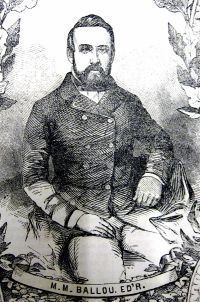 Maturin M. Ballou,
The New Eldorado: A Summer Journey to Alaska
Maturin M. Ballou,
The New Eldorado: A Summer Journey to Alaska
“ It must inevitably build up a responsible and self-respecting community, by uniting proprietorship and domestic relations of the most desirable character, connected with steady and remunerative occupation. ”
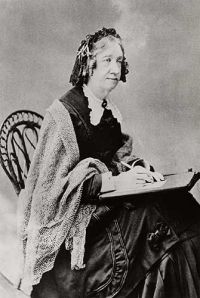 Catharine Esther Beecher,
Miss Beecher's Housekeeper and Healthkeeper
Catharine Esther Beecher,
Miss Beecher's Housekeeper and Healthkeeper
“ She has constantly changing domestics, with all varieties of temper and habits, whom she must govern, instruct, and direct; she is required to regulate the finances of the domestic state, and constantly to adapt expenditures to the means and to the relative claims of each department. She has the direction of the kitchen, where ignorance, forgetfulness, and awkwardness, are to be so regulated that the various operations shall each start at the right time, and all be in completeness at the same given hour. ”
Lucy Maynard Salmon,
Domestic service
(1897)
“ Domestic [288] service is for men an occupation, and they make preparation for it as for any other technical trade. They must spend from one to two years in other countries learning the language [348] in order to increase their market value; the position they can command and the wages they can earn depend, other things being equal, on the amount of capital they have invested in themselves. ”
 Lilian Whiting,
The Land of Enchantment: From Pike's Peak to the Pacific
Lilian Whiting,
The Land of Enchantment: From Pike's Peak to the Pacific
“ Much is heard regarding strikes and other forms of the eternal conflict between labor and capital; and yet the high rates paid, the concessions constantly made to the demands of employés, the conditions provided for them, would seem, at a superficial glance, to be such as to bridge over every difficulty. Domestic service is something that presents the greatest problem on the part of the employer. ”
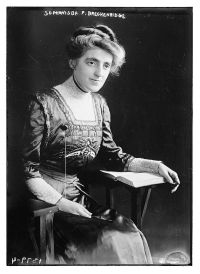 Sophonisba Preston Breckinridge,
New Homes for Old
Sophonisba Preston Breckinridge,
New Homes for Old
“ We are of the opinion, however, that as regards help with domestic work, the position of the wives of professional men with small incomes, and of the large army of men of moderate means who are engaged in commerce and industry is becoming critical, and that some form of municipal service might help to solve this most difficult problem. ”
Edward Farr, The History of England in Three Volumes…
“ Protection to home industry, with the view of encouraging the establishment of domestic manufactures; retrenchment in the expenditure of the government, or the better apportionment of that expenditure to the existing means of the province, and an extension of our home market, and the consolidation of British interest, by the union of the colonies—these present specific objects worthy the employment of our highest efforts for their attainment. ”
Lucy Maynard Salmon,
Domestic service
(1897)
“ The industrial barriers within the occupation must be removed before domestic service will attract large numbers of capable, efficient persons; this can be at least partially accomplished by taking the employee out of the house and allowing him or her to become a self-reliant, independent, business person.Another direction in which progress lies is in the effort to put the employment on a business basis. This must be accomplished if any improvement is to come. ”
Portal:Central Intelligence Agency, The World Factbook (1990)
“ To this end the authorities have switched to a system of household responsibility in agriculture in place of the old collectivization, increased the authority of local officials and plant managers in industry, permitted a wide variety of small-scale enterprise in services and light manufacturing, and opened the foreign economic sector to increased trade and joint ventures. ”
Lucy Maynard Salmon,
Domestic service
(1897)
“ An answer to the question may be of help in deciding whether the difficulties that are found in the present system of domestic service arise in every case necessarily from the personal relations which exist between employer and employee, or are largely due to economic conditions over which the individual employer has no control. ”
Lucy Maynard Salmon,
Domestic service
(1897)
“ But domestic service has through these causes been affected in certain specific ways. The employee who [68] disliked housework, but to whom no other occupation had been open, could go into a factory or a mill, since no time was consumed in learning the simple processes of mechanical work. Every invention formed the basis for a new occupation. Domestic service had a hundred competitors in a field where before the era of inventions it had stood alone. ”
 Isabel Anderson,
The Spell of Belgium
Isabel Anderson,
The Spell of Belgium
“ The Government established schools of housekeeping, where the girls learned domestic economy in every branch; they were sent to market, for instance, with six cents to buy the materials for a meal, which they afterwards cooked and served. ”
Lucy Maynard Salmon,
Domestic service
(1897)
“ Nearly every class of employers has its own special organization; the associated press, associated charities, local, state, and national educational associations, and associations of learned societies, show the influence of organization in other departments; nearly every class of employees also has its trade union or mutual benefit association; everywhere, except in the household, mutual interests are drawing together for protection, for consultation, for economy of forces and resources, for a score of reasons, those engaged in the same activities. ”
East Germany/SED, Constitution of the German Democratic Republic (1968)
“ In the enterprises, the activities of which provide the basis for the creation and increase of social wealth, the working people cooperate directly in management with the assistance of their elected bodies. ”
Catharine Esther Beecher,
Miss Beecher's Housekeeper and Healthkeeper
“ A moderate style of housekeeping, small, compact, and simple domestic establishments, must necessarily be the general order of life in America. So many openings of profit are to be found in this country, that domestic service necessarily wants the permanence which forms so agreeable a feature of it in the Old World. ”
 Albion Woodbury Small,
The American Journal of Sociology
(1896)
Albion Woodbury Small,
The American Journal of Sociology
(1896)
“ Over against all the ownership rights which do and should accrue to such manager, social responsibilities on the part of the management arise and develop with every stage in the progress of the business. These responsibilities are obligations to coöperators in the business, and to the society more remotely affected by the business. These obligations fix the ethical limits of ownership, and define the duties incumbent on proprietorship. ”
Lucy Maynard Salmon,
Domestic service
(1897)
“ The leading occupation in each of these cities is some form of manufacturing, and in each of them the proportion of persons engaged in manufacturing processes is larger than, with few exceptions, in the other cities. This fact explains the apparent contradiction between this statement and the one that domestic servants are found in the largest proportions in the largest cities. ”
 Mark Hovell,
The Chartist Movement
(1918)
Mark Hovell,
The Chartist Movement
(1918)
“ Under the old domestic system the employer resided as a rule in the neighbourhood of his work-people, but the new captains of industry, whose fathers had perhaps been content to follow the example of the domestic master by living next to their workshops and factories, built themselves country houses farther away from the town, whilst their employees festered amidst the appallingly insanitary streets and alleys which had grown up around the factories. ”
 Samuel Freeman Miller,
Ex parte Coy — Opinion of the Court
Samuel Freeman Miller,
Ex parte Coy — Opinion of the Court
“ As observed on a former occasion, 'they are invested with the sole power to regulate domestic affairs of the highest moment to the prosperity and happiness of their people, affecting the acquisition, enjoyment, transfer, and descent of property ”
D. Cussons, Cussons' Horncastle Compendium…
“ If you have no obvious superfluities, yet may not your economy, that is, your management of what you have, be more exact, methodical, and careful? So that even your own affairs will be more prosperous; and, from this good management, you may find much more to give to these great services than even now you are yourselves aware of. ”
Lucy Maynard Salmon,
Domestic service
(1897)
“ It is impossible to understand the condition of domestic service as it exists to-day without a cursory glance at the changes in household employments resulting from the inventions of the latter part of the eighteenth century. ”
Lucy Maynard Salmon,
Domestic service
(1897)
“ It is not strange, therefore, that reasonable, intelligent, and competent employers have difficulties to meet that lie entirely without the domain of their own households, and that many persons who twenty-five years ago experienced no difficulty whatever find to-day serious trouble in retaining their employees. ”
 John Stuart Mill,
On Liberty
(1869)
John Stuart Mill,
On Liberty
(1869)
“ The management of purely local business by the localities, and of the great enterprises of industry by the union of those who voluntarily supply the pecuniary means, is further recommended by all the advantages which have been set forth in this Essay as belonging to individuality of development, and diversity of modes of action. Government operations tend to be everywhere alike. With individuals and voluntary associations, on the contrary, there are varied experiments, and endless diversity of experience. ”
 James Fenimore Cooper,
The American Democrat
(1838)
James Fenimore Cooper,
The American Democrat
(1838)
“ The relations between the master and the domestic servant, are peculiar, and are capable of being made of a very endearing and useful nature. The house servant, whether man or woman, fills a more honorable, because a much more confidential station, than the lower mechanic, or farm laborer. The domestics are intrusted with the care of the children of those they serve, have necessarily charge of much valuable property, and are, in a manner, intrusted with the secrets of the domestic economy. ”
 Lynden Livingston Macassey,
Labour policy—false and true
(1922)
Lynden Livingston Macassey,
Labour policy—false and true
(1922)
“ But the management of a large number of industries and services will be in the hands of the municipalities and other local authorities, and federations of these, not only the provision of water and gas and the distribution of electricity, but also, in some countries, the provision of food, clothing and housing. The production and distribution of household supplies of every kind will form, for the most part, the sphere of the consumer’s co-operative societies. ”
Related terms
Authors who wrote about “domestic management”
 Frederick Winslow TaylorLucy Maynard SalmonCatharine Esther BeecherD. CussonsEast Germany/SEDConstituent Assembly of PortugalJohn Stuart MillEmily BlackwellRobert HayneAnne CobbettMaturin M. BallouSophonisba Preston BreckinridgeLilian WhitingEdward FarrIsabel AndersonSivachandra VasuSamuel SmilesVariousCaroline Louisa HuntAlbion Woodbury Small