“ INGOLF. You must understand that we will not stand by, and let you go down with only a loose stone to hold you up. HADDA PADDA. True, I wouldn't be as nervous, if I knew you were holding the rope. [Puts the spade aside, and looks down into the gorge.] INGOLF [unties the rope from the stone] . HADDA PADDA. I don't know whether I dare go down, Ingolf. INGOLF. Don't go—give it up. HADDA PADDA. I never saw the gorge so hushed. How it stretches its cold, greedy stone-fingers into the air!—But imagine my finding the pearls! [Determined.] I must go down. Is the rope safe? ”
Hindlimb
Definition and stakes
The theme of “hindlimb” has been addressed by authors such as . It is often associated with terms like rope, rock, mountaineering, climbing and Himalayas.
Quotes about “hindlimb”
“ We can see nothing but the white jersey, still moveless; but every motion of the other climbers and every word they speak echoes down the precipice, as if from a sounding board. You hear the iron-shod feet of the climbers feeling about for footholds on the ringing wall of rock. Once there is a horrible clatter as if both feet are dangling over the abyss and scraping convulsively for a hold. ”
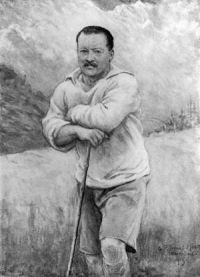 Charles Granville Bruce,
Twenty Years in the Himalaya — Chapter V. Suru
(1910)
Charles Granville Bruce,
Twenty Years in the Himalaya — Chapter V. Suru
(1910)
“ Still, we did well, capturing another peak over Konnag, approximately 17,500 feet, which gave us a most enjoyable day, with some of the best ice and rock climbing we had had; indeed a big traverse across an ice face was quite as sensational as I personally care for — a long day from camp, but only one day, and really typical of one of the best kinds of quite insignificant Himalayan peaks in which one can really enjoy oneself, and about which no one can quarrel or accuse one of not having done one's best, or of having generally behaved in any way deleterious to the sport of mountaineering. ”
 Abby Morton Diaz,
The William Henry Letters
Abby Morton Diaz,
The William Henry Letters
“ The longing which every boy has to climb is called the climbing instinct. In Hyladdu the climbing instinct was nipped in the bud,—smothered, crushed, kept under. He was forbidden to swing on gates, taught to avoid fence-posts, lamp-posts, and flag-staffs, and to look upon hills as summits of danger. Of shinning, he knew but the name. And that the very idea of climbing might be kept from his mind, all climbing plants were rooted out from the grounds; not even a morning-glory was allowed to run up a string! ”
Charles Granville Bruce,
Twenty Years in the Himalaya — Chapter III. Kumaon and Garhwal
(1910)
“ We were in a country which possibly had never been seen by human beings, or if seen, only by Graham’s party. The scenery was of the very highest Alpine order, and we had the real pleasure of not knowing how in the earth we were going to find our way out. We had, in fact, everything that makes a mountain expedition enjoyable, the one drawback being the heavy loads we carried. For all one’s appreciation of fine scenery, of nature in general, and of nice little questions in rock-climbing in particular, one’s pleasure is seriously marred by 40 lbs. ”
Winthrop Packard, White Mountain Trails (1912)
“ Often it is only the click and patter of a pebble obeying that ever present force as it bounds from ledge to ledge down the wall. But sometimes a larger fragment leaps out at the mysterious command and crashes down, splintering itself or what it strikes on the way to the bottom. My own climbing feet dislodged many that have caught on other fragments, and in the steeper, more crumbled portions of the path each climber does his share in producing miniature slides. Except on rare occasions the fall of the mountains is slight, but it is continually going on wherever peaks rise and cliffs overhang. ”
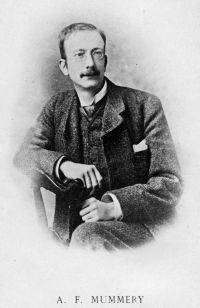 Albert Frederick Mummery,
My Climbs in the Alps and Caucasus
(1895)
Albert Frederick Mummery,
My Climbs in the Alps and Caucasus
(1895)
“ It was, however, pointed out, that our main object was not an ascent, but a training walk, and it would, in consequence, be an advantage rather than otherwise to have a sufficient extent of rock on which to develop our muscles and burn out, what Professor Tyndall refers to, as the "effete matters" which English life lodges in the muscles. We were quite unable to resist the strength of these arguments, and decided in favour of the south-western face, the descent from the southern ridge to the snow patch, and the re-ascent to the eastern ridge. ”
James B. Hendryx, The Gold Girl
“ Loose rock fragments were strewn about in increasing numbers, and the valley was narrowing to an extent that necessitated frequent fording of the shallow creek. "He can't make any better time than I can," muttered the girl, as she noted the slackening of her horse's speed. She was riding on a loose rein, giving her horse his head, for she realized that to force him might mean a misstep and a fall. She closed her eyes and shuddered at the thoughts of a fall. A thousand times better had she fallen and been pounded to a pulp by the flying hoofs of the horse herd, than to fall now—and survive it. ”
Edwin John Dingle, Across China on Foot
“ Sometimes one steps twenty inches from one stone to another, and were it not that the pathway is winding, although the turning and twisting makes unending toil, progress in the ascent would be impossible.... Mules are passing me—puffing, panting, perspiring. Poor brutes! One has fallen, and in rolling has dragged another with him, and there the twain lie motionless on those horrid stones while the exhausted muleteers raise their loads to allow them slowly to regain their feet. ”
Charles Granville Bruce,
Twenty Years in the Himalaya — Chapter V. Suru
(1910)
“ There are innumerable climbs all over the Hindu Koosh and Himalaya below the 20,000 line which will give one all one wants, and at the same time leave room for more. If one sets out wound up to do something unpleasant, i.e. to go above 20,000 feet as often as possible, this comes under the head of achievement; but for purposes of a purely mountaineering expedition I cannot imagine anything nicer than arranging a trip when each member of the party is determined not to stay longer than necessary in any named valley, and is also bound down not to pass the 20,000 limit. ”
George Wherry, Alpine notes and the climbing foot (1896)
“ There is one place in climbing the rocks where a rope is hung over a precipice, and by gently swinging on this rope a long step or giant stride is made across to a foothold beyond. It is only one of the many positions in mountaineering where imagination shows you what a slight distance there is between what you are and what you may become. In the descent a frightful avalanche of stones fell down just as we cleared the rocks, but it was not near enough to shake our nerves. ”
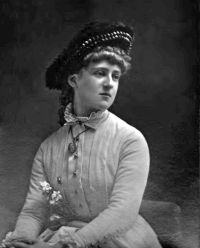 Mrs. Aubrey Le Blond,
Adventures on the Roof of the World
Mrs. Aubrey Le Blond,
Adventures on the Roof of the World
“ The wind here was far less trying as we were sheltered by the topmost pinnacle of the mountain. To me the feeling of danger from a gale on a rock peak is due even more to the difficulty of hearing what one’s companions are saying than to the risk of one’s balance being upset. It is extremely disconcerting, when a climber, descending steep rocks and anxious to make a long but perhaps an easy step downwards to good foot-hold, calls for more rope, and is promptly swung clear out into space by an invisible guide above, who has misunderstood his orders. ”
Bernard Capes, The Strength of the Rope (1901)
“ The windlass, as I have said, revolved slowly, but it revolved persistently. If I would remain with my head above the well-rim—which, I freely confess, I had a morbid desire to do—I must swarm as persistently up the rope. That was an eerie and airy sort of treadmill: to climb, and climb, and always climb, paying out the cord beneath me, that I might remain in one place. ”
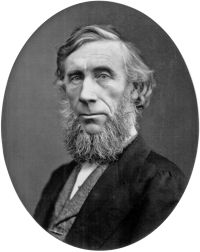 John Tyndall,
Hours of Exercise in the Alps
John Tyndall,
Hours of Exercise in the Alps
“ Fearing to wound the man, the ice-rubbish was cautiously rooted away; it rang curiously as it fell into the adjacent gloom. A layer two or three feet thick was thus removed; and finally, from the frozen mass, and so bloodless as to be almost as white as the surrounding snow, issued a single human hand. The fingers moved. Round it we rooted, cleared the arm, and reached the knapsack, which we cut away. We also regained our rope. The man’s head was then laid bare, and my brandy-flask was immediately at his lips. ”
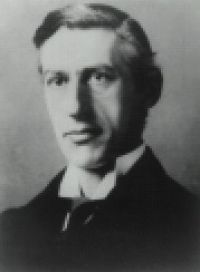 Norman Collie,
Climbing on the Himalaya and Other Mountain Ranges
Norman Collie,
Climbing on the Himalaya and Other Mountain Ranges
“ Two of the party were lowered down into a savage-looking gully, from which they ascended to a spot some thirty feet higher than the Split-Block, and by lowering a rope were able to pull up the last man direct, who could not descend alone into the gully. This sounds as if the last man had a comparatively easy climb. But as the ascent is literally made through the air, unless an extra rope is sent down to help him with a noose at the end which can be used as a stirrup, he will arrive up above in a somewhat congested state. ”
John Tyndall,
Hours of Exercise in the Alps
“ The rope, I reply, notwithstanding all its possible drawbacks under such circumstances, is the safeguard of the climber. Not to speak of the moral effect of its presence, an amount of help upon a dangerous slope that might be measured by the gravity of a few pounds is often of incalculable importance; and thus, though the rope may be not only useless but disastrous if the footing be clearly lost, and the [290] glissade fairly begun, it lessens immensely the chance of this occurrence.With steady perseverance, difficulties upon a mountain, as elsewhere, come to an end. ”
Norman Collie,
Climbing on the Himalaya and Other Mountain Ranges
“ Then afterwards, when we turned into our sleeping-bags before the roaring camp-fire, and the twilight slowly passed into the azure night, and overhead the glistening stars were blazing in the clear sky, a worthy ceiling to this mountain land, it was agreed unanimously that it was worth coming many thousand miles to enjoy climbing in the Himalaya, and that those who lived at home ingloriously at their ease knew not the joys that were to be found amidst the ice and snows of the greatest of mountain ranges. ”
Albert Frederick Mummery,
My Climbs in the Alps and Caucasus
(1895)
“ His eloquence, however, was as nothing compared with the mute oratory of the slope. We could realise in every limb the pain of lifting a leg till the knee almost touches the chin, then the agony of tightening the various muscles till one's weight is fairly raised upon it, followed by the heartbreaking squash as the snow gives way, and a hole eighteen inches deep remains almost the only result of the effort. ”
John Tyndall,
Hours of Exercise in the Alps
“ With perfect courage and a faultless head, he has but one disadvantage, and that is an excess of weight of at least two stone. In his first attempt the snow-ledge breaks, and he falls back; but two men are now at the rope, the tension of which, aided by his own activity, prevents him from sinking far. By a second effort he clears the difficulty, is followed by his guide, and all four of us reach the slope above the chasm. Its steepness was greater than that of a cathedral roof, while below us, and within a few yards of us, was a chasm into which it would be certain death to fall. ”
J. W. Hendron, Frijoles: A Hidden Valley in the New World
“ A tenseness of nerve and muscle envelops a person. An Indian father crept noiselessly down the steep slope to the valley far below—stopped, listened—not a sound but the whining of the wind through the high tops of pines or the caw of a raven flying high above, or the rolling waters of the little river. Following again and picking each step, bow and arrow in hand, ready to draw, he stopped. ”
 G. A. Henty,
For Name and Fame; Or, Through Afghan Passes
G. A. Henty,
For Name and Fame; Or, Through Afghan Passes
“ Round the trunk, like a snake embracing its victim, a great climber had wound itself. Its main stem was as thick as a man's arm, and there were dozens of smaller, cord-like climbers. Thus, the lads had no difficulty in climbing to the point where the branches grew out. ”
John Tyndall,
The Glaciers of the Alps
“ I prefer such a slope to one on which the thought of danger cannot be entertained. I become more weary upon a dead level, or in walking up such a valley as that which stretches between Visp and Zermatt, than on a steep mountain side. The sense of weariness is often no index to the expenditure of muscular force: the muscles may be charged with force, and, if the nervous excitant be feeble, the strength lies dormant, and we are tired without exertion. ”
Old Rail Fence Corners: The A. B. C's…
“ Hindman took the position of a soldier, with his pitchfork at "charge bayonets" and awaited the approach of the Indian. The Indian came to within a very few feet of Mr. Hindman and stopped. Each stood, looked, and waited for the other to open the meeting; finally the Indian turned as if to retreat, and Mr. Hindman turned again toward the creek.He then followed the creek bed down to the house of Mr. Charles Mack, where he found a pony belonging to himself, which he had ridden there that morning, [Pg 269] and started with all speed for his own home, where he arrived just before dark. ”
Henry Inman, Tales of the Trail: Short Stories of Western Life
“ Foaming little torrents splash and sparkle in the sunshine, as they course through the fertile intervales. Their sources are cool mountain springs hidden in the dark recesses of the towering range, which were, until the restless "Gringo" invaded the solitude of the charming region at the advent of the iron trail to erect saw-mills, filled with that most epicurean and gamy of all the finny tribe, the speckled brook-trout. ”
Francis Lynde, The Master of Appleby
“ On each hand the mountains rose precipitous, the one on the left swelling unbroken to a bald and rounded summit, forest covered save for its tonsured head high in air, while that on the right was steeper and lower, with a line of cliffs at the top. As we fared on, the valley narrowed to a mere chasm, with the river thundering along the base of the tonsured mountain, and the Indian path hugging the cliff on the right.In the gloomiest depths of this defile we came upon the hunter's stumbling-block. ”
Norman Collie,
Climbing on the Himalaya and Other Mountain Ranges
“ I tried to climb straight up the ridge, but perpendicular slabs, with only small cracks in them, barred the way. To be entirely outside the mountain, when in a peculiarly difficult place, is by no means pleasant. The imagination is far less troubled with ideas of what might happen should one fall, when the extreme steepness is partially hidden from one's view in the privacy of a rock chimney.Baffled in my attempt to make a direct ascent, I looked to the left for some convenient traverse. There was none; vertical slabs, many hundreds of [Pg 202] feet high, entirely stopped the way. ”
Charles Granville Bruce,
Twenty Years in the Himalaya — Preface
(1910)
“ A last word on the training of mountaineers; it is almost an impossibility to train a mountaineer in the Himalaya. The country is too large, not sufficient variety can be obtained, and for an amateur one has to go so far, and gets so few days in the real mountains. The Himalaya will never produce an Alexander Burgener or an Emile Rey: it is impossible to get the experience. No I not even fancy rock-climbing will ever arrive, for there is much too much of interest on all sides to spend much time in any one locality. ”
Arthur M. Winfield, The Rover Boys at School (1908)
“ But no such limb was handy, and even had there been there would have been no time in which to prepare it for use, for the rapids were now in plain sight, the water boiling and foaming as it darted over one rock and another, in a descent of thirty feet in forty yards. ”
Charles Granville Bruce,
Twenty Years in the Himalaya — Chapter IV. Dharmsala and Chamba
(1910)
“ Nothing could be truer than this of very high climbing, whereas the amount of sport that could be obtained and the amount of real mountaineering that could be done, with a limit of 20,000 feet, is enormous, and an unexampled time could be put in. ”
Mrs. Aubrey Le Blond,
Adventures on the Roof of the World
“ The direction in which we were travelling and the angle of the slope made the rope utterly useless. Close attention is very exhausting: much more exertion is required to walk ten steps, bestowing the utmost possible care on each movement, than to walk a hundred up or down a much steeper incline when the angle demands a more accustomed balance. Not for an instant might we relax our vigilance till, at 5.30 P.M., we reached once more the ridge close to the place where we had forced our way through the cornice in the morning. ”
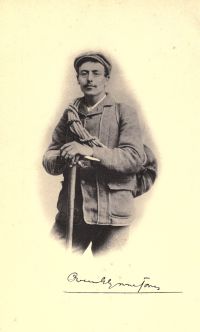 Owen Glynne Jones,
Rock-climbing in the English Lake District
Owen Glynne Jones,
Rock-climbing in the English Lake District
“ The side of the Needle facing Lingmell exhibits an obvious alternative route to the shoulder. The climbing is twelve or fifteen feet longer, and rather more interesting. Facing the Needle at its foot with our backs to Lingmell, we bear to the right into a square corner. We pass up this on the left to a little level platform, reached best by an armpull and a foothold well away on the buttress. I have seen good men in much trouble on this corner. ”
