William James, Psychology: Briefer Course
“ But if the assumption of 'simple sensations' recurring in immutable shape is so easily shown to be baseless, how much more baseless is the assumption of immutability in the larger masses of our thought! ”
Immutability, the quality of remaining unchanged despite external influences, has long been a central topic in philosophical and theological discussions. William James contrasts it with the ever-changing nature of human thought, while Holbach connects it to the unchanging laws of nature.
Plotinus links it to the divine, highlighting the unchanging essence of the Supreme Being, and Poe questions its relevance to truth itself. From metaphysical debates to scientific theories, immutability functions as a framework for examining permanence in the face of change, exposing its contested role in shaping ideas about reality.
William James, Psychology: Briefer Course
“ But if the assumption of 'simple sensations' recurring in immutable shape is so easily shown to be baseless, how much more baseless is the assumption of immutability in the larger masses of our thought! ”
baron d' Paul Henri Thiry Holbach, The System of Nature, or, the Laws of the Moral and Physical World…
“ Here we shall be able to perceive that, supposing the laws by which nature acts to be immutable, it does not require tiny of these logical distinctions to account for the changes that take place: the mutation which results, is, on the contrary, a striking proof of the immutability of the system which produces them ”
William James, A Pluralistic Universe
“ When an experience comes with sufficient saliency to stand out, we keep the thought of it for future use, and store it in our conceptual system. What does not of itself stand out, we learn to cut out; so the system grows completer, and new reality, as it comes, gets named after and conceptually strung upon this or that element of it which we have already established. The immutability of such an abstract system is its great practical merit; the same identical terms and relations in it can always be recovered and referred to—change itself is just such an unalterable concept. ”
George Barry O'Toole, The case against evolution (1925)
“ To begin with, it must be frankly acknowledged that here the theory of transformism is, to all appearances, upon very strong ground. Its first strategic advantage over the theory of immutability consists in the fact that, unlike the latter, its attitude towards the problem is positive and not negative. When challenged to explain the structural uniformities observed in organic Nature, the theory of immutability is mute, because it knows of no second causes or natural agencies adequate to account for the facts. ”
 Stephen Charnock,
The Existence and Attributes of God…
Stephen Charnock,
The Existence and Attributes of God…
“ No creature can be capable of immutability by nature. Mutability is so essential to a creature, that a creature cannot be supposed without it; you must suppose it a Creator, not a creature, if you allow it to be of an immutable nature. Immutability is the property of the Supreme Being. ”
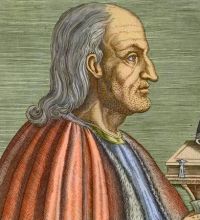 Saint Anselm,
Monologium — On the Being of God
Saint Anselm,
Monologium — On the Being of God
“ It is made clear, then, that of all those facts, called accidents, a part bring some degree of mutability in their train, while a part do not impair at all the immutability of that in whose case they occur. Hence, although the supreme Nature in its simplicity has never undergone such accidents as cause mutation, yet it does not disdain occasional expression in terms of those accidents which are in no wise inconsistent with supreme immutability ”
 Plotinus,
Enneads — The Impassivity of the Unembodied
Plotinus,
Enneads — The Impassivity of the Unembodied
“ Holding, as he does, that it is the patterns displayed upon Matter that cause all experience in living bodies while the Matter itself remains unaffected, he chooses this way of stating its immutability, leaving us to make out for ourselves that those very patterns impressed upon it do not comport any experience, any modification, in itself. ”
 Edgar Allan Poe,
Eureka: A Prose Poem
Edgar Allan Poe,
Eureka: A Prose Poem
“ It is seen, then, that the axiomatic principle itself is susceptible of variation, and of course that axioms are susceptible of similar change. Being mutable, the “truths” which grow out of them are necessarily mutable too; or, in other words, are never to be positively depended upon as truths at all—since Truth and Immutability are one. ”
Jaime Luciano Balmes, Fundamental Philosophy, Vol. 2…
“ But let us leave such absurdities, and go on with our analysis of the idea of a necessary and unconditioned being. Immutability excludes perfectibility, so that it is necessary either to suppose the summit of perfection primitively in the necessary being, or to admit that it can never attain this perfection. Perfectibility is one of the characteristics of the contingent, which improves its mode of being by a series of transformations; the absolutely necessary is what it is, and can be nothing else. ”
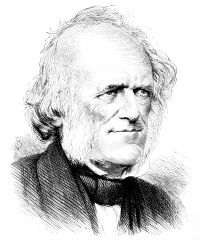 Charles Lyell,
The Antiquity of Man
(1863)
Charles Lyell,
The Antiquity of Man
(1863)
“ Implicit trust in the immutability of species is then restored, and the more insensible the shades from one extreme to the other, in a word, the more complete the evidence of transition, the more nugatory does the argument derived from it appear. ”
Mary Hays, Memoirs of Emma Courtney
“ That immutability, which constitutes the perfection of what we (from the poverty of language) term the divine mind, would inevitably be the bane of creatures liable to error; it is of the constancy, rather than of the fickleness, of human beings, that we have reason to complain. ”
 Philip Schaff,
Nicene and Post-Nicene Fathers…
(1885)
Philip Schaff,
Nicene and Post-Nicene Fathers…
(1885)
“ Since, then, there is a twofold division of existences, into created and uncreated, and since the uncreated world possesses within itself immutability and immobility, while the created is liable to change and alteration, of which will he, who with calculation and deliberation is to choose what is for his benefit, prefer to be the offspring ”
 Friedrich Schiller,
Aesthetical Essays of Friedrich Schiller
Friedrich Schiller,
Aesthetical Essays of Friedrich Schiller
“ If the formal impulsion becomes receptive, that is, if thought anticipates sensation, and the person substitutes itself in the place of the world, it loses as a subject and autonomous force what it gains as object, because immutability implies change, and that to manifest itself also absolute reality requires limits. As soon as man is only form, he has no form, and the personality vanishes with the condition. In a word, it is only inasmuch as he is spontaneous, autonomous, that there is reality out of him, that he is also receptive ”
Charles Stuart, A memoir of Granville Sharp (1836)
“ This law is written upon the heart of every man, teaching him what to choose and what to refuse. What is written by reason in the heart, cannot be effaced; neither is it liable to change from either place or time, but ought to be preserved every where by all men. For the laws of nature are immutable; and the reason of their immutability is this, that they have for their foundation, the nature of things, which is always and every where the same. ”
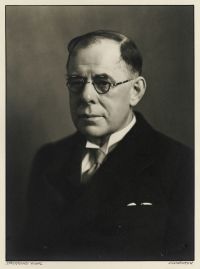 A. E. Taylor,
Elements of metaphysics
(1903)
A. E. Taylor,
Elements of metaphysics
(1903)
“ The problem presented by the apparently unceasing mutability of existence is one of the earliest as well as one of the most persistent in the whole range of Philosophy. In itself it might seem that the successive presentation in time of various states is neither more nor less noteworthy a feature of the world of experience than the simultaneous presentation of a like variety, but the problem of mutability has always appealed with special force to the human imagination from its intimate connection with our personal hopes and fears, ambitions and disappointments. ”
J. G. Broughton Pegg, The New Eschatology
“ Mutability is liability to change, or a continual tendency to remove from one state to another. Whatever is changeable, or whatever can experience alteration, is, therefore, mutable. But this mutability attaches not to material nature alone, but to all creation; the highest archangel in the highest heaven, as well as every spirit embodied on earth, is a mutable creature. The state of glory in the eternal world, as well as the state of man below, is a state of mutability,—a state in which there are continual changes either for the better or the worse. ”
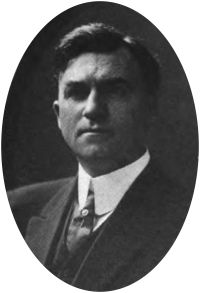 Eugene V. Brewster,
What's What in America
Eugene V. Brewster,
What's What in America
“ As times and conditions change, so do opinions, and thus has it been with the writer. Change is the only thing that is constant—strange paradox—and mutability is the one immutable law of the universe. ”
 F. H. Bradley,
Appearance and Reality — Chapter XXVI
(1893)
F. H. Bradley,
Appearance and Reality — Chapter XXVI
(1893)
“ In short, even if the unity of thought and will were by itself self-evident, yet the various aspects of the world can hardly be reduced to it. And, on the other side, even if this reduction were accomplished, the identity of will and thought, and their diversity, are still not understood. If finitude and process in time is reduced to their divergence, how is it they come to diverge? ”
Th. Ribot, The evolution of general ideas (1899)
“ In this labor of construction by continuous repetition, two psychological facts are to be noted:1. No sooner is unity passed, in the elaboration of numbers, than intuition fails altogether. Directly we reach 5, 6, 7, etc, (the limit varies with the individual) , objects can no longer be perceived or represented together: there is now no more in consciousness than the sign, the substitute for the absent intuition: each number becomes a sum of unities fixed by a name.2. For our unity-type we substitute higher unities, which admit of simplification. ”
Proclus, The philosophical and mathematical commentaries of Proclus on the first book of Euclid's elements… (1791)
“ And thus it will preserve to us a certain proportion, that as the natures which are moved by others, are to those which are moved by themselves, so are these last to immoveable natures; and hence it will obtain the condition of a bond, on account of its peculiar mediocrity, unfolding, indeed, united causes, but reducing the dissipated powers of sensibles into one, and being contained by an immoveable and perpetually abiding cause; but containing itself the generation, which, moved by another, is subject to continual mutation. ”
Steven David Justin Sills, An Apostate: Nawin of Thais
“ But, in accepting the mutation—there was little choice but to accept it and as he had always flaunted himself in the livery of his manhood there was no point in reversing the trend now—how was he to know that the man he now was was the man he was meant to be? Who was to say that one was meant to be anything at all but atoms attracted to each other loosely and reverberating off each other in temporary mass, an agglomeration less solid, less real, than a rock, and more equivalent to a gas? ”
Freiherr von Friedrich Hügel, The Mystical Element of Religion…
“ There is, in the third place, the dominant consciousness of Multiplicity in Unity and of Unity in Multiplicity, and of the necessity of the soul’s ever moving from one to the other—moving out of itself and into the world of Multiplicity, of sense and exterior work ”
A. E. Taylor,
Elements of metaphysics
(1903)
“ Reality, because systematic, must be the expression of a single principle in and through a multiplicity. The unity and multiplicity must both be real, and each must necessarily involve the other. § 5. If both are to be equally real, the whole system must be a single experience, and its constituents must also be experiences. A perfect systematic whole can be neither an aggregate, nor a mechanical whole of parts, nor an organism. The whole must exist for the parts, and they for it. ”
Edgar Allan Poe,
Eureka: A Prose Poem
“ Does not the infinitude of division refer to the utterness of individuality? Does not the entireness of the complex hint at the perfection of the simple? It is not that the atoms, as we see them, are divided or that they are complex in their relations—but that they are inconceivably divided and unutterably complex:—it is the extremeness of the conditions to which I now allude, rather than to the conditions themselves. ”
Jaime Luciano Balmes, Fundamental Philosophy, Vol. 1…
“ If it be said that nothing is offered to us but phenomena, and that we do not attain to the reality, the absolute and identical unity hidden beneath them, we can reply with this dilemma: either our experience is confined to phenomena, or it reaches the very nature of things: if the former, we cannot know what is concealed under the phenomena, nor absolute and identical unity; if the latter, then nature is not one but multiplex, for we everywhere encounter multiplicity. ”
 Edmund Burke,
The Works of the Right Honourable Edmund Burke…
Edmund Burke,
The Works of the Right Honourable Edmund Burke…
“ SUCCESSION AND UNIFORMITY.Succession and uniformity of parts are what constitute the artificial infinite. 1. Succession; which is requisite that the parts may be continued so long and in such a direction, as by their frequent impulses on the sense to impress the imagination with an idea of their progress beyond their actual limits. 2. Uniformity; because, if the figures of the parts should be changed, the imagination at every change finds a check; you are presented at every alteration with the termination of one idea, and the beginning of another ”
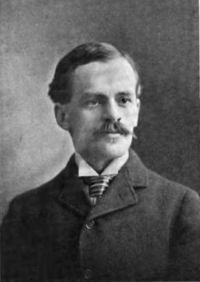 Alfred H. Lloyd,
The will to doubt
Alfred H. Lloyd,
The will to doubt
“ Nor is this particular conflict in our ordinary ideas yet before us in all its fatefulness, for—as if to defy the principle of consistency to the very last degree of its forbearance—we are often, if not usually, given not only to unifying our world of things in terms of just one more thing, or of persons in terms of just one more person, but also to thinking of this one more thing, or person as sui generis, as altogether different in nature and substance. ”
Alfred H. Lloyd,
The will to doubt
“ The dividing partitions may still stand, but only as unsubstantial forms wholly transparent and ineffective, so that the undivided universe is really present to consciousness. The undivided universe, however, as present to consciousness, is a call for will, since it cannot be fully realized in any formal consciousness. The natural decline of an asserted specialism, then, or the development of specialism into a mere form without substance, into a virtual universalism, makes science applicable. ”
Chauncey Giles, The True and False Theory of Evolution… (1887)
“ Will the limit of variety ever be reached? That is impossible in the nature of things, because new influences are constantly operating upon men, which must change the qualities of character and consequently the form of the face. Here, then, we see the nature of the infinite in one direction, and can understand it as well as we can anything else.People often mystify themselves upon this subject. They think the infinite is incomprehensible because they cannot see its boundaries. ”
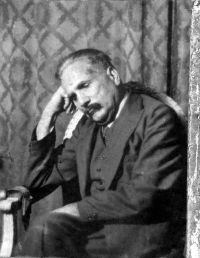 Sir Muhammad Iqbal,
The Development of Metaphysics in Persia
Sir Muhammad Iqbal,
The Development of Metaphysics in Persia
“ The proposition that all movers must be themselves movable, leads to infinite regress—which [Pg 180] must stop at the immovable mover, the source and the final object of all motion. The Real, moreover, is a pure unity; for if there is a plurality of Reals, one would limit the other. The Real as creator also cannot be conceived as more than one; since a plurality of creators would mean a plurality of worlds which must be circular touching one another, and this again implies vacuum which is impossible. ”
 Herbert Spencer,
Popular Science Monthly
(1874)
Herbert Spencer,
Popular Science Monthly
(1874)
“ And here let us not omit to note that along with the notion of transmutation is involved the notion of duality. These things have obviously two states of existence. Much evidence forces on the primitive man the notion that things can change their forms as well as their substances. Did we not thoughtlessly assume that truths which culture has made obvious to us are naturally obvious, we should see that an unlimited belief in metamorphosis is one which the savage cannot avoid. ”
Bronson Alcott's Fruitlands, compiled by Clara Endicott Sears
“ Mutability to such a vision, is as the eddy that spirit maketh around its own self-circling agency, revealing alike in the smallest ripple and the mightiest surges the power that stirreth at the centre. ”
Various, The Catholic World, Vol. 22, October…
“ Why should the mere diversity in other existences make us apprehend that the missing is also the lost, and that we have any substantial cause for doubting that all which exists will go on existing? Do we anywhere see symptoms of annihilation? It is true we see endless mutations, but those very mutations are a guarantee to us of the continuousness of being. ”
Antonio Aliotta, The Idealistic Reaction Against Science (1914)
“ Multiplicity and transformation, as we receive them directly from intuition, are not contradictory in themselves, the contradiction exists only between our one-sided concepts. We may resolve movement as presented to us by intuition into abstract elements, but in that case we must bear in mind that each one of these elements is but a partial view, a limit which we ourselves have laid down in order to facilitate analysis and research, and which does not correspond to any real division. ”
William James, The Principles of Psychology, Volume 1…
“ As each object may come and go, be forgotten and then thought of again, it is held that the thought of it has a precisely similar independence, self-identity, and mobility. The thought of the object's recurrent identity is regarded as the identity of its recurrent thought; and the perceptions of multiplicity, of coexistence, of succession, are severally conceived to be brought about only through a multiplicity, a coexistence, a succession, of perceptions. ”
A. E. Taylor,
Elements of metaphysics
(1903)
“ To think of the world as a single systematic unity, then, means to think of it as the manifestation in a possibly infinite multiplicity of detail of one perfectly determinate principle. And, of course, what we have called the individual elements of the multiplicity may on inspection themselves turn out to be systems of infinite complexity determined by a law of construction derived in a determinate way from that of the complete system, and so on literally ad infinitum. ”
