Lancet window

Definition and stakes

Matthew Holbeche Bloxam,  The Principles of Gothic Ecclesiastical Architecture…

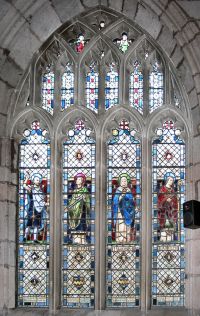
“ A. In the early stages of this style the lancet arch-headed window, very long and narrow, was prevalent; frequently two, three, or more of these were connected together by hood mouldings, the middle window rising higher than those at the [91] sides; sometimes they were unconnected, and without hood mouldings. In the east wall of Early English chancels three lancet windows, thus arranged, are frequently displayed. At a later period a broader window, divided into two lights by a plain mullion, finished at the top with a lozenge or circle, was used ”
Source: Gutenberg

Portrait of John Cassell John Cassell,  Cassell's Illustrated History of England (1865)

“ In its early period, or what is called Geometrical, the lancet window is still sometimes used; but it is foliated and not plain, as in Early English. The heads of two-lights windows are divided by arches springing from the mullions. The spaces are filled with triangles, trefoils, quatrefoils, circles, &c., all the forms being such as could easily be drawn with the compasses; but the ogee, or flowing curve, is never used. In larger windows the same filling up of the head with geometrical forms is used, and plain intersecting tracery is not uncommon. ”
Source: Wikisource

P. H. Ditchfield,  English Villages

“ Mouldings are often the surest guides in helping us to ascertain the date of a building. We have already studied the Norman mouldings. In this style they are composed of bold rounds and deep hollows, usually plain, or ornamented with the dog-tooth.
The lancet window is now introduced, at first of only one light, very narrow and long, and differing from the Norman window in having a pointed arch. At the east end of the chancel there are often three lancet windows, the centre one higher than the rest, with one dripstone over them.
”
Source: Gutenberg

Get perspective with Kwize: daily news enlightened by great literature