“ The yard is swung at about one-third of its length, where it has a strop to pass over the hook on the traveller—an iron ring on the mast to which the end of the halyard is attached, and which prevents the sail blowing away from the mast.Fig. 27.In order to ensure a lug sail that will stand well, the peak should be cut high, as in the drawing. It is a common fault to cut the head of a lug sail too square. Such a sail can never be made to set flatly. A short beamy dinghy with one lug is a handy little craft for the amateur ”
Lug sail
Definition and stakes
Quotes about “lug sail”
E. Keble Chatterton,
Sailing ships
(1909)
“ These little craft sail very close to the wind and are out in the worst of weathers, and require considerable skill in handling. The one lug-sail has to be lowered and hoisted at each tack, but they are wonderfully quick both under sail and when rowed. Any sailing man will tell you how excellent a sail for lifting a boat the lug-sail is, and well the little Deal galley needs it. The yard of the sail hooks on to a traveller and is hoisted by halyards up the mast, a purchase being used to “sweat” it down taught. ”
A. E. W. (Alfred Edward Woodley) Mason, Lawrence Clavering (January 30, 2012 [eBook #38718] [Most recently updated June 3, 2022])
“ We must needs tack if we are to reach the coast by daybreak.""Well?""I cannot do it, sir, without your help. It needs two to tack if you sail with a lug-sail."And that I found to be true. For the sail being what is called a square-sail with a gaff along the top of it, each time the pinnace went about it was necessary to lower it, and hoist it again on the other side of the mast. The which it fell to me to do, while Ashlock guided the tiller. So that I knew there was good reason for his waking me. ”
Basil Hall,
The lieutenant and commander
“ The out-rigger, which is always kept to windward, acting by its weight at the end of so long a lever, prevents the vessel from turning over by the pressure of the sail; or, should the wind shift suddenly, so as to bring the sail aback, the buoyancy of the floating log would prevent the canoe from upsetting on that side by retaining the out-rigger horizontal. The mast, which is very taunt, or lofty, supports a lug-sail of immense size, and is stepped exactly in midships, that is, at the same distance from both ends of the canoe. ”
Frank Frankfort Moore, A Gray Eye or So. In Three Volumes…
“ Sometimes the centre-piece of an old coat has been used for this purpose; but if so, it is only fair to state that it is on record that the centre-piece of an old sail has been shaped into a jacket for the ordinary wearing of a lad. The lug sail may yet find its way into a drawing room in Belgravia and repose side by side with the workhouse sheeting which occupies an honoured place in that apartment. On through the even waves that roll from between the headlands at the entrance, to the little strand of pebbles at the end of the lough, the boats lumbered. ”
W. D. Bernard, Narrative of the Voyages and Services of the Nemesis from 1840 to 1843
“ Both ends are made exactly alike, so that, instead of going about, they have only to shift the large lug-sail, the mast being in the middle, and it is quite indifferent which end of the boat goes foremost. To counteract the natural tendency of so narrow a body to upset, two slight long spars are run out at the side, connected at the outer ends by a long and stout piece of wood, tapering at either extremity, not unlike a narrow canoe ”
Frank Frankfort Moore, A Gray Eye or So. In Three Volumes…
“ One of the legends of the coast is that when a lug sail is new its colour is brown, and as a new sail is never seen at Cairndhu there are no means of finding out if the story is true or false. The sails, as they exist, are kaleidoscopic in their patchwork. It is understood that anything will serve as a patch for a lug sail. ”
Earl Thomas Brassey Brassey, Yachting, Vol. 1
“ Old sailors and fishermen will tell you that a boat with a yard is always stiffer than one with a gaff. With a dipping lug, such as fishermen use, or a balance lug, this seems not improbable, as in these rigs a considerable part of the yard and sail is to windward or in front of the mast; but with a standing lugsail, which, if it has a boom, is practically identical in shape with a cutter's mainsail, it is hard to believe that there is much in it—the peak halliards can hardly make much difference. ”
Hawthorne Daniel, Ships of the seven seas (1925)
“ The moving compass card revolves so that the points or degrees with which it is marked pass close to this line, and thus the man who is steering the ship can always tell exactly the direction in which the ship is headed.luff (of a sail) —The weather edge; that is, the edge toward the wind. To luff, in sailing, is to bring a vessel’s bow more toward the wind.lug—A type of sail of which there are three principal kinds: dipping lug, balance lug, and standing lug. A lug sail is four-sided and is hung from a yard which is mounted on a mast in a fore and aft position. ”
“ A balance lug requires more frequent setting up to preserve its flatness than any other sort of sail.In a small dinghy, no purchase is needed for the halyards; the sail will lower more easily and quicker without one. The tabernacle also is unnecessary, as the mast can be easily unstepped.The sail is kept close to the mast by an iron traveller; but if the sail be cut with a high peak it will be found that the traveller has a tendency to prevent the sail from lowering completely. A traveller is also liable to jam if the mast is not kept well greased. ”
Stephen Sydney Reynolds, A Poor Man's House
“ Again, because the gear for night work in small craft must be as simple as possible, such boats usually carry only a mizzen and a dipping lug—the latter a large, very picturesque, but unhandy, sail which has to be lowered or 'dipped' every time the boat tacks. Neither comfort nor safety is provided by the three feet or so of decking, the 'cuddy' or 'cutty,' in the bows. To sleep there with one's head underneath, is to have one's feet outside, and vice versa. In rough broken seas the open beach drifter must be handled skilfully indeed, if she is not to fill and sink. ”
Robert Stevenson, An Account of the Bell Rock Light-House
“ Fig. 7. represents an Attending-boat, occasionally used during the summer months for visiting the Rock, and relieving the light-keepers. a a is a section of the principal boat, measuring 22 feet in length of keel, and equipped in her rigging after the manner technically termed Lateen-sails, which were originally introduced into use on the Firth of Forth by Mr Thomas Bruce of Grangemuir. These sails are considered more safe than the common lug-sail, from their greatest breadth being carried very low on the mast. ”
Daniel Carter Beard,
Boat-Building and Boating
“ In the chapter on how to build the Rough and Ready, the sprit sail is depicted and fully described.The Balance Lugcomes as near the square sail of a ship as any canvas used on small boats, but you can see, by referring to the diagram, Fig. 151, [116] that the leach and the luff are not parallel and that the gaff hangs at an angle. To boom out the canvas and make it sit flat there are three sticks extended across the sail from the front to the back, luff to leach, called battens. ”
“ This necessitates plenty of sea room, and would be an awkward operation to undertake while turning up a narrow and crowded channel. To handle a dipping lug with safety in a stiff breeze requires considerable experience both on the part of the steersman and of the hand or hands to whom the dipping of the sail is entrusted. ”
“ It never stands flat, except when the boat is close-hauled, and not always then, unless the sheet is led exactly to the right place; and though a sail without a boom jibes with greater safety, it is much more liable to accidental jibes than one with a boom.The Balance Lug.—The favourite sail for small centre-board craft in England is undoubtedly the balance lug. Most of the racing boats on the Upper Thames are fitted with this sail ”
John C. Hutcheson, The Island Treasure
“ As the ship was then found not to steer so well close-hauled, without any headsail, on account of the jib being lowered down, the foretopmost staysail was hoisted in its place and the bunt of the spanker loosened, to show a sort of ‘goose-wing’ aft,—this little additional fore and aft sail now giving her just the steadying power she wanted for her helm, and enabling her to lie a bit closer to the wind.“Thet will do, the port watch!” ”
“ In the first place we heave our vessel to. To do this we slack away our lee foresheet and haul in the weather one, while we flatten in the main and mizzen sheets.The wind striking the after sails drives the vessel up in the wind; but the foresail being hauled to windward and becoming a back sail makes her pay off. By trimming the sheets properly the head and after sails can thus be made to balance each other, and the yacht will float on the water practically motionless, with her head to the wind, and remain so for as long as we please without any hand being required at the tiller. ”
“ The lofty peak of our wherry's sail holds the air over the bushes, and we keep slowly moving along, while smaller boats are either becalmed or, catching sudden puffs, lay over at alarming angles. It is a Saturday evening, and very many little yachts, from the open lugsail sailing boat on which a high-roofed cabin-top has been placed to the 4- or 8-ton yachts of smarter build, are making their way down to more open waters for the happy and healthy week end, most blessed to the person whose occupations are sedentary. ”
“ She was careened down to the breeze, so that her lower studd'n'sail-boom every moment dashed a cloud of spray from the romping billows, and her lee rail was at times under water. Her masts curved and whiffled beneath the immense piles of canvas, like a stringed bow."She walks the waters bravely," said the captain, casting a glance of exultation at the distended sails and bending spars, and then at our arrowy wake.—"But, by Jupiter, the chase still almost holds her way with us. We need more sail aft. ”
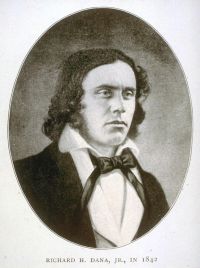
Richard Henry Dana,
Two Years Before the Mast
“ Clouds look black and wild; wind rising, and ship working hard against a heavy sea, which breaks over the forecastle, and washes aft through the scuppers. Still, no more sail is taken in, for the captain is a driver, and, like all drivers, very partial to his top-gallant sails. A top-gallant sail, too, makes the difference between a breeze and a gale. When a top-gallant sail is on a ship, it is only a breeze, though I have seen ours set over a reefed topsail, when half the bowsprit was under water, and it was up to a man's knees in the scuppers. ”
Charles Warren Stoddard,
In the Footprints of the Padres
“ We try to secure the buoy, tacking to and fro; just at the wrong moment our main halyards part, and the sail comes crashing to the deck. To avoid being cast on the inhospitable shore, we put to sea under jib and foresail, and are five miles away before damages are repaired and we dare venture to return; head about, and make fast this time. Hurrah! After several trips of the small boat, succeed in landing luggage and provisions above high-water mark on the Farallones; each trip of the boat is an event, for it comes in on a big breaker, and grounds in a torrent of foam and sand. ”
William A. Ross, A Yacht Voyage to Norway, Denmark…
“ The cutter lay like a log on the water, the reef-points rattling on the main-sail like a shower of small shot; and, every time he heard the sound, the man at the helm would raise his eyes aloft, and, fixing them steadily on the gaff-topsail for a minute or two, turn round and scan the horizon ”
Oliver George Ready, Life and sport in China
“ Built on graceful lines, and of light material, they possess the buoyancy of a duck, rarely shipping water even in the heaviest sea, while with two masts carrying well-shaped sails of matting, immense perforated, balanced rudders, and being of light draught, they handle so well that they can turn a complete circle in their own length. While unable to sail as close to the wind as a yacht, their chief point is in [115] running, when with huge sails set on either side they will tear along at a pace perfectly astounding for craft of their unpretentious build and rig. ”
Ralph Stock, The Cruise of the Dream Ship
“ A winch is better than a capstan for heaving anchor, and if placed abaft the mast, serves also for "swigging" on halyards, or hoisting sail.As for sails, the dream ship's were all "barked" or tanned after the fisherman style, and there is no doubt that this process prevents rot, especially in the humid tropics. We carried one medium-weight mainsail, a working and a balloon foresail, storm and balloon jibs, and a squaresail, and of these the last was the most generally useful. Again I hear the howlers howling: "Why not a spinnaker?" ”
Thomas Fleming Day, On Yacht Sailing
“ Sometimes, owing to the wind not being directly ahead, we are able to remain longer on one tack than on the other. This is what is called making a long and short leg.To properly sail a boat on the wind requires constant and minute attention to the helm and the canvas. The best way for the new hand is to sit low down in the cockpit to leeward of the tiller; this places him nearly under the boom. Let him look up and watch his sail just at the throat; here is where it will shake first. To sail the boat close he must just keep that portion of the sail shaking—or lifting as it is termed. ”
Douglas Frazar, Practical Boat-Sailing: A Concise and Simple Treatise
“ There are times when the sea is too high, and the sail so much reduced that a yacht will not go about by turning towards the wind, but must be gotten on the other tack by wearing, as it is technically called in ships, where the yards are square, and jibing, as it is called in crafts that carry fore-and-aft sails, i.e., sails that hoist up on a mast, and are stretched upon booms, in contradistinction to those that are fastened to yards that cross the mast at right angles, as in a ship often called by sailors, for this reason, a "square-rigger." ”
“ The day was fine and the breeze so light that the old patched sails were taking the schooner along at a gentle three knots per hour. A sail or two shone like snow in the offing, and a gull hovered in the air astern. From the cabin to the galley, and from the galley to the untidy tangle in the bows, there was no sign of life to benefit by the conversation of the skipper and mate as they discussed a wicked and mutinous spirit which had become observable in the crew. ”
Douglas Frazar, Practical Boat-Sailing: A Concise and Simple Treatise
“ Then, unless the yacht gets a stern-board, which has been explained elsewhere, she is helped round by pushing the main-boom—which is made fast by its sheet, and works itself—out over the starboard quarter. When the yacht is just about to pass the direction of the wind, and is nearly upon the other tack, give the order to "trim down on the port jib-sheet,"—the same sheet as has just been cast off; and the outer surface of the sail will act as a lever to push the head of the yacht off till the wind fills the mainsail, when the order, "Let draw!" ”
Douglas Frazar, Practical Boat-Sailing: A Concise and Simple Treatise
“ Push the helm very slowly over to leeward, and, as the yacht commences to come towards the wind, keep the eye fastened upon the luff, or inner leach, of the mainsail. As soon as the yacht is too near the wind to have the sail stand full, a little wave will be seen to agitate the luff of the sail, from its head to the foot, usually commencing near the head, and just under the gaff, as that part of the sail is at a further angle from the wind than the part that is fastened to the main-boom; the gaff blowing out much further to leeward, not being confined by a sheet as the main-boom is. ”
Earl Thomas Brassey Brassey, Yachting, Vol. 1
“ I prefer the sloop rig of a single foresail on a short iron bumpkin, to the end of which the forestay is attached, to the cutter rig of staysail and jib with a regular bowsprit; for a bowsprit is an awkward thing in rounding to and coming alongside a ship, under all sorts of conditions of wind and tide, and a second head-sail gives you more gear to attend to when you are single-handed. And on a boat of this size a single foresail is not too large to be easily handled. ”