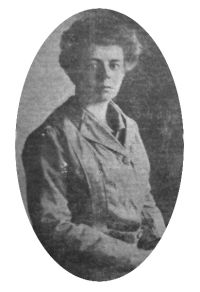
“ Toward the center of it rose a box-like structure with apparently an arched skylight above it. A little distance away from the structure, he distinguished the outlines of what appeared to be a scuttle. Warily he approached it, and using every precaution to make the least possible sound, he attempted to raise the scuttle. A long sigh of relief escaped him as he succeeded. The scuttle was not locked.He paused long enough to glance keenly about him. There was no sign of another human being, but a sound smote his ear. ”
Scuttle
Definition and stakes
The theme of “scuttle” has been addressed by authors such as Mary Antin, Robert Louis Stevenson, Natalie Sumner Lincoln, Herman Melville and John Sherburne Sleeper. It is often associated with terms like scuta, scute, ship, antenna and scutellum.
Quotes about “scuttle”
 Mary Antin,
Atlantic Narratives: Modern Short Stories…
Mary Antin,
Atlantic Narratives: Modern Short Stories…
“ There was a ripping sound as he tore the arm away from that sucker-covered arm of the scuttle, but no harm was done to either combatant.What with the lurching of the sloop, the rocking of the big unsteady trap, the resistance of our captive, and Gregory’s shouting, there was considerable turmoil for so limited an area as that we occupied on our small craft. The scuttle was gradually crowded down, and was presently forced to take refuge in the well to escape the black man’s oar. In the bottom of the trap lay the empty shell of the great crayfish which had tempted the creature to his undoing. ”
Mary Antin,
Atlantic Narratives: Modern Short Stories…
“ The lair of the scuttle, according to Gregory, may be discovered by certain unmistakable signs. It is the accustomed way of the creature to drag his prey to his hiding-place, there to devour it at leisure. ”
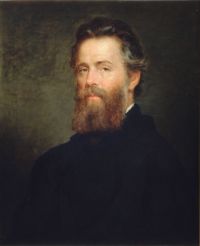 Herman Melville,
White Jacket; Or, The World on a Man-of-War
Herman Melville,
White Jacket; Or, The World on a Man-of-War
“ I wonder that they station no sentries at the port-holes, to see that no air is breathed, except according to Navy regulations. As five hundred men come to drink at this scuttle-butt; as it is often surrounded by officers’ servants drawing water for their masters to wash; by the cooks of the range, who hither come to fill their coffee-pots; and by the cooks of the ship’s messes to procure water for their duffs; the scuttle-butt may be denominated the town-pump of the ship. ”
John Sherburne Sleeper, Jack in the Forecastle; or, Incidents in the Early Life of Hawser Martingale
“ A cordial greeting was soon interchanged between captain Page and Old Neptune on deck, to which we prisoners listened with much interest. The slide of the scuttle was removed, and orders given for one of the "strangers" to come on deck and be shaved. Anxious to develop the mystery and be qualified to bear a part in the frolic, I pressed forward; but as soon as my head appeared above the rim of the scuttle I was seized, blindfolded, and led to the main deck, where I was urged, by a press of politeness I could not withstand, to be seated on a plank. ”
James Anthony Gardner, Recollections of James Anthony Gardner… (1906)
“ A ‘scuttle’ is defined by Falconer as ‘a small hatchway cut for some particular purpose through a ship’s deck, or through the coverings of the hatchways’; ‘scuttling’ is ‘the act of cutting large holes through the bottom or sides of a ship.’ A ‘scuttle butt’ was a large cask, whose bung-hole had been cut into a small scuttle, secured on the main deck in some convenient place, to hold water for present use. ”
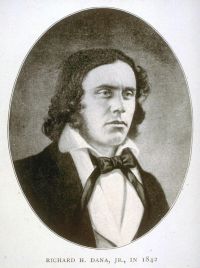 Richard Henry Dana,
Two Years Before the Mast
Richard Henry Dana,
Two Years Before the Mast
“ In a few minutes it came—three knocks on the scuttle, and "All hands ahoy! bear-a-hand up and make sail." We sprang up for our clothes, and were about halfway dressed, when the mate called out, down the scuttle, "Tumble up here, men! tumble up! before she drags her anchor." We were on deck in an instant. "Lay aloft and loose the topsails!" shouted the captain, as soon as the first man showed himself. Springing into the rigging, I saw that the Ayacucho's topsails were loosed, and heard her crew singing-out at the sheets as they were hauling them home. ”
1911 Encyclopædia Britannica, Volume 24… (1911)
“ The name survives in the coal-scuttle, styled “purdonium” in English auctioneers' catalogues, which now assumes various forms. “Scuttle” in this sense must be distinguished from the word meaning a small opening in the deck or side of a ship, either forming a hatchway or cut through the covering of the hatchway; from which to “scuttle” a ship means to cut a hole in the bottom so that she sinks. ”
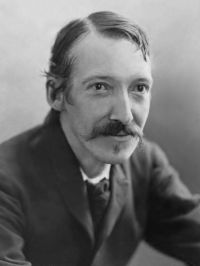 Robert Louis Stevenson,
Kidnapped
(1887)
Robert Louis Stevenson,
Kidnapped
(1887)
“ All this time, you should know, the Covenant was meeting continual head-winds and tumbling up and down against head-seas, so that the scuttle was almost constantly shut, and the forecastle lighted only by a swinging lantern on a beam. There was constant labour for all hands; the sails had to be made and shortened every hour; the strain told on the men's temper; there was a growl of quarrelling all day, long from berth to berth ”
 William Henry Giles Kingston,
Hurricane Hurry
William Henry Giles Kingston,
Hurricane Hurry
“ I jumped on deck in a moment. I was not long in making out a brig under all sail holding the same course we were on. As I took the glass from my eye I found Scuttle standing by my side.“What do you think of her?” I asked.“Maybe she’s a whaler, or maybe a sealer, or a merchantman from one of the provincial ports, or maybe a transport with British red-coats aboard; but, Mr Hurry, it requires a man with a longer sight than I’ve got to tell just now what she is,” said the skipper, in the long drawling tone of a New Englander. ”
Van Tassel Sutphen, The Doomsman
“ Apparently the house had been occupied as a tenement in the ancient time; the marks of its degradation had survived the universal decay, and there was even a fetid suggestion in the air of old-time squalor and disease. Glad he was to be free of it all, and he let the scuttle fall to with a bang.After surveying the different routes as best he could, Constans determined to work his way to the southward. He took one forward step and stood transfixed; from below then came a faint but unmistakable tap, tap upon the closed scuttle. ”
Alice MacGowan, The Million-Dollar Suitcase
“ Where was the girl's fine memory that she couldn't recollect a [Pg 66] man's words for the little time I'd been gone! "All I said was, 'Just a minute and I'll be back.'""Yes, that's all you said to Worth." She glanced at the boy serenely as he waited for her at the ladder's foot. "He's not a trained observer; he doesn't deduce even from what he does observe." There were twinkling lights in her black eyes. "But what your hurried trip to the office said to me was that you'd gone for the key of the room that led to the roof scuttle." ”
 Charles Darwin,
A Monograph on the Sub-class Cirripedia…
Charles Darwin,
A Monograph on the Sub-class Cirripedia…
“ In S. vulgare the males are attached, often several together, to the extreme edges of the two scuta, and therefore immediately over the orifice leading into the sack; in S. rutilum and ornatum, they are attached in concavities on the under side of both scuta, just above the depression for the adductor scutorum muscle. In the former of these species, the pit for the reception of the male is formed by shelly matter not having been deposited over a certain space on the under side of the valve; and the pit is converted by a covering of membrane into a pouch. ”
 Horatio C Wood, Jr.,
The Myriapoda of North America
(1865)
Horatio C Wood, Jr.,
The Myriapoda of North America
(1865)
“ The scuta are ornamented, rarely with a white blotch on each side of the mesial line, but generally with two lateral black dots. The first scutum in the female has the anterior margin oblique as to the main axis of the body, and is prolonged laterally so as to form processes, mostly canaliculate, with a rounded border. In the male the anterior margin is at right angles to the axis of the body, and the lateral parallel to it, so that there are no processes. ”
Horatio C Wood, Jr.,
The Myriapoda of North America
(1865)
“ When surface markings exist on the scuta, they are very useful in defining species. The color is also a good character in some groups. Where one of these fails us the other very generally assists. The form of the last scutum is sometimes distinctive. The best characters, however, are those derived from the genital organs. The form, &c., of the antennæ and head often afford some clue. Genus POLYDESMUS, Latreille. [24] Meatus laterales in scutis 5—7—9—10—12—13—15—16—17—18—19—positus. ”
Charles Darwin,
A Monograph on the Sub-class Cirripedia…
“ Scuta.—These valves are important, inasmuch as the animal’s body is attached to them; in Pl. 25, fig. 1, the broken line, surrounding a, b, shows where the body has been cut, in removing the scutum on the near side, the other scutum, S, being left articulated to the tergum, T. In shape the scuta are generally sub-triangular; but in some species of Pyrgoma and in Chelonobia, &c. they are much elongated. ”
Charles Darwin,
A Monograph on the Sub-class Cirripedia…
“ Scuta oval, of varying proportions; the basal margin is generally narrow, and blends into the [Pg 101] carina-tergal margin; the internal basal rim generally is well developed, sometimes with, and sometimes without internal teeth beneath the umbones. In P. eburnea, and sometimes in P. crassa, there is a line of apparent fissure, and in P. fissa of actual disseverment, running from the umbo to the apex of each scutum, nearly in the line in which a ridge extends in Lepas: the primordial valves of the scuta in these three species, are seated at the basal angles of the lateral and larger segments. ”
Linnean Society of London, Journal of the Proceedings of the Linnean Society - Vol…
“ It is bent upon itself with an angle open forwards, and is divided into two halves (each of which contains seven scutes) by the union of the middle scutes of the fifteenth subcervical with those of the first row of what may be termed the subdorsal scutes, or those which lie under the thorax and abdomen. Of subdorsal and subcaudal scutes there are, up to the broken-off end of the tail, thirty-seven rows, with the following numbers of scutes:—It will be noticed that there are three more rows of ventral than of dorsal scutes. ”
Horatio C Wood, Jr.,
The Myriapoda of North America
(1865)
“ The basal portion of the mandibles on each side project, so that if a vertical section of the head through the middle were taken it would be an oval with its greater diameter transverse. The eyes are in strictly triangular patches, with remarkably straight sides. The scuta are so deeply canaliculate along their dorsal centre as to be almost divided into two parts. The dorsum is not perfectly rounded, but there is somewhat of a ridge or angle in the centre. Each scutum is furnished with a regular series of distant large puncta, or perhaps more properly, pores. ”
Horatio C Wood, Jr.,
The Myriapoda of North America
(1865)
“ They are connected by a black band, which is much broader in the middle than at the ends. The first scutum is large, with very small lateral processes even in the female. There is on its anterior edge a very obscure light border, and a little posterior to this a black, more or less obsolete, band. The scuta are regularly, although rather lightly and distantly canaliculate over their whole surface. The last scutum is distinctly but minutely punctate, has its edge whitish, and is not at all mucronate. The anal scales are not at all pilose. ”
 John James Audubon,
Ornithological biography, Vol. 4…
(1835)
John James Audubon,
Ornithological biography, Vol. 4…
(1835)
“ Neck rather short. Body rather slender. Wings very long. Feet of moderate length, rather strong; tibia bare below for a short space, covered behind with narrow scutella; tarsus compressed, anteriorly covered with numerous scutella and three inferior 215 series of transverse scales, laterally with oblong scales, posteriorly with oblique scutella. Toes slender, with numerous scutella; first extremely small, second considerably shorter than fourth, third longest; anterior toes connected by reticulated webs, of which the anterior margins are deeply concave, the outer and inner slightly marginate. ”
Charles Darwin,
A Monograph on the Sub-class Cirripedia…
“ The Scuta are triangular, with their umbones or centres of growth at the apex; the tergal margin, as seen from within, is either nearly straight or much hollowed out, accordingly as the scuta simply overlap the terga, or are received in a furrow. In some of the species there is a distinct pit for the adductor muscle, and in others this cannot be distinguished. ”
 Dru Drury,
Illustrations of Exotic Entomology
Dru Drury,
Illustrations of Exotic Entomology
“ The Back, dorsum or upper part, answering to the back in some animals, terminates in some species in a triangular manner, so as to represent the scutellum, as in Plate 33. Fig. 5, 6, and 8. Tab. Ann. Fig. 1. f. Fig. 2. e. The Breast, or sternum, is the under part of the thorax, and always furnished with legs.The Scutellum is a small but hard part like a scale, frequently of a triangular shape, placed behind the dorsum of the prothorax, and joining to it. It is not developed in every genus, being chiefly perceived in the Coleopterous, Hemipterous, and transparent-winged orders. ”
Charles Darwin,
A Monograph on the Sub-class Cirripedia…
“ The sutural edges of the alæ are generally distinctly crenated. The basis is often slightly cup-formed, and very plainly porose: its surface is marked by radiating ridges. The orifice of the shell is large, and elongated, especially in young specimens. The basal diameter of the largest specimen is .4 of an inch. The Scuta have no trace of the two or three longitudinal furrows so conspicuous on these valves in B. bisulcatus, and which, in that species, run down from the apex of the valve; this fact showing that the furrows occur in quite young individuals. ”
Various, Journal of Entomology and Zoology…
“ The outer edges of each scutum are prolonged into curved hooked spines. The first scutum is the shortest and broadest, and has the heavier spine or hook, while the last two segments often lack the hook. The abdomen is finely granulate and at the lower edge of each scutum there are eight heavy, short, simple hairs.Pedipalps: Longer than body, coxa smooth, trochanter with large protuberance ending in a strong spine on outer side; femur longer than cephalothorax, slightly concave on inner edge, convex on outer edge. Tibia pedicellate, shorter than femur. ”
Horatio C Wood, Jr.,
The Myriapoda of North America
(1865)
“ The head is broad, and has its anterior surface pubescent. The antennæ are rather long, filiform, pubescent, and strongly clavate. The first scutum is transversely oval. It is narrower than the head. The surface of the scuta is covered with minute flattened tubercles. On the more anterior these are quite distinct and arranged somewhat regularly in a fourfold series. On the more posterior they become less and less distinct, so that in some individuals these scuta have scarcely more than a rough appearance. ”
David Sharp, The Cambridge Natural History, Vol… (1899)
“ Scutellum frequently spined; terminal appendages of the tarsi small, but pulvilli and a pulvilliform empodium are {479}present. This is a large family, whose members are very diversified, consequently definition of the whole is difficult. The species of the typical sub-family Stratiomyinae generally have the margins of the body prettily marked with green or yellow, and the scutellum spined. In the remarkable American genus, Hermetia, the abdomen is much constricted at the base, and the scutellum is not spined; in the division Sarginae the body is frequently of brilliant metallic colours. ”
Charles Darwin,
A Monograph on the Sub-class Cirripedia…
“ Valves white, smooth, moderately thick, marked by the lines of growth. The occludent segments of the scuta, and nearly the whole of the terga, and the whole of the carina, enveloped in lemon-yellow membrane, tinged with orange, but the specimen had long been kept dry.Scuta formed of two, apparently always separate, segments, closely united, so that externally their separation [Pg 110] is hardly visible, and does not allow of movement; the fissure thus formed runs almost in the line connecting the umbo and apex, (where in most species a ridge extends,) but a little on the carinal side of it. ”
Horatio C Wood, Jr.,
The Myriapoda of North America
(1865)
“ Scuta 8. Segments 16. Stomata of the scuta median. Feet and antenna multiarticulate. In the Cermatiidæ the head is large, more or less truncate anteriorly, having its surface rough and uneven. The eyes are compound and very prominent. The palpi very elongate and spinous. The antennæ very long, and composed of a multitude of joints. The mandibles are elongate and distant. The scuta (eight in number) are rounded and deeply emarginate posteriorly, where they are furnished with a longitudinal, slit-like orifice or stoma. Their surface is more or less roughened with minute tubercles or spines. ”
Hans Gadow, The Cambridge natural history, Vol… (1909)
“ The snout is stout, rather broad; the top of the head is rough but without any ridges. The upper and lower jaw each contain nineteen teeth on either side. The nuchal scutes, six in number, are packed closely together, the four biggest forming a square. Four smaller scutes are arranged in a curved line on the occiput. The dorsal shield is composed of four, sometimes of six rows of larger scutes, of which the central pair is the broadest. The fingers are webbed at the base; the outer toes are broadly webbed, and the outer edge of the hind-limbs is turned into a serrated fringe. ”
