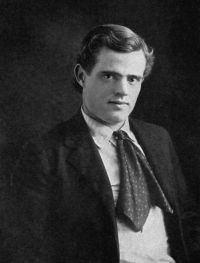
“ As the last coach comes by I sprint in the same direction with it. It is a swift, short sprint. I cannot hope to equal the speed of the train, but I can reduce the difference of our speed to the minimum, and, hence, reduce the shock of impact, when I leap on board. In the fleeting instant of darkness I do not see the iron hand-rail of the last platform; nor is there time for me to locate it. I reach for where I think it ought to be, and at the same instant my feet leave the ground. It is all in the toss. The next moment I may be rolling in the gravel with broken ribs, or arms, or head. ”
Sprint
Definition and stakes
The theme of “sprint” has been addressed by authors such as Ed. James, Jack London, H. W. Gibson, Various and Alec Waugh. It is often associated with terms like speed, runner, racing, stride and running.
Quotes about “sprint”
Ed. James, Practical Training for Running…
“ In a trial for a sprint race, which of course must be run through to know the time, if the day is any way near at hand, suppose a week or ten days off, total rest should be taken the following day until the afternoon, when another trial should take place, when a difference 14 in favor of the pedestrian will in most instances be found to have been accomplished. In Westhall’s experience in sprint racing there has been invariably the above successful result. ”
Three Hundred Things a Bright Boy Can Do
“ The Long Jump.—Speed is an important element in this feat, more important indeed than the spring. Experts take a run of from a hundred to two hundred feet as though they were running a sprint race and are going at their highest speed when they rise from the ground. When they are coming to the ground again they thrust their legs forward as far as they can, and so gain a foot or even more. ”
Handbook of Summer Athletic Sports
“ SPRINT RUNNER. We have thus fully noticed long-distance running before treating of "sprint" races and other short dashes, because it is a more important branch of athletics. The correct system is one that can be readily acquired by all, old and young, and will be found of great value whenever one is in a hurry to go to a certain place. ”
Handbook of Summer Athletic Sports
“ The longest sprint race, and the most severe of all, is the furlong dash—two hundred and twenty yards. This kind of racing is a tremendous strain on the lungs and heart, as the same pace which carries the runner over the hundred yard track has to be kept up and even increased. It requires a broad deep chest in the runner, with little flesh, and that hard and firm. To train for such a race requires at least a year's practice, and amateurs would do well to leave it alone altogether. ”
H. W. Gibson, Camping For Boys
“ The longest sprint race should be, for boys, 50 yards, for juniors, 75 yards. No adolescent who is not past the pubescent stage should run sprint races longer than 100 yards. Cross-country running is beneficial when taken at a slow pace and without competition. ”
Various, Harper's Round Table, February 25…
“ The training for the 100 yards and that for the 220 are almost identical, for an athlete who runs one of these events almost invariably becomes proficient in the other. In fact, the 220 is a long sprint—the word sprint meaning to run at full speed the entire distance of a race. The most important feature of sprinting, of course, is the start, and no runner can become too proficient in this. Up to within five or six years the standing start was universal, but in 1889 or 1890 Lee of the New York Athletic Club introduced the crouching start, and since then that has become the standard in America. ”
Handbook of Summer Athletic Sports
“ When the trial is changed to a sprint race, where great speed is required and a severe temporary strain comes on heart and lungs, the pugilist would answer the purpose better, as condition is the great point in such a match, style being secondary.For longer running contests up to twenty miles, where economy of strength is everything, style becomes a valuable adjunct; and here the professional runner is indicated as the proper trainer.For twenty-four-hour walks and runs the professional pedestrian is also the man to employ, as such efforts are not above the capacity of men in fair condition. ”
Ed. James, Practical Training for Running…
“ Every race you engage in will increase your experience and give you confidence for the next time. Good time for 100 yards ranges from 11 seconds to 101⁄4, according to the ground, &c. The top speed is seldom obtained until 40 yards are covered. A good sprinter will generally beat two others in 200 yards, each to run 100 yards with him on end. For sprinting, wind is not such a desideratum as elasticity of muscle. The shorter the distance, the greater care and practice should be made in starting; the longer you have to sprint, the greater will be the necessity for working up the muscles. ”
Various, Harper's Round Table, February 25…
“ Yet a man does not run on his toes; he runs on the ball of his foot; and in order that the spikes of his shoes may enter the track to the best advantage the sole should strike flat, that the nails may dig well in and secure a firm hold.For a beginner who has never undertaken any systematic training in sprinting, and who desires to become proficient in it, I should recommend the following schedule, to be carefully carried out for three weeks:Monday.—Practise the start six times, running at speed only about twenty yards from the scratch. ”
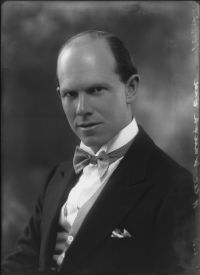 Alec Waugh,
Public School Life: Boys, Parents…
Alec Waugh,
Public School Life: Boys, Parents…
“ It is not unfair in a hundred yards' sprint to start a second before the pistol is fired if you know that the other runners are going to do likewise, but it is hard lines on the one runner who is compelled to wait for the proper signal. ”
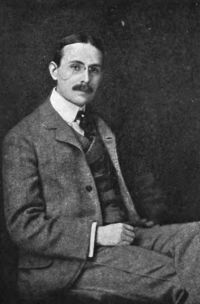 Ralph Henry Barbour,
The Purple Pennant
Ralph Henry Barbour,
The Purple Pennant
“ You made a nice start to-day in the two-twenty and you used a nice stride when you found it, which wasn’t until you were pretty nearly to the tape, but you waved your arms all over the lot and never once used them to help your running. Now if you’re ever going to do anything in the sprints, or in the distances, either, you’ve got to learn how to use your arms. A sprinter runs with three things, Perry; his legs, his arms and his head. You use your legs fairly well, although you’re trying to get too long a stride for a chap with legs the length yours are ”
Donald Ferguson, The Scranton High Chums on the Cinder Path
“ Those who could not sprint, leap the bars, throw hammer or discus, or do any other of the ordinary stunts, might, at least, have some chance of winning a prize in the climbing of the greased pole, the catching of the greased pig, the running of the obstacle race, or testing their ability to hop in the three-legged race, where each couple of boys would have a right and left leg bound together, and then attempt to cross a given line ahead of all like competitors. ”
Three Hundred Things a Bright Boy Can Do
“ This will make the muscles begin to harden. Then run steadily for a quarter of a mile at a time, not troubling much about the speed. Cultivate the use of the toes and stride straight forward. Towards the end of the run the speed may be increased, for the muscles will then be in working order. Even now, Pg 24 however, the young sprinter should not tire himself. A week should be employed in this way before the more severe training is undertaken. ”
1911 Encyclopædia Britannica (1911)
“ Running at the present day is divided into sprinting (distances up to one-quarter of a mile) , middle-distance running (from one-quarter of a mile to 1000 yds.) and long-distance running (over 1000 yds.) . Sprinting consists of running over short distances with a full and continuous burst of speed, the chief distances being 100 yds., 220 yds. and quarter-mile. Distances up to and including 220 yds. are in America called dashes. The course for sprinting races, when run in the open air, is marked off in lanes for the individual runners by means of cords stretched upon short iron rods. ”
Ed. James, Practical Training for Running…
“ Again, the tendency of all young runners to watch their adversary at the start is counteracted, the opponent in this way being in advance, with a straight course only left open for the novice to the goal. So many sprinters, from standing in a wrong position at the scratch, or from taking a longer stride with one leg than the other, jostle or run across their opponent in the spin, thereby either losing their own chance of success or depriving others of it. ”
Ralph Henry Barbour,
Tom, Dick and Harriet — 22. Ferry Hill vs…
(1907)
“ There’s nothing very spectacular about a mile race. It is rather a test of endurance than of speed when compared to the middle distances and sprints, and as the time for the distance is likely to be somewhere around five minutes the pace is not fast enough to be inspiring to the spectators. ”
Ed. James, Practical Training for Running…
“ HINTS IN, BEFORE, AND AFTER THE RACE.In sprinting, a good start is of such importance that we would suggest a careful practice in it. It is a curious fact that a novice will invariably start with one foot a yard or so behind the other, either with the body bent down low, or with the body erect, and swinging the arms as if they were the means of propulsion about to be trusted to. In the former case, he runs one yard more than his distance, in the latter he exhausts and unsteadies himself. ”
Various, Harper's Round Table, February 4…
“ The sprinter starts down the track, measuring his strides carefully so as to come properly upon the first mark, and then he sprints at his greatest speed down the track to the take-off. If he has measured his distances correctly, he will land, as is shown in No. 3, with his jumping foot squarely upon the take-off. If he feels that he has gotten out of his stride, it is better not to make the jump at all, but to stop, for over-stepping the mark by a few inches will ruin the jump, and under-reaching the mark will detract just that much from the measure of his effort. ”
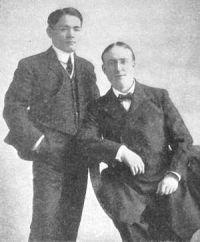 H. Irving Hancock,
The High School Pitcher; or, Dick & Co…
H. Irving Hancock,
The High School Pitcher; or, Dick & Co…
“ In the mornings I want every man, when it isn't raining, to go out and jog along the road, in running shoes and sweaters, for twenty minutes without a break; for thirty minutes, instead, on any morning when you can spare the time."Whenever you can do so, practice swift, short sprints. Many a nine, full of otherwise good men, loses a game or a season's record just because this important matter of speedy base running has been neglected. ”
Claude Harris Miller, Outdoor Sports and Games
“ The sprinting stroke is a direct glide ahead with the foot straight. A trained skater can go very long distances with very little fatigue but one must carefully measure his speed to the distance to be travelled. ”
Ed. James, Practical Training for Running…
“ A bad beginning makes a bad end, and nothing is so detrimental to a sprinter as a bad start. He may get shut out, he loses his stride, or perhaps get spiked by the man who has crossed him; and when he does get into proper swing, he is too far behind to be able to make up what was lost at the beginning. Avoid walking long distances; they rather tend to stiffen the muscles and make them slow. Never miss your race; if you can only get one spin daily, make the most of it. Always run in form—that is to say, as you would in the race, on your toes, with an easy, springing action of the thighs. ”
John Corbin, An American at Oxford
“ Though similar walks are sometimes given in America as a preliminary "seasoning," our training, for months before a meeting, is confined to the track. This is not unwise as long as a runner's stride needs developing; and in the heat of our summers such walks as the English take might sometimes prove exhausting. Yet my personal observations convinced me that for distance runners—and for sprinters, too, perhaps—the English method is far better. Under our training the muscles often seem overpowered by nervous lassitude; at the start of a race I have often felt it an effort to stand. ”
Various, The New Gresham Encyclopedia. Amiel to Atrauli
“ The 1⁄4 mile is the common ground for the sprinter and the middle-distance runner, and 48 seconds has been beaten on several occasions, although it may be said that anything inside 50 seconds is a first-class performance. ”
Burt L. Standish, Frank Merriwell's Endurance; or…
“ True it is running, but runners are divided into three classes—the sprinters, the middle-distance men, and the long-distance or cross-country men. Those adapted for the second class named, or who have won records or events in that class, find it more easy to become cross-country men than do those of the first class. ”
William Lindsey, At Start and Finish
“ You may boast of your fine horses and beautiful women, but give me an athlete in perfect training, particularly if I have had the handling of him, and have seen the fat disappear and the strong, clean muscle take its place.The boys are seated on the long benches or standing in front of the lockers. Here is the slender figure of a sprinter, not an ounce of superfluous flesh or unused muscle, the cords of his shapely legs standing out clear and firm through the satin skin. There is a [Pg 142] shot-putter, stopping a moment to chaff with a friend, stripped to the waist, his shirt in his hand. ”
The New Student's Reference Work (1914)
“ Track-Events are sports practiced on a circular path. They comprise running and hurdling. Running includes sprinting for 50, 100 or 440 yards and runs of 1⁄2, 1 and 2 miles. Hurdling is sprinting for 120 or 220 yards and leaping 10 hurdles, those of the longer course being 21⁄2 feet in height, those of the shorter course a foot higher. ”
1911 Encyclopædia Britannica (1911)
“ Starting in sprints has now become very expert. The old method of dropping a handkerchief was the worst possible way to give the starting signal, since the muscles react most slowly to impressions of sight, less so to those of touch, and most quickly to those of sound, a difference of 4⁄100 of a second in reaction amounting to over one foot in a run of 100 yds. ”
Ralph Henry Barbour,
The Purple Pennant
“ I mean by that don’t put all your strength into the going; save something for the last thirty yards or so. Then let yourself out! Remember that the hundred-yards is a hustle all the way, but the two-twenty is just a hundred and twenty yards longer and the fellow who tries to win in the first half of the race dies at the finish. Of course, it all comes by trying and learning. Experience brings judgment, and judgment is what a sprinter [256] has to have. ”
Donald Ferguson, The Chums of Scranton High on the Cinder Path
“ Scores were busily engaged in running around the cinder-path, taking the high jump, trying the hurdles, so as to perfect themselves against the coming Saturday when the wonderful event was to come off; sprinting for the short races of fifty, or a hundred yards; throwing the discus or the hammer, and numerous other lively doings. ”
G. Frederic Turner, Gloria (1910)
“ Imagine a track some six feet in width, formed of snow turned to ice by the process of constant watering, and so smooth and slippery that a burnished mirror would be rough and dull in comparison. Imagine this track inclined at a steep angle, walled in on both sides with low ice-banks, and trailing a long and sinuous course for a length of over a mile! Here we have the potentialities of speed when we remember that racing "bobs" are just low frameworks of wood whose steel runners glide over the polished track with as little friction as a flash of lightning traversing a thunder-cloud. ”
Graham B. Forbes, The boys of Columbia High in track athletics (1913)
“ Those who knew better saw that the good runners did not start at headlong pace. They held back in a bunch, and were saving their wind. In a run that covers five or ten miles it is the height of folly to make any effort at great speed at the start. By degrees experienced and knowing runners get into their stride, and in this fashion are able to finish strongly. ”
William Martin, The Book of Sports
“ The degree of velocity is acquired in proportion to the length and quickness of the steps. The person should therefore endeavour to ascertain whether long or short steps suit his muscular powers best; generally speaking [Pg 46] a moderately short step, quickly repeated, accelerates motion most. In learning to run, the pupil should first endeavour to improve his breath by degrees: he must try his speed first in short distances, to be gradually increased: the distance will vary according to the age and strength of the runner. ”
Donald Walker, Walker's manly exercises (1855)
“ As a general rule, however, it may as well be said here as elsewhere that, in brook-jumping, pace comes first and then judgment. With a powerful impetus you get over; should your horse blunder, somehow—if with a fall at the other side, no matter: less speed enables you to pick your ground better, but it throws all the odds on the side of a cold-bath, should the span be wider than you calculated on, or the bank be soft, and let you in. ”
