Suture (anatomy)

Definition and stakes

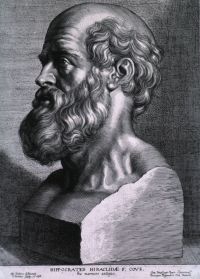
Portrait of Hippocrates Hippocrates,  The Genuine Works of Hippocrates… (1886)

“ I shall begin, then, with Aristotle, the contemporary of our author, who, in his work “On the History of Animals,” gives the following very inaccurate description of the sutures of the human skull: “The female cranium has one circular suture, but men generally three, which unite in one point. But a male skull has been seen not having a suture.” [747] Celsus describes the sutures in the following terms: “Ex ceteris, quo suturæ pauciores sunt, eo capitis valetudo commodior est. ”
Source: Gutenberg

Portrait of Hippocrates Hippocrates,  The Genuine Works of Hippocrates… (1886)

“ A suture appearing in a wound, when the bone is laid bare, on whatever part of the head the wound may have been inflicted, is the weakest point of the head to resist a blow or a weapon, when the weapon happens to be impinged into the suture itself; but more especially when this occurs in the bregma at the weakest part of the head, and the sutures happen to be situated near the wound, and the weapon has hit the sutures themselves. ”
Source: Gutenberg

Aleš Hrdlička,  A Bilateral Division of the Parietal Bone in a Chimpanzee…

“ Ranke [10] opposes both Gruber's and Putnam's opinion, and presents instead a theory somewhat vague and not satisfactorily demonstrated, by which he accounts for the origin of oblique sutures from partial horizontal sutures in the parietal bone through "half-pathological processes." In his words, "the oblique parietal suture is allied to the half-pathological conditions of the skull; it is wholly unjustifiable to speak, as W. Gruber has done, of a separate Parietale secundarium posterius, severed by the suture, as of a typical, in a certain sense normal, formation. ”
Source: Gutenberg

Get perspective with Kwize: daily news enlightened by great literature