“ The distinguished men waited there silent and uneasy. All round them stood the marvellous instruments by which the late Sir William Gouldesbrough had obtained a triumph unknown before in the history of the world.The yellow radiance of the electric light poured down upon the gleaming mahogany, brass, vulcanite and steel. ”
Quotes about “vulcanite”
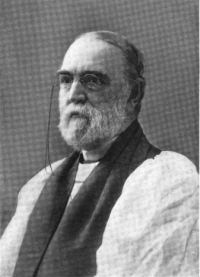 Thomas Augustus Jaggar,
My experiments with volcanoes
(1956)
Thomas Augustus Jaggar,
My experiments with volcanoes
(1956)
“ The tremendous accumulations of broken rocks over lava beds on the cone of Vesuvius, and on all the Caribbee Islands, recall the breccias, or volcanic conglomerates, of the Yellowstone and of the High Plateaus of Utah. Floods of basalt alternate with vast falls or outwashes of volcanic gravel. Avalanches, landslides, torrents, floods—call them what you will—cover immense areas of the Cordillera. Vesuvius and Pelée pile up cones, but the Caribbees and Italy are also heaped with agglomerates. Erosion destroys cones, but erosion makes agglomerations or valley fills of rocks and mud. ”
John H. Williams, The Guardians of the Columbia
“ Innumerable craters build cones of lava and scoriæ along the Cascade uptilt, and scatter clouds of volcanic ashes upon the steady sea winds, to blanket the country for hundreds of miles with deep layers of future soil.A reign of ice follows the era of tropic heat. Stupendous glaciers grind the volcanic rocks, and carving new valleys, endow them with fertility for new forests that will rise where once the palm forests stood. With advancing age, the earth grows cold and quiet, awakening only to an occasional volcanic eruption or earthquake as a reminder of former violence. ”
 Charles Darwin,
Volcanic Islands
Charles Darwin,
Volcanic Islands
“ As the later eruptions, however, from most volcanic mountains, burst through their basal parts, owing to the increased height and weight of the internal column of molten rock, we see why, in most cases, only the lower flanks of the central, trachytic masses, are enveloped by basaltic streams. The separation of the ingredients of a mass of lava, would, perhaps, sometimes take place within the body of a volcanic mountain, if lofty and of great dimensions, instead of within the underground focus ”
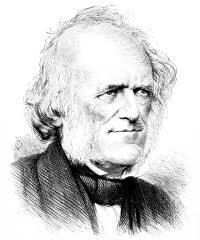 Sir Charles Lyell,
A Manual of Elementary Geology
Sir Charles Lyell,
A Manual of Elementary Geology
“ We know that in the Bay of Baiæ, in 1538, in Cutch in 1819, and on several occasions in Peru and Chili, since the commencement of the present century, the permanent upheaval or subsidence of land has been accompanied by the simultaneous emission of lava at one or more points in the same volcanic region. From these and other examples it may be inferred that the rising or sinking of the earth's crust, operations by which sea is converted into land, and land into sea, are a part only of the consequences of subterranean igneous action. ”
 John Smith Flett,
1911 Encyclopædia Britannica
(1911)
John Smith Flett,
1911 Encyclopædia Britannica
(1911)
“ The volcanic rocks, found typically as lava flows, include rhyolite and obsidian (with sometimes perlite) , trachyte and phonolite (and leucitophyre which is treated under leucite) , andesite and dacite, basalt (with the related dolerite, variolite and tachylyte) , nephelinite and tephrite. Among sedimentary rocks we recognize a volcanic group (including tuff, agglomerate and some kinds of pumice) , an arenaceous series such as sand (some with glauconite) , sandstone, quartzite, greywacke and gravel; an argillaceous group including clay, firebrick, phyllite, laterite shale and slate ”
Thomas Augustus Jaggar,
My experiments with volcanoes
(1956)
“ Professional geology is largely continental because its field work has been on continents. My work has been oceanic; my field, seventy percent of the earth’s surface, extending over a thick crust down to the earth core. The earth core is fluid and massive and hot, as all geology agrees. Isostasy, which postulates a thin flexible shell, is violated by the ocean deeps and the volcanic ridges. Volcanic rift echelons like the Cordillera and the Hawaiian ridge are too long to be generated as the fracture of a crust fifty miles deep. ”
Edward Hull, Volcanoes: Past and Present
“ Volcanic phenomena are the outward manifestations of forces deep-seated beneath the crust of the globe; and in seeking for the causes of such phenomena we must be guided by observation of their nature and mode of action. The universality of these phenomena all over the surface of our globe, in past or present times, indicates the existence of a general cause beneath the crust. It is true that there are to be found large tracts from which volcanic rocks (except those of great geological antiquity) are absent, such as Central Russia, the Nubian Desert, and the Central States of North America ”
J. H. Kerry-Nicholls, The King Country; or, Explorations in New Zealand
“ The heated, quaking soil was covered with thick deposits of silica, sulphur, oxide of iron, pumice, obsidian, scoria, and other volcanic products, and, with its sulphurous atmosphere, fierce heat, and shrieking sounds, it appeared as we entered it like a short cut to Pandemonium. The high hills on each side of the gorge rose up in quaint, fantastic shape, and their rugged sides, composed of shattered volcanic rock, sent forth water and jets of steam from a thousand fissures. ”
Sir Charles Lyell,
A Manual of Elementary Geology
“ We must remember, also, that piles of volcanic matter, like the Plomb du Cantal, which rises in the immediate neighbourhood of Aurillac, are themselves equally the result of successive accumulation, consisting of reiterated sheets of lava, showers of scoriæ, and ejected fragments of rock.—Lastly, we must not forget that continents and mountain-chains, colossal as are their dimensions, are nothing more than an assemblage of many such igneous and aqueous groups, formed in succession during an indefinite lapse of ages, and superimposed upon each other. ”
H. N. Hutchinson, The Story of the Hills: A Book About Mountains for General Readers
“ Some highly heated rocks, though they never rise to the surface to form lava-flows, are forced up with overwhelming pressure from below, and wedge themselves into 155 the sedimentary rocks that overlie them, thus forming what are known as volcanic dykes, and intrusive masses or sheets of once molten rock. In this category we include such rocks as basalt, felstone, pitchstone, and other rocks of fiery origin that have flowed from volcanoes as lava, as well as those like granite, which have cooled and become solid below the surface, and are Plutonic, or deep-seated, igneous rocks. ”
 Albert S. Evans,
A La California
(1873)
Albert S. Evans,
A La California
(1873)
“ Evidences of remote volcanic action abound in the vicinity, the whole surface of the ground being composed, in fact, of tufa, ashes, and coarse, broken sandstone, mixed with metamorphic rock, ascribed to the cretaceous age, and indicating disturbance by severe earthquakes or volcanic convulsions of a comparatively recent date. None of the trees are perfect—only the trunks and main roots appearing to have been petrified—and all are lying flat upon the ground, or half buried in it, scattered and broken, as if blown down by a sudden gale or whirlwind. ”
Sir Charles Lyell,
A Manual of Elementary Geology
“ Test of age by organic remains.—We have seen how, in the vicinity of active volcanos, scoriæ, pumice, fine sand, and fragments of rock are thrown up into the air, and then showered down upon the land, or into neighbouring lakes or seas. In the tuffs so formed shells, corals, or any other durable organic bodies which may happen to be strewed over the bottom of a lake or sea will be imbedded, and thus continue as permanent memorials of the geological period when the volcanic eruption occurred. ”
Sir Charles Lyell,
A Manual of Elementary Geology
“ From this hypothesis of the great depth at which the granites originated, has been derived the name of "Plutonic rocks." The beginner will easily conceive that the influence of subterranean heat may extend downwards from the crater of every active volcano to a great depth below, perhaps several miles or leagues, and the effects which are produced deep in the bowels of the earth may, or rather must be, distinct; so that volcanic and plutonic rocks, each different in texture, and sometimes even in composition, may originate simultaneously, the one at the surface, the other far beneath it. ”
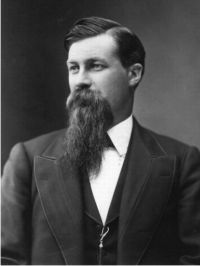 Thomas C. Chamberlin,
Geology
(1906)
Thomas C. Chamberlin,
Geology
(1906)
“ Diastrophism, then, as it affects the ocean-bottoms and the ocean-borders, may make the water of any ocean shallower or deeper; it may cause the emergence or submergence of land; it may make coast-lines regular or irregular; it may shift the habitat of life, and through these changes may greatly influence the processes of gradation, which are especially active along the contact of sea and land.Vulcanism affects the sea-bottom much as it affects the land. At the volcanic centers, where the great body of extruded matter accumulates, mounds and mountains are built up. ”
“ After thousands of years, the great cone is stripped away to expose the hardened “volcanic plug” in the conduit. During this period of inactivity, streams broaden their valleys and dissect the lava plateau to form isolated lava-capped mesas. d. Continued erosion removes all traces of the cone and the land is worn down to a surface of low relief. All that remains is a projecting plug or “volcanic neck,” a small lava-capped mesa, and vestiges of the once lofty volcano and its surrounding lava plateau. ”
Viscount James Bryce Bryce, South America: Observations and Impressions
“ It is like traversing the interior of an extinct volcano, for the rocks are all volcanic, of different ages and different colours, black and grey lavas, yellow and pink and whitish and bluish beds of tufa and indurated ash, sometimes with long streaks of gravel or dark sand streaming down from the base of the precipices above. At one place there is seen just under such a precipice, a row of sharp black pinnacles, not unlike miniature aiguilles, apparently the remains of a lava bed that has disintegrated, leaving its harder parts to stand erect. ”
 Archibald Geikie,
The Story of a Boulder; or, Gleanings from the Note-book of a Field Geologist
Archibald Geikie,
The Story of a Boulder; or, Gleanings from the Note-book of a Field Geologist
“ Settling down among the mud and sand at the bottom, the volcanic matter accumulated in wide horizontal beds, every marked inequality being smoothed down by the currents until a series of regularly stratified layers came to be formed, entombing any organisms that might find their way to the bottom or be lying there at the time. The ash of terrestrial volcanoes has no marked stratification because thrown out in open air, while that of the carboniferous rocks of central Scotland is distinctly bedded from having been deposited under water. ”
John W. Judd, Volcanoes: What They are and What They Teach (1881)
“ No one who has carefully studied the appearances presented by volcanic mountains in different stages of dissection, by the action of denuding forces, can avoid recognising these great granitic masses as the cooled reservoirs from which volcanoes have in all probability been supplied during earlier periods of the earth's history.The eruption of these great masses of incandescent rock, impregnated with water and acid gases, through strata of limestone, sandstone, clay, coal, &c., may be expected to produce striking and wonderful chemical changes in the latter. ”
Julia Ellen Rogers, Earth and Sky Every Child Should Know
“ Rainier are peaks built up by the materials thrown out of the craters of volcanoes dead these thousands of years. Vesuvius is at present showing us how volcanic mountains are made. Each eruption builds larger the cone—that is, the chimney through which the molten rocks, the ashes, and the steam are ejected. Side craters may open, the main cone be broken and its form changed, but the mass of lava and stones and ashes grows with each eruption. The mountain grows by the additions it receives. ”
John W. Judd, Volcanoes: What They are and What They Teach (1881)
“ To these deeper parts of the ocean no sediments carried down by the rivers are borne, and the remains of calcareous - 74 - organisms are, in these abysses, soon dissolved; under such conditions, therefore, almost the only material accumulating on the sea bottom is the ubiquitous wind- and wave-borne volcanic products. These particles of volcanic dust and fragments of pumice by their disintegration give rise to a clayey material, and the oxidation of the magnetite, which all lavas contain, communicates to the mass a reddish tint. ”
Thomas Augustus Jaggar,
My experiments with volcanoes
(1956)
“ How do deep earthquakes stem from friction 300 miles down under the Cordillera and the west Pacific? Do earth and moon spheres as rounded tetrahedra crack similarly? Because of rotation are north-south cracks dominant? Are the core fluids changing volcanism through the ages?The twenty-eight percent of earth surface which lies above the sea in continents is made up of siliceous sediments of shallow water basins, with quartz as the dominant mineral, their strata wrinkled, and eroded into mountain ranges. Desert and lake or river bottoms make up most of the remainder. ”
Steven R. Brantley, Volcanoes of the United States
“ The Earth’s crust, on which we live and depend, is in large part the product of millions of once-active volcanoes and tremendous volumes of magma (molten rock below ground) that did not erupt but instead cooled below the surface. Such persistent and widespread volcanism has resulted in many valuable natural resources throughout the world. For example, volcanic ash blown over thousands of square kilometers of land increases soil fertility for forests and agriculture by adding nutrients and acting as a mulch. ”
Sir Charles Lyell,
Principles of Geology
“ We see, therefore, an evident connection, first, between the bursting forth every now and then of volcanic matter through rents and fissures, and the expansion or forcing outwards of the earth's crust, and, secondly, between a dormant and less energetic development of subterranean heat, and an amount of subsidence sufficiently great to cause mountains to disappear over the broad face of the ocean, leaving only small and scattered lagoon islands, or groups of atolls, to indicate the spots where those mountains once stood. ”
Luigi Palmieri, The Eruption of Vesuvius in 1872
“ To the popular mind, Volcanoes and Earthquakes are only isolated items of curiosity amongst "the wonders of the world:" few geologists even appear to realise how great and important are the relations of Vulcanicity to their science, viewed as a whole. Yet of Vulcanicity it is not too much to say, that in proportion as its nature and doctrines come to be known and understood as parts of the Cosmos, the nearer will it be seen to lie at the basis of all Physical Geology. ”
H. N. Hutchinson, The Story of the Hills: A Book About Mountains for General Readers
“ The building up of a volcano may be fairly illustrated by the little cone of sand formed in an hourglass as the sand-grains fall. These settle down at a certain slope, or angle, at which they can remain, instead of falling down to the bottom, as they do directly this slope is exceeded. Some volcanoes are built up almost entirely of volcanic ash and its embedded blocks. Vesuvius, Teneriffe, Jorullo, in Mexico, and Cotopaxi, in the Andes, are examples of steep volcanic cones built up in this way. Others, less steep and more irregular in shape, are chiefly formed of successive lava-flows. ”
John W. Judd, Volcanoes: What They are and What They Teach (1881)
“ When we examine with due care the lavas, tuffs, and other volcanic ejections which constitute such mountain-masses as those of the Hebrides, of the Auvergne, and of Hungary, we find clear proofs that the ancient Miocene volcanoes of these districts were clothed with luxuriant forests, through which wild animals roamed in the greatest abundance. The intervals between the ejections of successive lava-streams were often so great, that soils were formed on the mountain-slope, and streams cut deep ravines and valleys in them. ”
 H. F. B. Lynch,
Armenia, Travels and Studies (Volume 2 of 2…
H. F. B. Lynch,
Armenia, Travels and Studies (Volume 2 of 2…
“ As you travel from plain to plain, from one basin to another, the horizon is most often filled by some shapely volcanic outline, slowly rising from the floor of the expanse. Yet the stratified rocks are seldom absent, emerging from the volcanic layers or only capped by a thin sheet of lava. Dominant among them are the limestones of various geological periods, from the Cretaceous and probably earlier, to the Pliocene deposits, when the greater part of the country must have been covered by a lake of fresh or brackish water. ”
Steven R. Brantley, Volcanoes of the United States
“ Young volcanoes, lava flows, and hot springs were discovered in a broad valley less than 8 km wide along the crest of the ridge in the 1970’s. The ocean floor is spreading apart and forming new ocean crust along this valley or “rift” as hot magma from the Earth’s interior is injected into the ridge and erupted at its top. ”
