“ Light-and-shade is a term referring to modelling or imitation of solidity; the study of it by drawing white casts and still life tends to put attention upon facts rather than upon experience in structure. It does not help one to appreciate tone-values in pictures. Such drawing is worth while as pure representation and the discipline of it contributes to mastery of technique, but it is absurd to prescribe this or life drawing as a training for the landscape painter. Its influence is only indirect, for modeling is of secondary importance in Painting, the art of two dimensions. ”
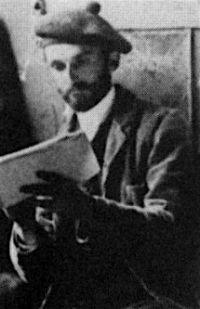
Arthur W. Dow
Biographical details

Arthur Wesley Dow (1857–1922) was an influential American painter, photographer, and educator whose work bridged Eastern and Western artistic traditions. Deeply inspired by Japanese ukiyo-e prints, he redefined artistic composition through principles of line, form, and hue, emphasizing creative expression over mere replication. As a pioneering educator, Dow’s seminal text Composition (1920) reshaped art pedagogy, advocating for structured exercises in design and encouraging personal interpretation of visual components.
His teachings at institutions like Columbia University and the Pratt Institute left an indelible mark on figures such as Georgia O’Keeffe and Frank Lloyd Wright, while his integration of Japanese aesthetics into Western art practices continues to echo in contemporary design and education. Dow’s legacy lies in his transformative approach to art as a universal language of self-expression, fundamentally altering how creativity is taught and understood.
Quotes by Arthur W. Dow
“ From the rude patterns marked with sticks on Indian bowls and pots, or painted in earth colors on wigwam and belt, or woven on blanket, this form of space art has grown, through the complexities of Egyptian and Peruvian textile design to the splendor of Byzantine mosaic, the jewel patterns of the Moguls, and Gothic sculpture ”
“ As fine relations (that is, harmony, beauty) can be understood only through the appreciations, the whole fabric of art education should be based upon a training in appreciation. This power cannot the imparted like information. Artistic skill cannot be given by dictation or acquired by reading. It does not come by merely learning to draw, by imitating nature, or by any process of storing the mind with facts. ”
“ The personal choice of proportions, tones and colors stamps the work with individuality. A master in art is always intensely individual, and what he does is an expression of his own peculiar choices.The beauty of proportion in your rectangle is measured by your feeling for fine relations, not by any formula what ever. No work has art-value unless it reflects the personality of its author, What everybody can do easily, or by rule, cannot be art.The study of Variation tends to lead the mind away from the conventional and humdrum, toward original and individual expression. ”
“ This approach to art through Structure is absolutely opposed to the time-honored approach through Imitation. For a great while we have been teaching art through imitation—of nature and the “historic styles”—leaving structure to take care of itself; gathering [pg 4] knowledge of facts but acquiring little power to use them. This is why so much modern painting is but picture-writing; only story-telling, not art; and so much architecture and decoration only dead copies of conventional motives. Good drawing results from trained judgment, not from the making of fac-similes or maps. ”
“ In a mural painting extreme roundness is a fatal defect, as illustrated in the Pantheon at Paris, where Puvis de Chavannes and his contemporaries have put pictorial designs upon the walls. Puvis created a mosaic of colored spaces intended to beautify the wall; charm of color and tone, poetry and illusion of landscape possess the beholder long before he even thinks of the special subjects. ”
“ Practice in composing with few and simple elements, of deciding when contrasting colors are of equal value, or equal intensity, is of direct use in art. The landscape painter opposes the whole sky to the whole ground; he wants a vibration of color in each, without disturbing the values; the designer in stained glass sometimes desires to fill a space with iridescent color, perhaps as a background for figures. ”
“ Another reason for drawing is found in the use of the shapes or hues in design. Desire to express an idea awakens interest in the means. Observation is keen, close application is an easy task, every sense is alert to accomplish the undertaking. This is quite different from drawing anything and everything for practice only.Mere accuracy has no art-value whatever. Some of the most pathetic things in the world are the pictures or statues whose only virtue is accuracy. The bare truth may be a deadly commonplace. ”
“ INK PAINTING Supreme excellence in the use of ink was attained by the Chinese and Japanese masters. Impressionism is by no means a modern art (except as to color-vibrations) for suggestiveness was highly prized in China a thousand years ago. The painter expected the beholder to create with him, in a sense, therefore he put upon paper the fewest possible lines and tones; just enough to cause form, texture and effect to be felt. Every brush-touch must be full-charged with meaning, and useless detail eliminated. ”
“ The study of “light and shade” has for its aim, not the creation of a beautiful idea in terms of contrasting masses of light and dark, but merely the accurate rendering of certain facts of nature,—hence is a scientific rather than an artistic exercise. The pupil who begins in this way will be embarrassed in advanced work by lack of experience in arranging and differentiating tones. Worse than that, it tends to cut him off from the appreciation of one whole class of great works of art. ”
“ Design, understood in its broad sense, is a better word, but popular usage has restricted it to decoration.Composition, building up of harmony, is the fundamental process in all the fine arts. I hold that art should be approached through composition rather than through imitative drawing. The many different acts and processes combined in a work of art may be attacked and mastered one by one, and thereby a power gained to handle them unconsciously when they must be used together. If a few elements can be united harmoniously, a step has been taken toward further creation. ”
“ COMPOSITION XVII.—IN DESIGN AND PAINTING The test of any system of art-study lies in what you can do with it. Harmony-building has been the theme of the foregoing pages, with progressive exercises in structural line, dark-and-light and color. The product should be power,—power to appreciate, power to do something worth while. Practice in simple harmonies gives control of the more complex relations, and enables one to create with freedom in any field of art. Such training is the best foundation for work in design, architecture, the crafts, painting, sculpture and teaching. ”
“ The nature-imitators hold that accurate representation is a virtue of highest order and to be attained in the beginning. It is undeniably serviceable, but to start with it is to begin at the wrong end. It is not the province of the landscape painter, for example, to represent so much topography, but to express an emotion; and this he must do by art. His art will be manifest in his composition; in his placing of his trees, hills and houses in synthetic relations to each other and to the space-boundary. ”
“ Nature's lessons could be learned by bringing the soul to her, and letting it behold itself as in a mirror; the teaching could be passed on to others by means of art—mainly the art of landscape painting. Religious emotion was the spring of art-power in the East, as it was in the West. Landscape painting as religious art, has its parallel in Greek and Gothic sculpture, in Italian painting of the world-story, of the Nativity, the Passion, and the joys of heaven. ”
“ The designer and picture-painter start in the same way. Each has before him a blank space on which he sketches out the main lines of his composition. This may be called his Line-idea, and on it hinges the excellence of the whole, for no delicacy of tone, or harmony of color can remedy a bad proportion. A picture, then, may be said to be in its beginning actually a pattern of lines. Could the art student have this fact in view at the outset, it would save him much time and anxiety. Nature will not teach him composition. ”
“ The most important fact about a great creative work is that it is beautiful; and the best way to see this is to study the art-structure of it,—the way it is built up as Line, Notan, Color,—the principle of composition which it exemplifies. ”
“ Color, with its infinity of relations, is baffling; its finer harmonies, like those of music, can be grasped by the appreciations only, not by reasoning or analysis. Color, in art, is a subject not well understood as yet, and there are violent differences of opinion among artists, teachers and critics, as to what constitutes good color-instruction. ”
“ EXAMPLES OF RECTANGULAR DESIGN. Contact with the best works of art is an essential part of art education, for from them comes power and the stimulus to create. The student hears and reads much that passes for art criticism but is only talk about the subject of a picture, the derivation and meaning of a design, or the accuracy of a drawing. These minor points have their place in discussing the literary and scientific sides of a masterpiece; they relate to art only superficially, and give no key to the perception of fine quality. ”
“ The best painting has form and character in every brush-touch.OIL COLOR. Instruction in oil painting is usually limited to what might be called drawing in paint. Of course the student must know his pigments, how to obtain hues and values by mixing, how to use brushes, how to sketch in, and all the elementary details,—but this is but a beginning. Expression of an idea or emotion depends upon appreciation of art structure; the point is not so much [pg 128] how to paint, as how to paint well. Artists often say that it matters not how you get an effect, if you only get it. ”
“ Such an exercise leads to the appreciation of landscape pictures, and is an introduction to pencil and charcoal sketching from nature, to monotypes and etching.Notan in landscape, a harmony of tone-relations, must not be mistaken for light-and-shadow which is only one effect or accident. Like all other facts of external nature, light-and-shadow must be expressed in art-form. The student under the spell of the academic dictum “Paint what you see and as you see it” feels that he must put down every accidental shadow “just as it is in nature” or be false to himself and false to art. ”
“ Those gifted with little aesthetic perception may go far astray in following the two-tone idea. It is very easy and somewhat fascinating to darken parts of designs with black ink. The late poster craze showed to what depth of vulgarity this can be carried. The pupil must be taught that all two-tone arrangements are not fine, and that the very purpose of this exercise is so to develop his appreciation that he may be able to tell the difference between the good, the commonplace, and the ugly. His only guides must be his own innate taste, and his instructor's experience. ”
“ The great general principle of Proportion needs no special illustration or exercise, because it is so intimate a part of all other principles and exercises. It may be studied in every example of supreme art. It is the foundation of all the finest work in line and mass. The mystery of Spacing will be revealed to the mind that has developed Appreciation. [pg 29] SYMMETRY. The most common and obvious way of satisfying the desire for order is to place two equal lines or shapes in exact balance, as in a gable, windows each side of a door, or objects on a shelf. ”
“ But Japanese art comes to the aid of the student of composition with abundant material—sketch books, design books, drawings and color prints. The learner should seek for genuine works of the best periods, avoiding modern bad reproductions, imitations, carelessly re-cut blocks, crude colors, and all the hasty and commonplace stuff prepared by dealers for the foreign market.The Japanese knew no division into Representative and Decorative; they thought of painting as the art of two dimensions, the art of rhythm and harmony, in which modelling and nature-imitation are subordinate. ”
“ Put together all the good points in such a method, and you have the qualities of the highest art; for what more do we require of the master than simplicity, unity, powerful handling, and that mysterious force that lays hold upon the imagination. ”
“ The stone-cutter was an artist as long as his restraint was self-imposed—as long as he held to unity of the whole composition and kept details in their own place—as long as he carved harmonies, not mere stories ”
“ Experience and appreciation are after all the only safeguards.APPLICATION. Having made the copy of the color-scheme, apply the same colors to several tracings of one design, (No. 67) . One of the things taught by this exercise is that distribution and proportion of color affect harmonic relations. Colors that harmonize as they stand in the print may seem discordant when used in different quantities; they will surely be so if the design is badly spaced. With a good design, and correct judgment as to hue, notan and intensity, the chances are that each variation will be satisfactory. ”
“ The usual advice of the academic painter to “keep trying,” is discouraging to the beginner and increases his confusion; it is not in accord with good sense either, for the other arts are not attacked through timid and aimless experiment. An artist may say that a certain group of colors is a harmony; the pupil cannot see it, but he takes the master's word for it. The artist is not teaching successfully unless he points the way to appreciation, however hard or long it may be.A systematic study of line and tone is very profitable, as we have seen ”
“ Methods of handling oil color may be reduced to two general classes: (a) the paint is used thin, as a wash, on a prepared canvas, or (b) it is put on in thick opaque touches. In either case the aim is the same—to paint for depth, vibration, illusion of light and color. If brush strokes are to be left intact, each of them must have shape and meaning,—that is, line; if color is put on in a thin wash, then its value, gradation, hue and texture are the main points,—and these belong to structural harmony. Mural painting is the highest form of the art, demanding perfect mastery of Composition. ”
“ The Orientals rarely represent shadows; they seem to regard them as of slight interest—mere fleeting effects or accidents. They prefer to model by line rather than by shading. They recognize notan as a vital and distinct element of the art of painting.The Buddhist priest-painters of the Zen sect discarded color, and for ages painted in ink, so mastering tone-relations as to attract the admiration and profoundly influence the art of the western world. ”
“ Increase of power always comes with exercise. If one uses a little of his appreciative faculty in simple ways, proceeding on gradually to the more difficult problems, he is in the line of natural growth. To put together a few straight lines, creating a harmony of movement and spacing, calls for exercise of good judgment and appreciation. ”
“ Art-language must be in art-form; a number of facts, or an incident, accurately described in paint and color may have no more connection with art than a similar set of written statements just plain prose. There is no art unless the statements are bound together in certain subtle relations which we call beauty. When beauty enters, the parts cease to have separate existence, but are melted together in a unit.Advanced composition is only a working out of simple elements into more complex and difficult interrelations. ”
“ Study the work of the best illustrators, noting the tone-scheme and the placing upon the page. ETCHING Etching, pen drawing and pencil sketching are line-arts. The needle, pen and lead pencil are tools for drawing lines, and there is much reason in Whistler's contention that tone and shading should not be attempted with them. The tool always gives character to work, and the best results are obtained when the possibilities of tools and materials are fully appreciated. If a sharp point is used in drawing, it will produce pure line, whose quality may reach any degree of excellence. ”
“ EXERCISE Choose a textile, or any design with a variety of spaces, and try notan-effects with tones from the scale. The object is to discover a fine notan-scheme of values, and by using the scale one is assured of definite intervals. If the notes are mixed in quantity, they may be tried upon a half-dozen tracings at once, from which the best should be chosen. Remember that the scale-work is only an exercise to help toward clarity of tone, and to encourage invention. ”
“ PROPORTION or GOOD SPACING. Principles of Composition, I must repeat, are only ways of arranging lines and shapes; art is not produced by them unless they are used in combination with this general principle,—Good Spacing. They are by no means recipes for art, and their names are of little consequence. Appreciation of fineness of relations must always govern the method and form of composition. It is possible to use all the principles here discussed, and to complete all the exercises, without gaining much, if any, art experience. ”
“ Well-ordered thought is as necessary in art as in any other field. Theory is a help to clear thinking and gives direction and purpose to practice. Color, however complicated, may be reduced to three simple elements: Color harmony depends upon adjustments in this three-fold nature. If a color-scheme is discordant, the fault may [pg 101] be discovered in,—wrong selection of hues or weak values, or ill-matched intensities, or all three. This simple classification reduces the perplexities that beset the student, by showing him where to look for the cause of failure. ”
“ On the other hand the artist is not subject to restrictions and fixed laws. He cannot allow even a master to interfere with his freedom; there is no “thou shalt” and “thou shalt not” in art. Admitting the value of all the arguments for restricting the use of the needle to line only, the artist observes that clustering of lines inevitably produces tone and suggests massing (notan of line, page 54) that this effect is developed in rich gradations by wiping the etching-plate in the process of printing. ”
“ Following this thought of the oneness of art, we find that the picture, the plan, and the pattern are alike in the sense that each is a group of synthetically related spaces. Abstract design is, as it were, the primer of painting, in which principles of Composition appear in a clear and definite form. In the picture they are not so obvious, being found in complex interrelations and concealed under detail. ”
“ Never try to erase an ink line,—if a mistake occurs begin again. Tracing, for the art-purpose of improving proportions and acquiring an expressive brush-touch, is a most valuable help to the production of good work. Architects use tracing-paper for changes in plans. Japanese artists trace again and again until satisfied with the quality of touch and strength of drawing. Straight line is chosen for elementary practice because of its simplicity, and because it prepares for work with curves. ”
“ Many line compositions can be derived from one flower subject, but each of these can in turn be made the source of a great variety of designs by carrying the exercise farther, into the field of Dark-and-Light. Paint certain of the areas black, and at once a whole new series suggests itself, from a single line design. To the beauty of the line is added the beauty of opposing and intermingling masses of black and white ”
“ The scientific mind has sought, by analysis of many masterpieces, to discover a set of perfect proportions, and to reduce them to mathematical form, for example, 3:5, or 4:7. The secret of spacing in Greek art has been looked for in the “golden mean”, viz: height is to length as length is to the sum of height and length. Doubtless such formulae were useful for ordinary work, but the finest things were certainly the product of feeling and trained judgment, not of mathematics. Art resists everything that interferes with free choice and personal decision; art knows no limits. ”
