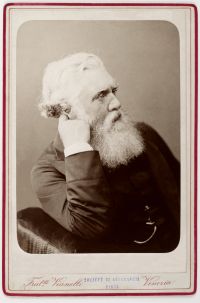
Austen Henry Layard

Biographical details

Portrait of Austen Henry Layard Austen Henry Layard,  Once a Week (1860)

“ In the representation of the human form, the sculptor, inspired by the exquisite beauty of the substance with which he had to deal, has been singularly happy. What could be more delicate and lovely than tie bosom of the sleeping girl, which seems to be warm with life itself; more truthful than the brawny and muscular frame of the man of labour; or more graceful and free than the form of the agile youth? The artist has dealt lovingly with a material the delicious softness and transparency of whose texture delights the eye and invites the touch. ”
Source: Wikisource

Portrait of Austen Henry Layard Austen Henry Layard,  Discoveries Among the Ruins of Nineveh and Babylon

“ At the north-western corner rose the great tower, the tomb of the founder of the principal palace. Its basement was encased with massive masonry of stone, relieved by recesses and other architectural ornaments. The upper part built of brick, was most probably painted, like the palaces of Babylon, with figures and mythic emblems. Its summit, I conjecture, to have consisted of several receding gradines like the top of the black obelisk, and I would venture to crown it with an altar on which may have burnt the eternal fire. Adjoining this tower were, two small temples, dedicated to Assyrian gods. ”
Source: Gutenberg

Portrait of Austen Henry Layard Austen Henry Layard,  Discoveries Among the Ruins of Nineveh and Babylon

“ The road from Baghdad to Hillah crosses, near the village of Mohawill, a wide and deep canal still carrying water to distant gardens. On the southern bank of this artificial stream is a line of earthen ramparts, which are generally believed to be the most northern remains of the ancient city of Babylon. From their summit the traveller scans a boundless plain, through which winds the Euphrates, with its dark belt of evergreen palms. Rising in the distance, high above all surrounding objects, is the one square mound, in form and size more like a natural hill than the work of men’s hands. ”
Source: Gutenberg

Get perspective with Kwize: daily news enlightened by great literature