Summary

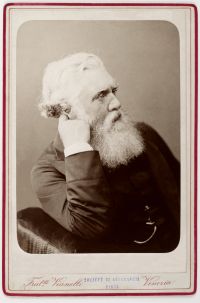
Portrait of Austen Henry Layard Austen Henry Layard Discoveries Among the Ruins of Nineveh and Babylon

The road from Baghdad to Hillah crosses, near the village of Mohawill, a wide and deep canal still carrying water to distant gardens. On the southern bank of this artificial stream is a line of earthen ramparts, which are generally believed to be the most northern remains of the ancient city of Babylon. From their summit the traveller scans a boundless plain, through which winds the Euphrates, with its dark belt of evergreen palms. Rising in the distance, high above all surrounding objects, is the one square mound, in form and size more like a natural hill than the work of men’s hands.
Source: Gutenberg

Portrait of Austen Henry Layard Austen Henry Layard Discoveries Among the Ruins of Nineveh and Babylon

Then as we ascend an eminence midway, walls, towers, minarets, and domes rise boldly from the margin of the broad river, cheating us into the belief, too soon to be dispelled, that Mosul is still a not unworthy representative of the great Nineveh. As we draw near, the long line of lofty mounds, the only remains of mighty bulwarks and spacious gates, detach themselves from the low undulating hills; now the vast mound of Kouyunjik overtops the surrounding heaps: then above it peers the white cone of the tomb of the prophet Jonah; many other well-remembered spots follow in rapid succession
Source: Gutenberg

Portrait of Austen Henry Layard Austen Henry Layard Discoveries Among the Ruins of Nineveh and Babylon

Eight hours’ ride from Amikh brought me to the large Armenian convent of Yedi Klissia, or the seven churches, built of substantial stone masonry, and inclosing a spacious courtyard planted with trees. It has more the appearance of a caravanserai than that of a place of religious retreat, and is beautifully situated near the mouth of a wooded ravine, half-way up a bold mountain, which ends in snowy peaks. Spread beneath it is a blue lake and a smiling plain, and the city, with its bold castellated rock, and its turreted walls half hid in gardens and orchards.
Source: Gutenberg

Get perspective with Kwize: daily news enlightened by great literature