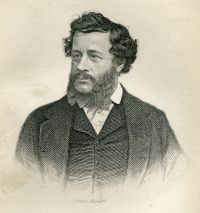
Charles Elmé Francatelli

Biographical details

Portrait of Charles Elmé Francatelli Charles Elmé Francatelli A Plain Cookery Book for the Working Classes

Put a dozen sage leaves into a tea-pot, pour boiling water upon them, and, after allowing the tea to stand for five or ten minutes, it may be drunk with sugar and milk, in the same way and instead of the cheaper kinds of teas, which are sold for foreign teas, but which are too often composed of some kind of leaf more or less resembling the real plant, without any of its genuine fragrance, and are, from their spurious and almost poisonous nature, calculated to produce evil to all who consume them, besides the drawback of their being expensive articles.
Source: Gutenberg

Portrait of Charles Elmé Francatelli Charles Elmé Francatelli A Plain Cookery Book for the Working Classes

The cheapest pieces of beef, suitable for baking or roasting, consist of the thick part of the ribs, cut from towards the shoulder, the mouse buttock and gravy pieces, and also what is commonly called the chuck of beef, which consists of the throat boned and tied up with string in the form of a small round. Whichever piece of beef you may happen to buy, it should be well sprinkled over with pepper, salt, and flour, and placed upon a small iron trivet in a baking dish containing peeled potatoes and about half-a-pint of water, and either baked in your own oven or else sent to the baker's.
Source: Gutenberg

Portrait of Charles Elmé Francatelli Charles Elmé Francatelli A Plain Cookery Book for the Working Classes

An ox-cheek is always to be bought cheap; let it be thoroughly washed in several waters, place it whole in a three gallon boiling-pot filled up with water, and set it to boil on the fire; skim it well, season with carrots, turnips, onions, celery, allspice, pepper, and salt; and allow the whole to boil very gently by the side of the hob for about three hours and a-half, by which time the ox-cheek, etc., will be done quite tender; the cheek must then be taken out on to a dish, the meat removed from the bone, and after being cut up in pieces, put back into the soup again.
Source: Gutenberg

Get perspective with Kwize: daily news enlightened by great literature