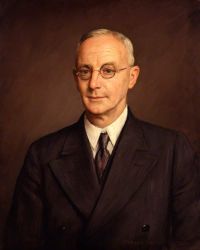
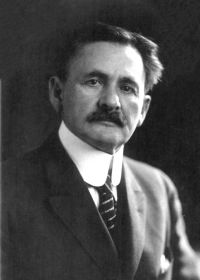
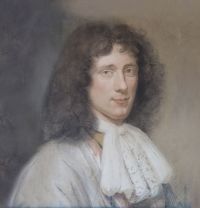
Charles Everitt, Hendrik A. Lorentz and Simon Newcomb

Biographical details

Charles Everitt, Hendrik A. Lorentz and Simon Newcomb 1911 Encyclopædia Britannica, Volume 16… (1911)

Rarely has it been given to one man to promote an entirely new theory or to devise an original instrument; it is more generally the case that, in the evolution of a single idea, there comes some stage which arrests our attention, and to which we assign the dignity of an “invention.” Furthermore, the obscurity that surrounds the early history of spectacles, the magic lantern, the telescope and the microscope, may find a partial solution in the spirit of the middle ages.
Source: Wikisource

Charles Everitt, Hendrik A. Lorentz and Simon Newcomb 1911 Encyclopædia Britannica, Volume 16… (1911)

New Hypotheses in the Corpuscular Theory.—The preceding explanation of reflection and refraction is open to a very serious objection. If the particles in a beam of light all moved with the same velocity and were acted on by the same forces, they all ought to follow exactly the same path. In order to understand that part of the incident light is reflected and part of it transmitted, Newton imagined that each corpuscle undergoes certain alternating changes; he assumed that in some of its different “phases” it is more apt to be reflected, and in others more apt to be transmitted.
Source: Wikisource

Charles Everitt, Hendrik A. Lorentz and Simon Newcomb 1911 Encyclopædia Britannica, Volume 16… (1911)

General Considerations on the Propagation of Waves.—“Waves,” i.e. local disturbances of equilibrium travelling onward with a certain speed, can exist in a large variety of systems. In a theory of these phenomena, the state of things at a definite point may in general be defined by a certain directed or vector quantity P, [10] which is zero in the state of equilibrium, and may be called the disturbance (for example, the velocity of the air in the case of sound vibrations, or the displacement of the particles of an elastic body from their positions of equilibrium) .
Source: Wikisource

Get perspective with Kwize: daily news enlightened by great literature