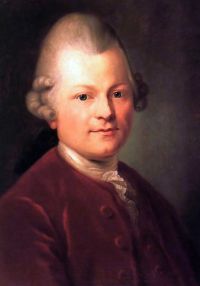
Johann Joachim Winckelmann

Biographical details

Portrait of Johann Joachim Winckelmann Johann Joachim Winckelmann Reflections on the painting and sculpture of the Greeks

VII. Even those motions of the soul, which otherwise seem opposite to each other, mingle here with peaceful harmony; a timid red spreading over his sickly face, announces health, like the faint glimmerings of the morn, which, though veiled by night, announce the day, and even a bright one.
The genius and taste of the artist shines forth in every part of his work: even the vases are copied from the best antique ones; the table before the bed, is, like Homer’s, of ivory.
The distances behind the figures represent a magnificent Greek building, whose decorations seem allegorical.
Source: Gutenberg

Portrait of Johann Joachim Winckelmann Johann Joachim Winckelmann Reflections on the painting and sculpture of the Greeks

The judicious artist falls asleep over a Daphne and Apollo, a Proserpine carried off by Pluto, an Europa, &c. he wishes for occasions to shew himself a poet, to produce significant images, to paint Allegory.
Painting goes beyond the senses: there is its most elevated pitch, to which the Greeks strove to raise themselves, as their writings evince. Parrhasius, like Aristides, a painter of the soul, was able to express the character even of a whole people: he painted the Athenians as mild as cruel, as fickle as steady, as brave as timid.
Source: Gutenberg

Portrait of Johann Joachim Winckelmann Johann Joachim Winckelmann Reflections on the painting and sculpture of the Greeks

To work curiously, and with unnecessary refinements, is as little the mark of a great artist, as to write learnedly is that of a great author. An image anxiously finished, in every minute trifle, may be fitly compared to a treatise crammed with quotations of books, that perhaps were never read. Remember this, and you will not be amazed at the laurel leaves of Bernini’s Apollo and Daphne, nor at the net held by Adams’s statue of water at Potzdam: you will only be convinced that workmanship is not the standard which distinguishes the antique from the modern.
Source: Gutenberg

Get perspective with Kwize: daily news enlightened by great literature