“ The attire of an attractive woman who has never belonged to him has always a mystery for a man, though he may have had three wives and kept a dressmaker's shop. But liveliness was succeeded by a vaguer emotion, as they lounged on the terrace over their coffee and liqueurs. Under the moon the river shone divine, limitless in its glint and shadow. Her features took tenderness from the tremulous light, and sometimes a silence fell which, as he yielded himself to the subtile endearment of the moment, soft as the breath of love on his face, Kent felt to be the supplement of speech. ”
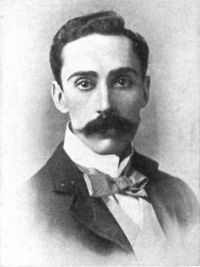
Leonard Merrick
Biographical details

Leonard Merrick (1864–1939), a British novelist, is celebrated for his psychological insight and vivid social critique, evident in works like Conrad in Quest of His Youth and Cynthia. His narratives often dissect the theater’s harsh realities, marital discord, and the dissonance between public personas and private lives.
Recognized by contemporaries such as J.M. Barrie and George Orwell, Merrick’s fiction blends sharp character studies with incisive observations on class and identity. Though largely forgotten today, his enduring legacy lies in his nuanced exploration of human vulnerability and the performative masks of society, solidifying his status as a novelist’s novelist.
Quotes by Leonard Merrick
 Leonard Merrick,
Conrad in Quest of His Youth: An Extravagance of Temperament
Leonard Merrick,
Conrad in Quest of His Youth: An Extravagance of Temperament
“ A little drizzle was in the air, but he did not heed it. The day, and the morrow, and a hundred days broke into smiles before him. And while he lingered there—on the laundress's step, in the squalid street, under the rain—Conrad suddenly awoke to the exhilaration that sparkled in him, was startled by its freshness. He realised that fizzing in his pulses and his mind was the zest, the buoyancy that he had mourned as dead. It was here, alive! He reviewed with gusto his emotions of the afternoon, the hope, the suspense, the desperation—the quiver of rejoicing. ”
Leonard Merrick,
To Tell You the Truth
“ I tried to classify the denizens, but well as I know Paris, I was baffled. I had the impression of entering a street of mysteries. It was as if, behind each of those morose, darkling windows, lowering upon me in their hundreds, there lurked gruesome things. Suddenly, on the foul ledge of a ground-floor window, dim with dirt, behind which some nameless stuff was looped, further to hide the secrets of the room, I saw blooming?—a pot of pansies! I cannot tell you how infinitely fresh its fairness looked in these surroundings, how divinely incongruous! ”