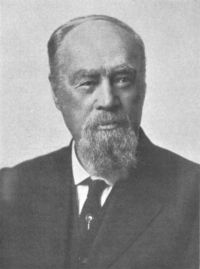
Reginald Lane-Poole

Biographical details

Reginald Lane-Poole,  Sebastian Bach

“ In this way the solemn act of the last supper is carried to a sublime height, and inspired with a supernal tenderness, wherein music reaches its noblest and most divine ideal. Once only does the glory fade from around Christ’s words, and that is at the last cry, Eli, Eli, lama asabthani. Here it is the organ—the accompaniment of the human recitative—which alone sustains the harmony. It is the finest thought in all Bach’s writing. ”

Source: Gutenberg

Reginald Lane-Poole,  Illustrations of the History of Medieval Thought and Learning (1920)

“ Guitmund, archbishop of Aversa, speaking of the time when Fulbert, who died in 1029, came to govern the school of Chartres, which he made the chief home of learning in Gaul, confesses that at that time the liberal arts had all but become extinct in the land. A single name illuminates the literary record of the age, and Gerbert the Aquitanian, pope Silvester the Second, owes his unique position less to his writings than to his personal influence as a teacher; as a teacher too not of moral but of natural philosophy, as a master not of theology but of statecraft. ”
Source: Wikisource

Reginald Lane-Poole,  Sebastian Bach

“ The Passions according to S. John and S. Matthew lie before us as the noblest monuments of Bach’s spirit. Often as they have been compared, to the inevitable disadvantage of the former work, it needs little study of them to shew that any comparison must be strained and unnatural. Each is in truth incomparable, whether in relation to the other, or to the rest of sacred music. The S. John Passion is the perfection of church-music; the S. Matthew reaches the goal of all sacred art, while its colossal dimensions take it almost, happily not quite, out of the range of church performance. ”
Source: Gutenberg

Get perspective with Kwize: daily news enlightened by great literature