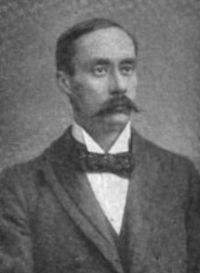
“ There is of course no reason why a landscape painter should be refined in manner or choice in his habits. There is no necessary connection between the subjects of such an artist and himself, except his hand and eye. He lives a life of visions that may come and go without affecting his life or even his thought, as we generally use that word. The most tremendous phenomena of nature may be seen and studied, and reproduced with such power as to strike terror into those who see the picture, and yet leave the artist unaltered in demeanour and taste. ”
Quotes by W. Cosmo Monkhouse
“ Sparing and not very pleasant in colour, it is yet in this respect a great advance upon the former work of others and of his own; such colour as there is penetrates the shade and is complete in harmony and tone, while the sky has no blank space and is part of the picture, the vivifying uniting power of the composition, with more interest and feeling in one roll of its truly-studied masses of cloud-form than could be found in the whole of any sky of his contemporaries. ”
“ The poet-painter, the dumb-poet, as he has well been called, shows little eccentricity of genius in his youth. There was the strong inclination to draw, but no strong inclination to draw anything in particular, or anything very beautiful. On the contrary, he drew the most uninteresting and prosaic of things, copied bad topographical prints and ugly buildings. When it was proposed to make him an architect he did not rebel; when it was afterwards proposed to make him a portrait-painter he did not murmur. It was Mr. Hardwick, not himself, that insisted on his going to the Royal Academy. ”
“ Not to be able to enjoy habitually the society of pure educated women, not to be able to welcome your friend to your hearth, could not have been good for a man’s character, or his art, or his intellect.His uninterrupted privacy possibly enabled him to produce more, and to develop his genius farther in one direction; but we could have well spared many of his pictures for a few works graced with a wider culture and a healthier sentiment. He could paint, and paint, perhaps, better for his isolation— “The light that never was on sea or land, The consecration and the Poet’s dream.” ”
“ The tiny group of poplars in the middle distance are painted with such dexterity that the impression of multitudinous leafage is perfectly conveyed, and the stillness of clear smooth water filled with innumerable variegated reflections, the beautiful distance with castle, church, and town, and the group of gulls in the foreground, make a picture of placid beauty in which there is no straining for effect, no mannerism, nothing to remind you of the artist. ”
“ It is no use now regretting that his vast powers in their prime were used wastefully in what will appear to many as the falsification of English landscape; it is far better to rejoice that the genius and knowledge of the man were so transcendent that, in spite of all the worst that can be said, each separate drawing is precious in itself as a record of natural phenomena, and a masterly arrangement of indefinite forms and beautiful colour. ”
“ The pictures of 1797-99 confirmed beyond any doubt that a great artist had arisen, who was not only a painter but a poet—a poet, not so much of the pathos of ruin, though so many of his pictures had ruins in them, nor of the chequered fate of mankind, though there is something of the “Fallacies of Hope” indicated in the quotations to his pictures—as of the mystery and beauty of light, of the power of nature, her inexhaustible variety and energy, her infinite complexity and fulness. ”
“ So died the great solitary genius, Turner, the first of all men to endeavour to paint the full power of the sun, the greatest imagination that ever sought expression in landscape, the greatest pictorial interpreter of the elemental forces of nature, that ever lived. His life, and character, and art, complex as they were in their manifestation, were as simple in motive as those of the most ordinary man. Art, fame, and money were what he strived for from the beginning to the end of his days, and those days were embittered at the end by fallacies of hope with regard to all three. ”
“ Spending a few months at a day school, and a few more at a “floral drawing master,” then a few more at school at Margate, making drawings for sale, colouring prints, fruitlessly studying perspective, bandied about from school master to drawing master, and from drawing master to architect—such a life for a young mind from ten to fourteen years of age is enough to spoil the finest intellectual digestion. ”
“ That sky—it is a very visible infinity—liquid, measureless, unfathomable, panting and melting through the chasms in the long fields of snow-white flaked, slow-moving vapour, that guide the eye along the multitudinous waves down to the islanded rest of the Euganean hills. Do we dream, or does the white forked sail drift nearer, and nearer yet, diminishing the blue sea between us with the fulness of its wings? ”
“ But the voice that was raised so late in his honour did not die, its vibrations have lasted from that day to this; and if the champion himself seems to be in some need of a defender now, if mouths that once were full of his praise are silent or raised only for the most part to depreciate, it is only what came to Turner and what comes to all who use their imagination too freely to enforce their convictions. A time must come when the spirit of analysis will eat into the most brilliant rhetoric ”
“ Others have drawn the appearance of clouds, but Turner knew how they formed. Others have drawn rocks, but he could give their structure, consistency, and quality of surface, with a few deft lines and a wash; others could hide things in a mist, but he could reveal things through mist. Others could make something like a rainbow, but he, almost alone, and without colour, could show it standing out, a bow of light arrested by vapour in mid-air, not flat upon a mountain, or printed on a cloud. ”
“ Never before was so great an artist surrounded by such a skilled body of interpreters in black and white. The drawings were unequal in merit, but nearly all of them wonderful for power of colour and daring effect, with ever lessening regard for local accuracy. The artist threw aside all traditions and conventions, and proclaimed himself as “Turner,” the great composer of chromatic harmonies in forms of sea and sky, hills and plains, sunshine and storm, towns and shipping, castles and cathedrals. ”
“ Maiden Lane is not a very brilliant thoroughfare, and was still narrower and darker at this time, but still this picture, though doubtless accurate, seems to make it still darker, and in the engraving of the house in Thornbury’s life of Turner, even the front window that looked into Maiden Lane is rendered ominously black by the shadow of a watchman thrown up by his low-held lantern. To us it seems that there is plenty of dark in Turner’s life without thus unduly heightening the gloom of his first dwelling-place. ”
“ He could make nature, and this confidence in his creative power led him sometimes into strange errors, which no one else could have made, such as putting the sun and moon in impossible positions in the same picture, and making boats sail in opposite directions before the wind; but how much more truth of natural phenomena has he not given even in such pictures than can be found in any literal transcript of nature! His colour appears to many to be untrue ”
“ But in spite of this, the great fact in comparing Turner with the other water-colour painters of his own time—and we are speaking now of his early works—is this, that whereas each of the best of the others is remarkable for one or two special beauties of style or effect, he is remarkable for all. He could reach near, if not quite, to the golden simplicity of Girtin, to the silver sweetness of Cozens; he could draw trees with the delicate dexterity of Edridge, and equal the beautiful distances of Glover ”
“ What verses of what poet, what episode of history may have been in the artist’s mind is of little consequence, when the thought is expressed in the same terms of infinite sunny distance, crumbling ruin and towering tree. The artist may have meant to embody the whole of Byron’s mind in the Childe Harold, the history of Italy in Caligula’s Palace and Bridge, the folly of life in Apollo and the Sibyl, but it does not matter now, the things are “Turners,” neither more nor less; we doubt very much whether Turner cared greatly for the particular stories attached to many of his pictures. ”
“ Visited the Royal Academy Exhibition. Particularly struck with a sea-view by Turner; fishing vessels coming in, with a heavy swell, in apprehension of tempest gathering in the distance, and casting, as it advances, a night of shade, while a parting glow is spread with fine effect upon the shore. The whole composition bold in design and masterly in execution. I am entirely unacquainted with the artist; but if he proceeds as he has begun, he cannot fail to become the first in his department. ”
“ The contrast is too great to make the picture pleasant, the facts are too few to make it perfect; to make it one or the other, it would be necessary to do as Turner did, and rightly did, with his perfect drawings—suppress facts that jarred with his scheme of form and colour, and insert figures or mountains or clouds that were necessary to complete it; but a biography is nothing if not real—it belongs to the other side of art. ”
“ Turner, we are in Venice now.”Unfortunately the brave young champion was too late, the eloquent voice that could translate into such glowing words the dumb poetry of Turner’s pictures had scarcely made the air of England thrill with its musical enthusiasm when black night fell upon the artist. The sudden snapping of some vital chord, of which that same Graduate of Oxford only last year pathetically wrote, took place, and the glorious sun of his genius disappeared without any twilight; he was dead as an artist, and dying as a man. Neither his work nor his life could be defended any more. ”
“ Dreamlike and dim, but glorious, the unnumbered palaces lift their shafts out of the hollow sea—pale ranks of motionless flame—their mighty towers sent up to heaven like tongues of more eager fire—their grey domes looming vast and dark, like eclipsed worlds—their sculptured arabesques and purple marble fading farther and fainter, league beyond league, lost in the light of distance. ”
“ There he sat, a shabby Bacchus, nodding like a Mandarin at his picture, which he, with a pendulum motion, now touched with his brush and now receded from. Yet, in spite of sherry, precarious seat, and old age, he went on shaping in some wonderful dream of colour; every touch meaning something, every pin’s head of colour being a note in the chromatic scale.”We have spoken of Turner as declining as an artist, but we are not sure that he did so till about 1845, when, Mr. Ruskin says, “his health, and with it in great degree his mind, failed suddenly.” ”
“ He had begun by imitation, he had gone on by rivalry, he had achieved a style of his own by which he had upset all preconceived notions of landscape painting, and had triumphed in establishing the superiority of pictures painted in a light key, but he was not content. His progress had always been towards light even from the earliest days, when he worked in monochrome. Sunlight was his discovery, he had found its presence in shadow, he had studied its complicated reflections, before he commenced to work in colour. ”
“ Detail after detail, thought beyond thought, you find and feel them through the radiant mystery, inexhaustible as indistinct, beautiful, but never all revealed; secret in fulness, confused in symmetry, as nature herself is to the bewildered and foiled glance, giving out of that indistinctness, and through that confusion, the perpetual newness of the infinite and the beautiful. ”
“ It is this habit which makes any attempt to write a life of Turner pre-eminently unsatisfactory, for his refined sense of the most ethereal of natural phenomena is not relieved by any refinement in his manners, his supreme feeling for the splendour of the sun is unmatched by any light or brilliance in his social life; his extreme sensibility, a sensibility not only artistic but human, to all the emotional influences of nature, stands for ever as a contrast to his self-absorbed, suspicious individuality. ”
“ From the wash of sepia and Prussian blue, he had slowly proceeded in the direction of golden and reddish brown, and had produced both drawings and pictures with wonderful effects of mist and sunlight, but he had scarcely gone beyond the sober colouring of Vandevelde and Ruysdael till he began his great pictures in rivalry with Claude. In them may be seen perhaps the dawn of the new power in his art. In the Exhibition of 1815 were two prophecies of his new style, in which he was to transcend all former efforts in the painting of distance and in colour. ”
“ Boat’s Crew recovering an Anchor, another fine picture of the Vandevelde class.In all these years, during which he kept up this constant rivalry with so many artists, living and dead—and we have not exhausted the list of them—he was continuing his unresting severe study of nature. For many more years this was to continue, this double artistic life, the strife for fame by grand pictures, of which emulation was the motive, the patient development of his knowledge and power by the close study of nature. ”
“ The most obvious intention of the work was to show his own power, and there never was, and perhaps never will be again, such an exhibition of genius in the same direction. No rhetoric can say for it as much as it says for itself in those ninety plates, twenty of which were never published. If he did not exhaust art or nature, he may be fairly said to have exhausted all that was then known of landscape art, and to have gone further than any one else in the interpretation of nature. ”
“ Imaginative art of all kinds has a code analogous to, but not identical with, the moral code: beauty takes the seat of virtue and harmony of truth, and when the work is purely imaginative, there is no conflict between fancy and fact which can make the strictest shake his head. ”
“ In that wonderful memory of his, so faithful, by all accounts, to all places where he had once been happy, there was no chamber stored with sweet pictures of the home of his youth; no exhaustless reservoir of tender, healthy sentiment, such as most of us have, however poor. Here is a note of pathos on which we might dwell long and strongly without fear of dispute or charge of false sentiment. Children, indeed, do not miss what they have not: present sorrows did not probably affect his appetite, future forebodings did not dim his hopes ”
“ Even those men of genius who, instead of employing their imagination upon nature’s inanimate works, devote themselves to the study of man himself, socially and morally, do not by any means show that relation between themselves and their finest work that we appear naturally to expect. ”
“ The illustration from “Jacqueline” which we give, though not so transcendent in imagination, is a scene of extraordinary beauty of rock and torrent, and castle-crowned steep, such as no hand but Turner’s could have drawn, while the Vision from “The Voyage of Columbus” is equally characteristic, showing how he could make an impressive picture out of the vaguest notions by his extraordinary mastery of light and shade. ”
“ Yet to the pictorial code of morals he was the most faithful of artists, he almost always reached beauty, his harmonies were almost always perfect, and he strove after his own peculiar generalization of fact, and his own peculiar extract of truth with the greatest ardour. ”
“ Ruskin, who might have helped so much, has contributed little to the life of the artist but some brilliant passages of pathetic rhetoric. Overgrown by his luxuriant eloquence, and buried beneath the débris of Thornbury, the ruins of Turner’s Life lay hidden till last year.Mr. Hamerton’s “Life of Turner” has done much to remove a very serious blot from English literature. Very careful, but very frank, it presents a clear and consistent view of the great painter and his art, and is, moreover, penetrated with that intellectual insight and refined thought which illuminate all its author’s work. ”
“ These contain the most exquisite of all the engravings from Turner’s vignettes. Exquisite also are most of the drawings, but some of them are spoilt by the capriciousness of their colour, which seems in many cases to have been employed as an indication to the engraver rather than for the purpose of imitating the hues of nature. The most beautiful perhaps of all, Tornaro’s misty brow, seems to us far too blue, and the yellow of the sky in others is too strong to be probable or even in harmony with the rest of the drawing. ”
“ After looking carefully at all the ascertainable facts of Turner’s youth, we can only come to the conclusion that it was not the fault of nature or mankind that he grew into a solitary and disappointed man.Secretiveness on his own part and want of trust in his fellow-creatures seem to have been bred in him, and to have resisted all the many proofs which the friends of his youth, and we may say of his life, afforded, that there were kind and unselfish persons in the world whom he could trust, and who would trust him. ”
“ Yet, while at a first view this distinction between Turner as a man and Turner as an artist seems complete, further study shows that the man had a great and often a fatal influence on the artist, and that this was not without reaction both serious and deep, and so we find that his art and himself are no more to be divided in any human view of him than were his body and his soul when he was yet alive. ”
“ The two great dragons of Turner, that which guards the Garden of the Hesperides, and the Python, are specially interesting as the greatest efforts made by Turner’s imagination in the creation of living forms, excepting, perhaps, the cloud figure of Polyphemus. They are perhaps the only monsters of the kind created by an artist’s fancy, which are credible even for a moment. They will not stand analysis any more than any other painters’ monsters, but you can enjoy the pictures without being disturbed by palpable impossibilities. The distance at which we see Ladon helps the illusion ”
“ Feelings crossed each other in Turner’s mind as colours did in his works; it is often difficult to know whether his feeling is to be called noble or base, and the same complexity may be noticed in his “artistic” motives. When imitating other masters he brought his knowledge of nature to bear strongly on his work to make it more natural; when painting a natural scene, he employed all his traditional study to make it more “artistic.”By this time, however, he had learnt nearly all that was to be learnt from art, ancient or modern, in the landscape way, but it was different with nature. ”
“ In 1833 Turner exhibited his first pictures of Venice, the last home of his imagination. The date of his first visit to the “floating city” is uncertain. There are two series of Venetian sketches in the National Gallery, which mark two distinct impressions. In the first the colour is comparatively sober; the sky is noted as, before all things, a marvellously blue sky; the interest of the painter is in the watery streets, the picturesqueness of corners here and there, in narrow canals and the different-coloured marbles of the buildings ”
“ Nature is a cause which will last longer than any Chancery suit. Even artists cannot agree as to the amount of licence which it is proper to take, but they are all conscious that they at least keep on the right side; one thing only, all, or nearly all, are agreed upon, and that is that licence must be taken, or art becomes handicraft. About Turner almost the only thing which can be said with certainty is that he stretched his liberty to the extreme limits. ”
“ His constant fault, and, as we think, an inexcusable one, is the careless drawing of his figures. It is not an excuse to say that they must not be painted so as to draw attention from the landscape; first, because Turner in his earlier pictures showed that he could introduce well-finished figures without doing this; and secondly, because Turner’s figures in his later pictures do this by their badness. This carelessness gradually grew on him, because he would not take pains with them. He could draw very small figures very well, giving more spirit and essence than any other artist, in a touch. ”
“ Paul’s, Covent Garden, and Mary Turner, née Marshall, his wife, should have produced an artist, still less, one of the greatest artists that the world has yet seen. There is only one fact, and that a very sad one, which might be held to have some connection with his genius. ”
“ In Turner we see an obscure outlined form in everything, for though the warm tints of the masses of clouds serve to break down and diffuse the colour of the sails, their form is disturbed by the handling of his brush. ”
“ There is no picture which better shows the greatness of Turner’s power of pictorial imagination than the Apollo and Python. We have said that nature was almost Turner’s only book. The only written book which there is evidence that he really studied—read through, probably, again and again—is Ovid’s “Metamorphoses.” That he was fond of poetry there is no doubt, but the sparks that lit his imagination for nearly all his best classical compositions came from this book. ”
“ In comparing the two pictures as works of art, Vandervelde’s must have the preference as far as priority of composition is concerned; but Turner has had the boldness to tell the same story, clothing it with all the grandeur and sublimity of natural representation. The light and shade is very excellent; the mass of dark sky, brought in contact with the sail of the advancing boat, is broad in the extreme. ”