“ The scene below ground in the labyrinth of galleries is bewildering in its complexity, and very unlike the popular notion of a diamond mine (Fig. 7) . All below is dirt, mud, grime; half-naked men, dark as mahogany, lithe as athletes, dripping with perspiration, are seen in every direction, hammering, picking, shovelling, wheeling the trucks to and fro, keeping up a weird chant which rises in force and rhythm when a greater task calls for excessive muscular strain. ”
William Crookes
Biographical details

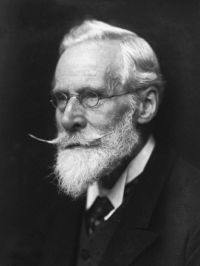
William Crookes (1832–1919), a British chemist and physicist, pioneered spectroscopy and vacuum tube technology, discovering thallium and inventing the Crookes tube, which laid the groundwork for modern physics. His studies on cathode rays and plasma foreshadowed quantum mechanics, while innovations such as the radiometer and ultraviolet-blocking lens demonstrated his practical ingenuity.
Beyond science, his involvement with spiritualism through the Society for Psychical Research highlighted his broad intellectual range, evident in works such as Diamonds and Popular Science Monthly, which combined empirical rigor with philosophical inquiry. Crookes’ legacy unites scientific achievements with interdisciplinary exploration, epitomizing 19th-century scientific eclecticism.
Quotes by William Crookes
 William Crookes,
Popular Science Monthly
(1876)
William Crookes,
Popular Science Monthly
(1876)
“ I simply wish to show you the marvelous sensitiveness of the apparatus with which I am accustomed to work. I may, indeed, say that I know these rough estimates to be incorrect. It must be remembered that our earth is not a lampblacked body inclosed in a glass case, nor is its shape such as to give the maximum of surface with the minimum of weight. The solar forces which perpetually pour on it are not simply absorbed and degraded into radiant heat, but are transformed into the various forms of motion we see around us, and into the countless forms of vegetable, animal, and human activity. ”
William Crookes,
Popular Science Monthly
(1876)
“ The spot of light flies off the scale. I now bring the candle near it alternately from one side to the other, and you see how perfectly it obeys the force of the candle. I think the movement is almost better seen without the screen than with it. The fog, which has been so great a detriment to every one else, is rather in my favor, for it shows the luminous index like a solid bar of light swaying to and fro across the room. The warmth of my finger, or the radiation from a candle, is therefore seen to drive the pith-disk away. ”