Summary

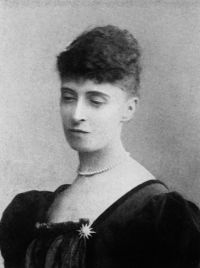
Portrait of Alice Meynell Alice Meynell The Rhythm of Life, and Other Essays

What a lesson in literature! How feelingly it persuades us that all except a very little of the ornament of letters and of life makes the dulness of the world. The tenderness of colour, the beauty of series and perspective, and the variety of surface, produced by the small culture of vegetables, are among the charms that come unsought, and that are not to be found by seeking—are never to be achieved if they are sought for their own sake. And another of the delights of the useful laborious land is its vitality. The soil may be thin and dry, but man’s life is added to its own.
Source: Gutenberg

Portrait of Alice Meynell Alice Meynell The Rhythm of Life, and Other Essays

To most of the great poets no greater praise can be given than praise of their imagery. Imagery is the natural language of their poetry. Without a parable she hardly speaks. But undoubtedly there is now and then a poet who touches the thing, not its likeness, too vitally, too sensitively, for even such a pause as the verse makes for love of the beautiful image. Those rare moments are simple, and their simplicity makes one of the reader’s keenest experiences. Other simplicities may be achieved by lesser art, but this is transcendent simplicity. There is nothing in the world more costly.
Source: Gutenberg

Portrait of Alice Meynell Alice Meynell The Rhythm of Life, and Other Essays

As to the earthly scenery, there are but two ‘views’ on the plain; for the aspect of the light is the whole landscape. To look with the sun or against the sun—this is the alternative splendour. To look with the sun is to face a golden country, shadowless, serene, noble and strong in light, with a certain lack of relief that suggests—to those who dream of landscape—the country of a dream. The serried pines, and the lighted fields, and the golden ricks of the farms are dyed with the sun as one might paint with a colour.
Source: Gutenberg

Get perspective with Kwize: daily news enlightened by great literature