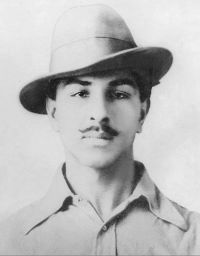
Bhagat Singh

Bhagat Singh

Summary

Portrait of Bhagat Singh Bhagat Singh Why I Am an Atheist (1931)

Not to become a king, nor to gain any other rewards here, or in the next birth or after death in paradise, shall they be inspired to challenge the oppressors, exploiters, and tyrants, but to cast off the yoke of serfdom from the neck of humanity and to establish liberty and peace shall they tread this—to their individual selves perilous and to their noble selves the only glorious imaginable—path. Is the pride in their noble cause to be misinterpreted as vanity?
Source: Wikisource

Portrait of Bhagat Singh Bhagat Singh Why I Am an Atheist (1931)

Any man who stands for progress has to criticize, disbelieve and challenge every item of the old faith. Item by item he has to reason out every nook and corner of the prevailing faith. If after considerable reasoning one is led to believe in any theory or philosophy, his faith is welcomed. His reasoning can be mistaken, wrong, misled and sometimes fallacious. But he is liable to correction because reason is the guiding star of his life. But mere faith and blind faith is dangerous: it dulls the brain, and makes a man reactionary.
Source: Wikisource

Portrait of Bhagat Singh Bhagat Singh Why I Am an Atheist (1931)

But conversation with some friends has given me a hint that certain of my friends—if I am not claiming too much in thinking them to be so—are inclined to conclude from the brief contact they have had with me, that it was too much on my part to deny the existence of God and that there was a certain amount of vanity that actuated my disbelief. Well, the problem is a serious one. I do not boast to be quite above these human traits. I am a man and nothing more. None can claim to be more. I also have this weakness in me. Vanity does form a part of my nature.
Source: Wikisource

Get perspective with Kwize: daily news enlightened by great literature