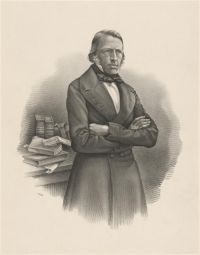
Carl Jacob Löwig

Carl Jacob Löwig

Summary

Portrait of Carl Jacob Löwig Carl Jacob Löwig Scientific Memoirs (1837)

The action of the oil and potassium, which at common temperatures goes on but slowly, is by a very gentle heat so much increased, that during the evolution of the hydrogen the combination of the spiroil and potassium is attended with the evolution of heat and light. At the same time not the slightest trace of carbon or of any carbonaceous matter is deposited, and the hydrogen which is evolved is quite pure. If the oil which is employed for these experiments be not quite free from water, evolution of hydrogen takes place as soon as it comes into contact with the potassium
Source: Wikisource

Portrait of Carl Jacob Löwig Carl Jacob Löwig Scientific Memoirs (1837)

If the hydrogen, which by uniting with the radical forms the acid, be oxidized by nitric acid, 4 additional eqs. of oxygen are taken up by the radical, thus forming the oxyacid of the same radical. Instead of 1 eq. of hydrogen, the radical can unite with 1 eq. of chlorine, bromine, iodine, or even of a metal. These latter combinations are also formed when the hydracid is made to act on metallic oxides. With ammonia, on the contrary, the hydracid unites without undergoing any change.
Source: Wikisource

Portrait of Carl Jacob Löwig Carl Jacob Löwig Scientific Memoirs (1837)

In order to free the bromide of spiroil from excess of bromine and hydrospiroil, it must be kept melted in a water-bath so long as acid fumes are given off. Bromide of spiroil is exactly similar to the chloride of spiroil in all its properties; it is quite insoluble in water, and is easily soluble in aether and alcohol. By the spontaneous evaporation of the alcoholic solution it is obtained crystallized; bromide of spiroil melts at a rather higher temperature than the chloride, and like the latter may also be entirely sublimed: when boiled with water it evaporates unaltered.
Source: Wikisource

Get perspective with Kwize: daily news enlightened by great literature