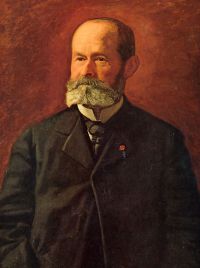
Daniel G. Brinton

Daniel G. Brinton

Summary

Portrait of Daniel G. Brinton Daniel G. Brinton,  The Religious Sentiment

“ In the language of feeling, love is a passion; but it does not spring from feeling alone. It is far more fervid when it rises through intellect than through sense. “Men have died from time to time, and worms have eaten them, but not for love,” says the fair Rosalind; and though her saying is not very true as to the love of sense, it is far less true as to the love of intellect. The martyrs to science and religion, to principles and faith, multiply a hundred-fold [59] those to the garden god. The spell of the idea is what
“Turns ruin into laughter and death into dreaming.”
”
Source: Gutenberg

Portrait of Daniel G. Brinton Daniel G. Brinton,  The Religious Sentiment

“ So, too, the religion of beauty and art contains an indefeasible germ of true religious thought. Art sees the universal in the isolated fact; it redeemed the coarse symbol of earlier days by associating it with the emotions of joy, instead of fear; commencing with an exaltation of the love to sex, it etherealized and ennobled passion; it taught man to look elsewhere than to material things for his highest pleasure, for the work of art always has its fortune in the imagination and not in the senses of the observer ”
Source: Gutenberg

Portrait of Daniel G. Brinton Daniel G. Brinton,  The Religious Sentiment

“ In one or other of these forms love has at all times been the burden of religion: the glad tidings it has always borne have been “love on earth.” The Phœnix in Egyptian myth appeared yearly as newly risen, but was ever the same bird, and bore the egg from which its parent was to have birth. So religions have assumed the guise in turn of self-love, sex-love, love of country and love of humanity, cherishing in each the germ of that highest love which alone is the parent of its last and only perfect embodiment. ”
Source: Gutenberg

Get perspective with Kwize: daily news enlightened by great literature