Summary

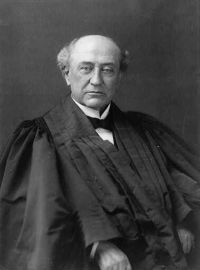
Portrait of David Josiah Brewer David Josiah Brewer Schick v. United States — Opinion of the Court

But the judiciary had no such function at common law. No court at common law assumed, without a jury, to try any offense, however trivial or petty, except under the authority of a statute conferring authority to that end. If the offense is punishable only by a fine of $50, as is the case here,-is it to be deemed a petty offense? And yet is one punable by a fine of $500 to be deemed a serious one? Must there not be some fixed rule or limit on the subject? In my judgment, the Constitution establishes a rule which must be respected by every branch of the government.
Source: Wikisource

Portrait of David Josiah Brewer David Josiah Brewer Schick v. United States — Opinion of the Court

A crime is a criminal offense and a criminal offense is a crime. But the contention of the prosecution, even if sound, does not answer the suggestion that, at common law, it was never the province of a court, by any inherent power it possessed, to prescribe what criminal offenses or crimes were triable, and what need not be tried, by jury. My point is that no criminal offense or crime against the United States can be tried except by jury, if the plea be not guilty, unless it be a petty offense or crime, and unless the legislative department declares that it may be so tried.
Source: Wikisource

Portrait of David Josiah Brewer David Josiah Brewer Schick v. United States — Opinion of the Court

But if there be no constitutional or statutory provision or public policy requiring a jury in the trial of petty offenses, upon what ground can it be contended that a defendant therein may not voluntarily waive a jury? Can it be that a defendant can plead guilty of the most serious, even a capital, offense, and thus dispense with all inquiry by a jury, and cannot, when informed against for a petty offense, waive a trial by jury?
Source: Wikisource

Get perspective with Kwize: daily news enlightened by great literature