“ Latter day biologists have come to see clearly that the inadequacy of natural selection lies in its failure to explain the origin of the fit; and Darwin himself recognized clearly enough that it is not an originative or creative principle. It is only a condition of survival, and hence a condition of progress. But whether we conceive with Darwin that selection has acted mainly upon slight individual variations, or with DeVries that it has operated with larger and more stable mutations, any adequate general theory of evolution must explain the origin of the fit. ”
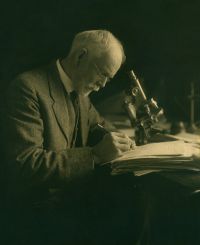
Edmund B. Wilson
Summary
Edmund B. Wilson’s Biology explores the interaction between mechanistic explanations and vitalistic theories in understanding life’s phenomena, placing it within late 19th- to early 20th-century scientific discussion. The text critically examines evolution, heredity, and organic adaptations, questioning whether natural selection alone is enough to account for the emergence of biological fitness or if a vital force goes beyond physico-chemical analysis.
Wilson engages with debates between Darwinian natural selection and competing theories, while highlighting biology’s role in unraveling life’s complexities through empirical observation and historical continuity. The work emphasizes the ongoing conflict between materialism and the perceived distinctiveness of organic processes, portraying biology as both a science of mechanisms and an inquiry into life’s enduring enigmas.
Quotes from Biology (Edmund B. Wilson)
“ If we may imagine the physico-chemical analysis of the body to be carried through to the very end, may we expect to find at last an unknown something that transcends such analysis and is neither a form of physical energy nor anything given in the physical or chemical configuration of the body? Shall we find anything corresponding to the usual popular conception—which was also along the view of physiologists—that the body is "animated" by a specific "vital principle," or "vital force," a dominating "archæus" that exists only in the realm of organic nature? ”
“ Every physiologist will maintain that we cannot name one of these activities, not even thought, that is not carried on by a physical mechanism. He will maintain further that in most cases the vital actions are not merely accompanied by physico-chemical operations but actually consist of them; and he may go so far as definitely to maintain that we have no evidence that life itself can be regarded as anything more than their sum total. ”
