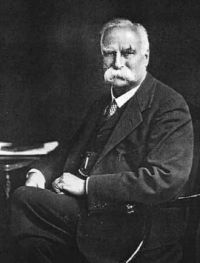
Edward Bagnall Poulton

Edward Bagnall Poulton

Summary

Portrait of Edward Bagnall Poulton Edward Bagnall Poulton 1911 Encyclopædia Britannica (1911)

The essential causes of his success are to be found in this latter sentence, the creative genius ever inspired by existing knowledge to build hypotheses by whose aid further knowledge could be won, the calm unbiassed mind, the transparent honesty and love of truth which enabled him to abandon or to modify his own creations when they ceased to be supported by observation. The even balance between these powers was as important as their remarkable development. The great naturalist appeared in the ripeness of time, when the world was ready for his splendid generalizations.
Source: Wikisource

Portrait of Edward Bagnall Poulton Edward Bagnall Poulton 1911 Encyclopædia Britannica (1911)

All through the period a varying proportion of naturalists, probably larger now than at any other time, has followed the founders of the theory, and has sought the motive-cause of evolution in “the accumulative power of natural selection,” which Darwin, as his first public statement indicates, looked upon “as by far the most important element in the production of new forms.”
Source: Wikisource

Portrait of Edward Bagnall Poulton Edward Bagnall Poulton 1911 Encyclopædia Britannica (1911)

They hold, with Darwin and Wallace, that although variation provides the essential material, natural selection, from its accumulative power, is of such paramount importance that it may be said to create new species as truly as a man may be said to make a building out of the material provided by stones of various shapes, a metaphor suggested and elaborated by Darwin, and forming the concluding sentences of The Variation of Animals and Plants under Domestication.
Source: Wikisource

Get perspective with Kwize: daily news enlightened by great literature