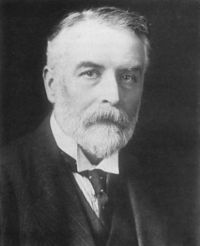
George Albert Boulenger

George Albert Boulenger

Summary

Portrait of George Albert Boulenger George Albert Boulenger The Cambridge natural history, Vol… (1904)

The Fish makes a floating nest, emerging on three sides, over which the male keeps a fierce watch; the recently-hatched larvae are remarkable for the enormous size of the yolk-sac, which hangs down, acting as a sort of anchor, and for the presence of long external branchial filaments, as in Selachian embryos. The Fish propels itself through the water entirely by the action of its dorsal fin, forwards and backwards with equal facility; when swimming rapidly backwards, it may be seen to use the end of its tail as a feeler to guide the way.
Source: Gutenberg

Portrait of George Albert Boulenger George Albert Boulenger The Cambridge natural history, Vol… (1904)

NATURE.—"In concluding the review we would express the opinion that by this handsome volume a very important addition to science has been made; that the beautiful illustrations, together with the clear and charming accounts of the life-histories which it contains, will do much to popularise the study of a rather neglected section of zoology; and that lovers of Reptiles, of which there are more than one generally thinks, will feel that the new knowledge imparted to them emanates from one who is thoroughly in sympathy with their enthusiasm."
Source: Gutenberg

Portrait of George Albert Boulenger George Albert Boulenger The Cambridge natural history, Vol… (1904)

The anus opens into the dorsal or cloacal part of the peribranchial cavity near the atrial aperture. The walls of the stomach are glandular, and most of the endoderm cells lining the tube are ciliated. A system of delicate, microscopic, branched tubules with dilated ends (the "refringent organ") , which ramifies over the outer wall of the intestine, and communicates with the cavity of the stomach at the pyloric end by means of a duct is probably a digestive gland. There is in Ascidia no separate large gland to which the name "liver" can be applied, as in some other Tunicata.
Source: Gutenberg

Get perspective with Kwize: daily news enlightened by great literature