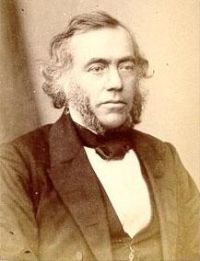
George James Allman

George James Allman

Summary

Portrait of George James Allman George James Allman Popular Science Monthly (1879)

Of two particles of protoplasm, between which we may defy all the power of the microscope, all the resources of the laboratory, to detect a difference, one can develop only to a jelly-fish, the other only to a man, and one conclusion alone is here possible—that deep within them there must be a fundamental difference which thus determines their inevitable destiny, but of which we know nothing, and can assert nothing beyond the statement that it must depend on their hidden molecular constitution.
Source: Wikisource

Portrait of George James Allman George James Allman Popular Science Monthly (1879)

Mind as well as body is thus traveling onward through higher and still higher phases; the great law of evolution is shaping the destiny of our race; and though now we may at most but indicate some weak point in the generalization which would refer consciousness as well as life to a common material source, who can say that in the far-off future there may not yet be evolved other and higher faculties from which light may stream in upon the darkness, and reveal to man the great mystery of thought?
Source: Wikisource

Portrait of George James Allman George James Allman Popular Science Monthly (1879)

In this society of cells each has its own work to perform, and the life of the organism is made up of the lives of its component cells. Here it is that we find most distinctly expressed the great law of the physiological division of labor. In the lowest organisms, where the whole being consists of a single cell, the performance of all the processes which constitute its life must devolve on the protoplasm of this one cell; but as we pass to more highly organized beings, the work becomes distributed among a multitude of workers. These workers are the cells which now make up the complex organism.
Source: Wikisource

Get perspective with Kwize: daily news enlightened by great literature