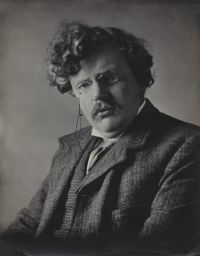
Gilbert Keith Chesterton

Gilbert Keith Chesterton

Summary

Portrait of Gilbert Keith Chesterton Gilbert Keith Chesterton Orthodoxy — Chapter IV: The Ethics of Elfland (1909)

Every man has forgotten who he is. One may understand the cosmos, but never the ego; the self is more distant than any star. Thou shalt love the Lord thy God; but thou shalt not know thyself. We are all under the same mental calamity; we have all forgotten our names. We have all forgotten what we really are. All that we call common sense and rationality and practicality and positivism only means that for certain dead levels of our life we forget that we have forgotten. All that we call spirit and art and ecstasy only means that for one awful instant we remember that we forget.
Source: Wikisource

Portrait of Gilbert Keith Chesterton Gilbert Keith Chesterton Orthodoxy — Chapter IV: The Ethics of Elfland (1909)

In short, I had always believed that the world involved magic: now I thought that perhaps it involved a magician. And this pointed a profound emotion always present and sub-conscious; that this world of ours has some purpose; and if there is a purpose, there is a person. I had always felt life first as a story: and if there is a story there is a story-teller.
But modern thought also hit my second human tradition. It went against the fairy feeling about strict limits and conditions. The one thing it loved to talk about was expansion and largeness.
Source: Wikisource

Portrait of Gilbert Keith Chesterton Gilbert Keith Chesterton Orthodoxy — Chapter IV: The Ethics of Elfland (1909)

Now, the fairy-tale philosopher is glad that the leaf is green precisely because it might have been scarlet. He feels as if it had turned green an instant before he looked at it. He is pleased that snow is white on the strictly reasonable ground that it might have been black. Every colour has in it a bold quality as of choice; the red of garden roses is not only decisive but dramatic, like suddenly spilt blood. He feels that something has been done. But the great determinists of the nineteenth century were strongly against this native feeling that something had happened an instant before.
Source: Wikisource

Get perspective with Kwize: daily news enlightened by great literature