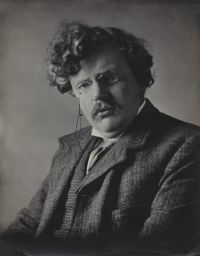
Gilbert Keith Chesterton

Gilbert Keith Chesterton

Summary

Portrait of Gilbert Keith Chesterton Gilbert Keith Chesterton Orthodoxy — VI: The Paradoxes of Christianity (1909)

But Christianity has done more: it has marked the limits of it in the awful graves of the suicide and the hero, showing the distance between him who dies for the sake of living and him who dies for the sake of dying. And it has held up ever since above the European lances the banner of the mystery of chivalry: the Christian courage, which is a disdain of death; not the Chinese courage, which is a disdain of life.
And now I began to find that this duplex passion was the Christian key to ethics everywhere. Everywhere the creed made a moderation out of the still crash of two impetuous emotions.
Source: Wikisource

Portrait of Gilbert Keith Chesterton Gilbert Keith Chesterton Orthodoxy — VI: The Paradoxes of Christianity (1909)

THAT is the problem the Church attempted; THAT is the miracle she achieved.
This is what I have called guessing the hidden eccentricities of life. This is knowing that a man's heart is to the left and not in the middle. This is knowing not only that the earth is round, but knowing exactly where it is flat. Christian doctrine detected the oddities of life. It not only discovered the law, but it foresaw the exceptions. Those underrate Christianity who say that it discovered mercy; any one might discover mercy. In fact every one did.
Source: Wikisource

Portrait of Gilbert Keith Chesterton Gilbert Keith Chesterton Orthodoxy — VI: The Paradoxes of Christianity (1909)

It is always easy to let the age have its head; the difficult thing is to keep one's own. It is always easy to be a modernist; as it is easy to be a snob. To have fallen into any of those open traps of error and exaggeration which fashion after fashion and sect after sect set along the historic path of Christendom--that would indeed have been simple. It is always simple to fall; there are an infinity of angles at which one falls, only one at which one stands. To have fallen into any one of the fads from Gnosticism to Christian Science would indeed have been obvious and tame.
Source: Wikisource

Get perspective with Kwize: daily news enlightened by great literature