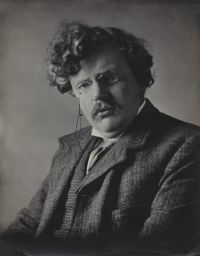
Gilbert Keith Chesterton

Gilbert Keith Chesterton

Summary

Portrait of Gilbert Keith Chesterton Gilbert Keith Chesterton,  Robert Browning — Chapter I (1903)

“ The Eden of the Middle Ages was really a garden, where each of God's flowers--truth and beauty and reason--flourished for its own sake, and with its own name. The Eden of modern progress is a kitchen garden.
It would have been hard, therefore, for Browning to have chosen a better example for his study of intellectual egotism than Paracelsus. Modern life accuses the mediæval tradition of crushing the intellect; Browning, with a truer instinct, accuses that tradition of over-glorifying it. There is, however, another and even more important deduction to be made from the moral of Paracelsus.
”
Source: Wikisource

Portrait of Gilbert Keith Chesterton Gilbert Keith Chesterton,  Robert Browning — Chapter I (1903)

“ No one can do the least justice to the great Jacobins who does not realise that to them breaking the civilisation of ages was like breaking the cords of a treasure-chest. And just as for more than a century great men had dreamed of this beautiful emancipation, so the dream began in the time of Keats and Shelley to creep down among the dullest professions and the most prosaic classes of society. ”
Source: Wikisource

Portrait of Gilbert Keith Chesterton Gilbert Keith Chesterton,  Robert Browning — Chapter I (1903)

“ Their faith in themselves is only a disillusionment with mankind. They are in that most dreadful position, dreadful alike in personal and public affairs--the position of the man who has lost faith and not lost love. This belief that all would go right if we could only get the strings into our own hands is a fallacy almost without exception, but nobody can justly say that it is not public-spirited. The sin and sorrow of despotism is not that it does not love men, but that it loves them too much and trusts them too little. ”
Source: Wikisource

Get perspective with Kwize: daily news enlightened by great literature