Summary

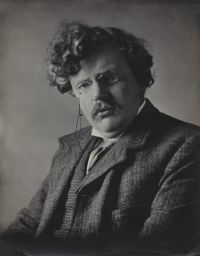
Portrait of Gilbert Keith Chesterton Gilbert Keith Chesterton The Superstition of Divorce — The Story of the Family (1920)

This triangle of truisms, of father, mother and child, cannot be destroyed; it can only destroy those civilisations which disregard it. Most modern reformers are merely bottomless sceptics, and have no basis on which to rebuild; and it is well that such reformers should realise that there is something they cannot reform. You can put down the mighty from their seat; you can turn the world upside down, and there is much to be said for the view that it may then be the right way up. But you cannot create a world in which the baby carries the mother.
Source: Wikisource

Portrait of Gilbert Keith Chesterton Gilbert Keith Chesterton The Superstition of Divorce — The Story of the Family (1920)

The only thing that can be set up to check or challenge this authority is a voluntary law and a voluntary loyalty. That loyalty is the protection of liberty, in the only sphere where liberty can fully dwell. It is a principle of the constitution that the King never dies. It is the whole principle of the family that the citizen never dies. There must be a heraldry and heredity of freedom; a tradition of resistance to tyranny. A man must be not only free, but free-born.
Source: Wikisource

Portrait of Gilbert Keith Chesterton Gilbert Keith Chesterton The Superstition of Divorce — The Story of the Family (1920)

Every sane man recognises that unlimited liberty is, anarchy, or rather is nonentity. The civic idea of liberty is to give the citizen a province of liberty; a limitation within which a citizen is a king. This is the only way in which truth can ever find refuge from public persecution, and the good man survive the bad government. But the good man by himself is no match for the city. There must be balanced against it another ideal institution, and in that sense an immortal institution.
Source: Wikisource

Get perspective with Kwize: daily news enlightened by great literature