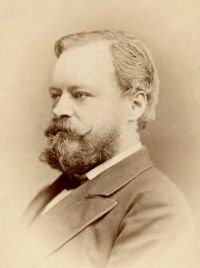
H. G. Seeley

H. G. Seeley

Summary

Portrait of H. G. Seeley H. G. Seeley The Ornithosauria

In some lizards, as the Chameleon, the sack-like lung at its distal termination is as simple as the air-cells of a bird; but those air-cells are not comparable with the bird's air-cells, since they are not prolongations of the bronchial tubes through the walls of the lungs. And it cannot be inferred that a reptile with wings would develop air-cells like those of a bird: in the first place, because those mammals which have wings do not develop air-cells; and, in the second place, because there is nothing in existing nature to lead any one to think that reptiles might have wings.
Source: Gutenberg

Portrait of H. G. Seeley H. G. Seeley The Ornithosauria

This is not the case with either Chelonians or Crocodiles, which have the quadrate bone firmly packed in the skull; nor is it paralleled even among those lizards and serpents which have the bone as free; while, on the contrary, it is characteristic of the whole class of birds. The form of the bone is not more Lacertian than Avian, while its direct attachment to the bone of the brain-case finds no parallel among lizards, but is exactly paralleled in all birds.
Source: Gutenberg

Portrait of H. G. Seeley H. G. Seeley The Ornithosauria

Thus, if with an avian basis some parts of the skeleton present points of agreement with reptiles, in other points there are resemblances with mammals not less characteristic. These phænomena do not show that in so far the animal is a mammal or a reptile, but only that mammals, ornithosaurians, and reptiles have had a common origin, and that while they have been differentiated so as to form separate classes they have severally retained characters which formerly were united in one class.
Source: Gutenberg

Get perspective with Kwize: daily news enlightened by great literature