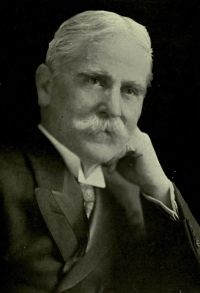
Henry Van Dyke

Henry Van Dyke

Summary

Portrait of Henry Van Dyke Henry Van Dyke,  Companionable Books

“ If Wordsworth is the Millet of poetry, Browning is the Holbein or the Denner. He never misses the mole, the wrinkle, the twist of the eyebrow, which makes the face stand out alone, the sudden touch of self-revelation which individualizes the character. Thus we find in Browning’s poetry few types of humanity, but plenty of men.
Yet he seldom, if ever, allows us to forget the background of society. His figures are far more individual than Wordsworth’s, but far less solitary. Behind each of them we feel the world out of which they have come and to which they belong.
”
Source: Gutenberg

Portrait of Henry Van Dyke Henry Van Dyke,  Companionable Books

“ In a virtuous action I properly am; in a virtuous act I add to the world; I plant into deserts conquered from Chaos and Nothing, and see the darkness receding on the limits of the horizon. There can be no excess to love, none to knowledge, none to beauty, when these attributes are considered in the purest sense. The soul refuses limits, and always affirms an Optimism, never a Pessimism.”
This is the note that brings a brave joy to the ear of youth. Old age gladly listens to the same note in the deeper, quieter music of Emerson’s poem, Terminus.
”
Source: Gutenberg

Portrait of Henry Van Dyke Henry Van Dyke,  Companionable Books

“ Keats is not a virile poet, like Dante or Shakespeare or Milton; that he would have become one if he had lived is a happy and loving guess. He is certainly not a member of the senile school of poetry, which celebrates the impotent and morbid passions of decay, with a café chantant for its temple, and the smoke of cigarettes for incense, and cups of absinthe for its libations, and for its goddess not the immortal Venus rising from the sea, but the weary, painted, and decrepit Venus sinking into the gutter. ”
Source: Gutenberg

Get perspective with Kwize: daily news enlightened by great literature