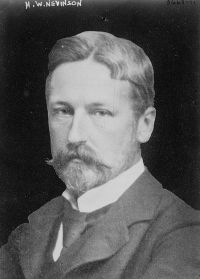
Henry Woodd Nevinson

Henry Woodd Nevinson

Summary

Portrait of Henry Woodd Nevinson Henry Woodd Nevinson A Modern Slavery (1906)

I can imagine no more noble existence than has fallen to those poor and naked blacks, who have dared all for freedom, and, scorning the stall-fed life of slavery, have chosen rather to throw themselves upon such mercy as nature has, to wander together in nakedness and hunger from forest to forest and hut to hut, to live in daily apprehension of murder, to lurk like apes under the high branches, and at last to fall to the bullets of the Christians, dead, but of no further service to the commercial gentlemen who bought them and lose £30 by every death.
Source: Gutenberg

Portrait of Henry Woodd Nevinson Henry Woodd Nevinson A Modern Slavery (1906)

In a long and wandering life I have nowhere found hospitality so complete and ungrudging and unconscious. Only those who have lived for months among the dirt and cursing of ox-wagons, or have tramped with savages far through deserts wet and dry, plunged in slime or burned with thirst, worn with fever and poisoned with starvation, could appreciate what it means to come at last into a mission station and see the trim thatched cottages, like an old English village, and to hear the quiet and pleasant voices, and feel again the sense of inward peace, which, I suppose, is the reward of holy living.
Source: Gutenberg

Portrait of Henry Woodd Nevinson Henry Woodd Nevinson A Modern Slavery (1906)

That is the sum of plantation life. So the man or woman known as a “contract laborer” toils, till gradually or suddenly death comes, and the poor, worn-out body is put to rot. Out in the forest you come upon the little heap of red earth under which it lies. On the top of the heap is set the conical basket of woven grasses which was the symbol of its toil in life, and now forms its only monument. For a fortnight after death the comrades of the dead think that the spirit hovers uneasily about the familiar huts. They dance and drink rum to cheer themselves and it.
Source: Gutenberg

Get perspective with Kwize: daily news enlightened by great literature