Summary

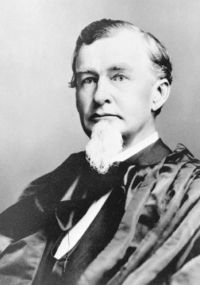
Portrait of Howell Edmunds Jackson Howell Edmunds Jackson Miller v. Eagle Manufacturing Company…

A single invention may include both the machine and the manufacture it creates; and in such cases, if the inventions are really separable, the inventor may be entitled to a monopoly of each. It is settled, also, that an inventor may make a new improvement on his own invention of a patentable character, for which he may obtain a separate patent
Source: Wikisource

Portrait of Howell Edmunds Jackson Howell Edmunds Jackson Miller v. Eagle Manufacturing Company…

The spring and its connecting apparatus are the same in each patent, and the claims of the first covered the double automatic action, upward or downward. There is nothing in the specification or claims to indicate that in the first patent the lifting action is in any degree slighter or weaker as the beam rises than in the second patent; on the contrary, both specifications clearly indicate that the spring device acts with increasing force in each patent as the beam rises.
Source: Wikisource

Portrait of Howell Edmunds Jackson Howell Edmunds Jackson Miller v. Eagle Manufacturing Company…

The novelty of Wright's invention consists, as held by the court below, in the application of a double-acting spring to assist the operator in either lifting the plow beams, or the plows attached thereto, or in sinking them deeper in the earth, as occasion might require, while the cultivator is in service. The first patent, issued in 1879, covered both the lifting and depressing actions or operations, while the second patent covered only the lifting effect. The spring device which was designed to accomplish these effects or operations, is the same in both patents.
Source: Wikisource

Get perspective with Kwize: daily news enlightened by great literature