Summary

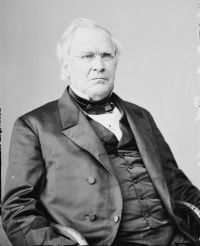
Portrait of Robert Cooper Grier Robert Cooper Grier O'Reilly v. Morse/Dissent Grier…

If the law gives a franchise or monopoly to the inventor of an art as fully as to the inventor of a machine, why shall its protection not be coextensive with the invention in one case as well as in the other? To look at an art as nothing but a combination of machinery, and give it protection only as such, against the use of the same or similar devices or mechanical equivalents, is to refuse it protection as an art. It ignores the distinction between an art and a machine
Source: Wikisource

Portrait of Robert Cooper Grier Robert Cooper Grier O'Reilly v. Morse/Dissent Grier…

The mere discovery of a new element, or law, or principle of nature, without any valuable application of it to the arts, is not the subject of a patent. But he who takes this new element or power, as yet useless, from the laboratory of the philosopher, and makes it the servant of man; who applies it to the perfecting of a new and useful art, or to the improvement of one already known, is the benefactor to whom the patent law tenders its protection. The devices and machines used in the exercise of it may or may not be new
Source: Wikisource

Portrait of Robert Cooper Grier Robert Cooper Grier O'Reilly v. Morse/Dissent Grier…

It is not easy to give a precise definition of what is meant by the term 'art,' as used in the acts of Congress-some, if not all, the traits which distinguish an art from the other legitimate subjects of a patent, are stated with clearness and accuracy by Mr. Curtis, in his Treatise on Patents. 'The term art, applies,' says he, 'to all those cases where the application of a principle is the most important part of the invention, and where the machinery, apparatus, or other means, by which the principle is applied, are incidental only and not of the essence of his invention.
Source: Wikisource

Get perspective with Kwize: daily news enlightened by great literature