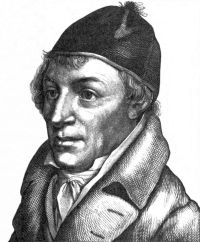
Johann Matthäus Bechstein

Johann Matthäus Bechstein

Summary

Portrait of Johann Matthäus Bechstein Johann Matthäus Bechstein The Natural History of Cage Birds

I have had a pair six years in my room without a cage, and they are satisfied with the food common for other birds: if kept in a cage, they must be fed on hemp seed, oats, millet, rape, and poppy seeds. They appear much delighted whilst bathing; during the night they seem very uneasy, hopping and running about continually. Their strong and piercing cry resembles a loud whistle; their song would be rather agreeable were it not interrupted in a peculiar manner; it is a warbling mingled with some high noisy notes, descending slowly from shrill to deep, and a little strong and broken whistling.
Source: Gutenberg

Portrait of Johann Matthäus Bechstein Johann Matthäus Bechstein The Natural History of Cage Birds

Attractive Qualities.—Its cry somewhat resembles the guir, guir of the lark; like the nutcracker, it can imitate the different notes, but not the songs, of other birds. Nothing is more agreeable than its own warbling, which much resembles the whistling of the grey parrot; its throat at the time being expanded like that of the green frog. It is a great pity that it only sings during the pairing season, which is from March to May, and even then often spoils the beautiful melody of its song, with some harsh, discordant notes. The female also sings.
Source: Gutenberg

Portrait of Johann Matthäus Bechstein Johann Matthäus Bechstein The Natural History of Cage Birds

Several singing birds may be named whose voices in some respects may compete with that of the nightingale; the lark, the canary, the greenfinch, the blackcap, the linnet, the goldfinch, the common blackbird, the solitary thrush, the American mocking-bird, are all listened to with pleasure when the nightingale is silent: some have fine tones, others have their voice as clear as it is soft, others have as fine flourishes, but there is not one which the nightingale does not surpass in the complete union of all these different talents, and in the prodigious variety of his songs
Source: Gutenberg

Get perspective with Kwize: daily news enlightened by great literature