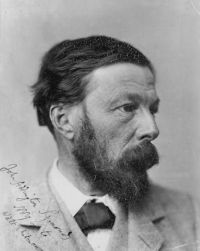
John Addington Symonds

John Addington Symonds

Summary

Portrait of John Addington Symonds John Addington Symonds Renaissance in Italy, Volume 4…

Boccaccio was a bourgeois of the fourteenth century; but his character, as stamped on the Decameron, was common to Italy during the next two hundred years. The whole book glows with the joyousness of a race discarding dreams for realities, scorning the terrors of a bygone creed, reveling in nature's liberty, proclaiming the empire of the senses with a frankness which passes over into license. In Boccaccio, the guiding genius of the Italian Renaissance arrives at consciousness. That blending of moral indifference with artistic seriousness, which we observe in him, marks the coming age.
Source: Gutenberg

Portrait of John Addington Symonds John Addington Symonds Renaissance in Italy, Volume 4…

The charm of Boiardo's poetry consists in its firm grasp on truth and nature, the spontaneity and immediateness of its painting. He has none of Poliziano's richness, no Virgilian dignity or sweetness, no smooth and sparkling fluency like that of Ariosto. But all that he writes has in it the perfume of the soil, the freedom of the open air; the spirits of the woods and sea and stars are in it. Of his style the most striking merit is rapidity. Almost always unpolished, sometimes even coarse, but invariably spirited and masculine, his verse leaps onward like a grayhound in its swiftness.
Source: Gutenberg

Portrait of John Addington Symonds John Addington Symonds Renaissance in Italy, Volume 4…

There is an old Greek proverb that "to desire the impossible is a malady of the soul." With this malady in its most incurable form the poet was stricken; and, instead of seeking cure, he nursed his sickness and delighted in the discord of his spirit. From that discord he wrought the harmonies of his sonnets and canzoni. That malady made him the poet of all men who have found in their emotions a dreamland more wonderful and pregnant with delight than in the world which we call real. After Laura's death his love was tranquilized to a sublimer music.
Source: Gutenberg

Get perspective with Kwize: daily news enlightened by great literature