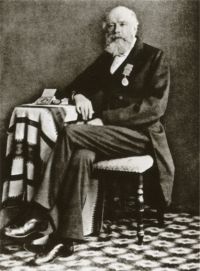
John Henry Parker

John Henry Parker

Summary

Portrait of John Henry Parker John Henry Parker Archaeological Journal (1845)

In England it is pretty clear, from a variety of evidence, that the masonry of the early part of the eleventh century was so bad that such buildings as were erected of stone at that period would scarcely stand above sixty years; and the more usual material for buildings of all kinds was wood: even quite at the end of that century the works of Lanfranc at Canterbury, of Remigius at Lincoln, and of Gundulph in the white tower, London, are still extremely rude, and the joints of the masonry wide enough to admit two fingers, while the principal part of the ornament is cut with the hatchet.
Source: Wikisource

Portrait of John Henry Parker John Henry Parker Archaeological Journal (1846)

In the south wall there is an Early English piscina, of a trefoiled shape, a small Decorated priest's door, and on the west side of it a two-light Decorated window with a transom, the lower part of which, now blocked up, seems to have been used as a low side opening. The chancel-arch is plain Norman, recessed on the west side only, with shafts in the nooks, having sculptured caps, the arch itself is square-edged with a flat soffit and plain jambs, partly cut away to admit a screen which is now destroyed.
Source: Wikisource

Portrait of John Henry Parker John Henry Parker Archaeological Journal (1846)

Those who contend that the style of the architecture is not consistent with so early a date, assume that the church was rebuilt by the college about thirty years afterwards; but the bursar's rolls are extant throughout that period, and nearly in unbroken succession to the present time: they have been carefully examined, and though many other parts of the college were then building, it appears clear that the church was partly erected in the lifetime of the founder before these documents begin.
Source: Wikisource

Get perspective with Kwize: daily news enlightened by great literature