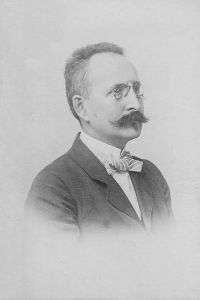
Leonard Jan Józef Lepszy

Leonard Jan Józef Lepszy

Summary

Portrait of Leonard Jan Józef Lepszy Leonard Jan Józef Lepszy Cracow, the royal capital of ancient Poland… (1912)

Hope and despair, life and death, valiant strife and passive fortitude, combine to produce a majestic "Soul's Tragedy," striking cruel claws of bitter reality into the spectator's heart and brain. His artistic talent is distinguished by a perfectly faultless moulding of forms. All his conceptions, however fascinating in their own allegorical intricacy, receive a separate and additional charm from being set in a most elaborate and thoroughly realistic background of landscape, which reminds one of the masterpieces of Japanese art.
Source: Wikisource

Portrait of Leonard Jan Józef Lepszy Leonard Jan Józef Lepszy Cracow, the royal capital of ancient Poland… (1912)

The decoration of the Sigismund Chapel is among the most beautiful specimens of its kind, and the harmonious architectonic proportions, together with the noble structure of the cupola, make the whole a perfect masterpiece of sixteenth-century art. The monumental architecture of the palace exercised a great influence on the whole development of the Polish Renascence; it became a general custom to erect buildings, both sacred and profane, in the new style, on the model of the castle and the cathedral.
Source: Wikisource

Portrait of Leonard Jan Józef Lepszy Leonard Jan Józef Lepszy Cracow, the royal capital of ancient Poland… (1912)

Thus having finished our sketch of modern Polish painting as developed within the walls of Cracow, we turn to the history of Applied Art in the modern era. Here again, the Renascence proved a life-giving impulse, stirring up men's imaginations to the production of new forms. The applied art of the Renascence did not come to us, as painting did, through the medium of Germany, but direct from Italy, its original source.
Source: Wikisource

Get perspective with Kwize: daily news enlightened by great literature