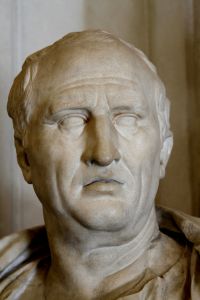
Marcus Tullius Cicero

Marcus Tullius Cicero

Summary

Portrait of Marcus Tullius Cicero Marcus Tullius Cicero,  On Invention — Book 2

“ There are many things, then, which allure us both by their dignity and also by the advantage which may be derived from them: such as glory, dignity, influence, friendship. Glory is the fact of a person's being repeatedly spoken of to his praise; dignity is the honourable authority of a person, combined with attention and honour and worthy respect paid to him. Influence is a great abundance of power or majesty, or of any sort of resource. ”
Source: Wikisource

Portrait of Marcus Tullius Cicero Marcus Tullius Cicero,  On Invention — Book 2

“ It has then four divisions—prudence, justice, fortitude, and temperance. Prudence is the knowledge of things which are good, or bad, or neither good nor bad. Its parts are memory, intelligence, and foresight. Memory is that faculty by which the mind recovers the knowledge of things which have been. Intelligence is that by which it perceives what exists at present. Foresight is that by which anything is seen to be about to happen, before it does happen. Justice is a habit of the mind which attributes its proper dignity to everything, preserving a due regard to the general welfare. ”
Source: Wikisource

Portrait of Marcus Tullius Cicero Marcus Tullius Cicero,  On Invention — Book 2

“ And if any necessity alleged appears to have in it anything discreditable, it will be desirable for the opponent, by a chain of common topics, to prove that it would have been better to suffer anything, or even to die, rather than to submit to a necessity of the sort. And then, from these topics, which have been already discussed when we spoke of the question of fact, it will be desirable to inquire into the nature of law and equity, and, as if we were dealing with an absolute juridical question, to consider this point by itself separately from all other points. ”
Source: Wikisource

Get perspective with Kwize: daily news enlightened by great literature