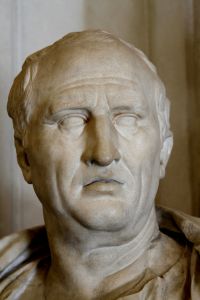
Marcus Tullius Cicero

Marcus Tullius Cicero

Summary

Portrait of Marcus Tullius Cicero Marcus Tullius Cicero The republic of Cicero

For riches, titles, and power, devoid of wisdom, of the knowledge of self-government, and that of the government of others, exhibit nothing but insolent and disgraceful pride. Nor can the condition of any city be more deplorable, than where the richest men pass for the best. But what can be more delightful than a state virtuously governed? What more illustrious than the man, who while he governs others, is himself the slave of no bad passions? Who, while he calls upon the citizens to observe the regulations he has formed, lives up to them all himself?
Source: Gutenberg

Portrait of Marcus Tullius Cicero Marcus Tullius Cicero The republic of Cicero

Wherefore let those who have treated upon the moral conduct of life, be deemed by us, great men, as they are; learned men; masters of truth and virtue. Yet let it be admitted that civil rights, and the government of a people, whether they are the fruits of men experienced in the management of public affairs, or, as the fact has been, the result of their literary leisure, be least despised; causing as they do to spring up in great minds, as we have often seen, an incredible and divine virtue.
Source: Gutenberg

Portrait of Marcus Tullius Cicero Marcus Tullius Cicero The republic of Cicero

For the royal form of government itself, not only is not to be condemned, but I know not whether it is not greatly to be preferred to the other simple forms, if I could approve of any simple form of government. But only as long as it preserves its proper character, which is that the safety, the equality, and tranquillity of the citizens, are to be preserved by the justice, the wisdom, and the perpetual power of one man. Many things however are altogether wanting to a people subject to a king.
Source: Gutenberg

Get perspective with Kwize: daily news enlightened by great literature