Summary

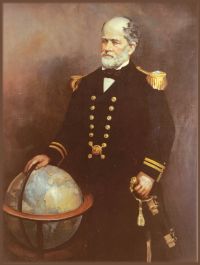
Portrait of Matthew Fontaine Maury Matthew Fontaine Maury Maury - Naval Observatory - Virginia Historical Society (1849)

It induced Tycho Brahe to undertake his catalogue.
It may be that there is now, at this very time in the firmament above, a world on fire. Argus, a well-known star in the Southern hemisphere, has suddenly blazed forth, and a star from the 2nd or 3rd magnitude now glares with the brilliancy of the first.
It is man’s boast that he was made to look aloft; for his alone is the privilege to pry in “Nature’s infinite book of secrecy,” and can it be therefore profitless to him and of no value to posterity to survey the skies, map the stars and contemplate “the eternal flowers of heaven?”
Source: Wikisource

Portrait of Matthew Fontaine Maury Matthew Fontaine Maury Maury - Naval Observatory - Virginia Historical Society (1849)

At the dead hour of the night, when the world is hushed in sleep, and all is still; when there is not a sound to be heard save the dead beat escapement of the clock counting with hollow voice the footsteps of time in his ceaseless round, I turn to the Ephemeris and find there, by calculations made so very long ago, that when that clock tells a certain hour, a star which I never saw will be in the field of The telescope for a moment, — flit through — and then disappear.
Source: Wikisource

Portrait of Matthew Fontaine Maury Matthew Fontaine Maury Maury - Naval Observatory - Virginia Historical Society (1849)

The heavens like the earth, are obedient to the great law of change. The stars are undergoing perpetual change, some change their position, some vary in magnitude, some in color, and some have blazed forth as flaming meteors in the sky, dazzled the world, and then disappeared, perhaps, forever.
The appearance of a new star in the firmament induced Hipparcus before the Christian era to undertake the first catalogue, which although lost to the world, was productive of great practical good.
Source: Wikisource

Get perspective with Kwize: daily news enlightened by great literature