Summary

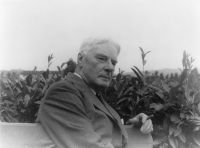
Portrait of Norman Douglas Norman Douglas Fountains in the Sand: Rambles Among the Oases of Tunisia

THE OASIS OF LEILA I rode, for a farewell visit, to the small oasis of Leila, or Lalla, which lies a few miles beyond the railway station. It is one of several parasitic oases of Gafsa: a collection of mud-houses whose gardens are watered by a far-famed spring, the fountain of Leila.
The water gushes out, tepid and unpleasant to the taste—but health-giving, they say, like so many unpleasant things—from under steep banks of clay through which the railway to Sfax has been cut. It is a sleepy hollow of palms, a place to dream away one's cares.
Source: Gutenberg

Portrait of Norman Douglas Norman Douglas Fountains in the Sand: Rambles Among the Oases of Tunisia

All too soon, I fear, the railway to Tozeur will have done its work; dusty boulevards, white bungalows, eucalyptus trees and bureaux de monopoles will profane its strangely wonderful beauty, its virginal monotone of golden grey. Nefta will become a neurasthenic demi-mondaine, like Biskra.
Such, at least, is the prognosis.
But one is apt to forget on how precarious a tenure these gardens are held, with the hungry desert gnawing ceaselessly at their outskirts; for the desert is hungry and yet patient; it has devoured sundry oases by simply waiting till man is preoccupied with other matters.
Source: Gutenberg

Portrait of Norman Douglas Norman Douglas Fountains in the Sand: Rambles Among the Oases of Tunisia

This Seldja-brook is a true child of the sun; cold in the morning and evening hours, its restless little heart becomes tepid at midday with the glowing beams.
Spiky reeds and tamarisks trip alongside, and the wild fig thrusts demoniac roots into the crevices; here and there you may see a group of oleasters, descendants, maybe, of the now vanished Roman olive plantations in the plain, or a stunted palm that has shot up from the stone cast away by some passing caravan. For these Oueds are all highways dating from immemorial ages; there is a ceaseless passage of man and animals along them.
Source: Gutenberg

Get perspective with Kwize: daily news enlightened by great literature