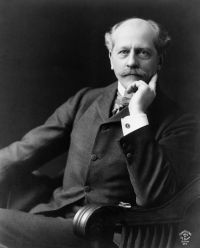
Percival Lowell

Percival Lowell

Summary

Portrait of Percival Lowell Percival Lowell Occult Japan — Noumena (1894)

Now when we search for the cause of our choice we always bring up against some determining thought. Whenever we succeed in overtaking that will-o'-the-wisp, our own will, and triumphantly clutch it, we find invariably that we have caught—an idea. Why am I willing to write these words, when as a matter of fact I am tempted to lie on the grass and gaze into the drifting islands of cloud? Because I decided yesterday that I would—an idea—or because it will be pleasurable later to have done so—an idea—or simply to prove to myself that I have a will—an idea again sarcastically bobbing up.
Source: Wikisource

Portrait of Percival Lowell Percival Lowell Occult Japan — Noumena (1894)

For it is no less a palpable fact that ideas take time to develop into distinctness, and even more time to fade again into oblivion. Dissolving views upon our cortical screen, the last grows ghostly as the next takes shape, and lingers some seconds ere it vanishes quite. It is this corona of past, present, and nascent thought, limning the central idea of the moment that gives that idea its setting, and us our sense of self.
Source: Wikisource

Portrait of Percival Lowell Percival Lowell Occult Japan — Noumena (1894)

After thus recognizing it in one's self, he will perceive it in others. Any nervous man is a perfect museum of specimens. While he is listening to you, or even talking himself, his eye will fall upon a paper-cutter upon the table, and out goes his hand to play with it; or, a book strikes him as being misplaced, and he must needs set it right; or, he sees his pipe, and forthwith proceeds to fill it; and so forth and so on. Each new idea instantly produces in him its fatalistic effect.
The reason we are not directly conscious of this force of our ideas is that one idea rarely has free play.
Source: Wikisource

Get perspective with Kwize: daily news enlightened by great literature